
Founder & Principal, Line of State
Between Alliance and Sovereignty
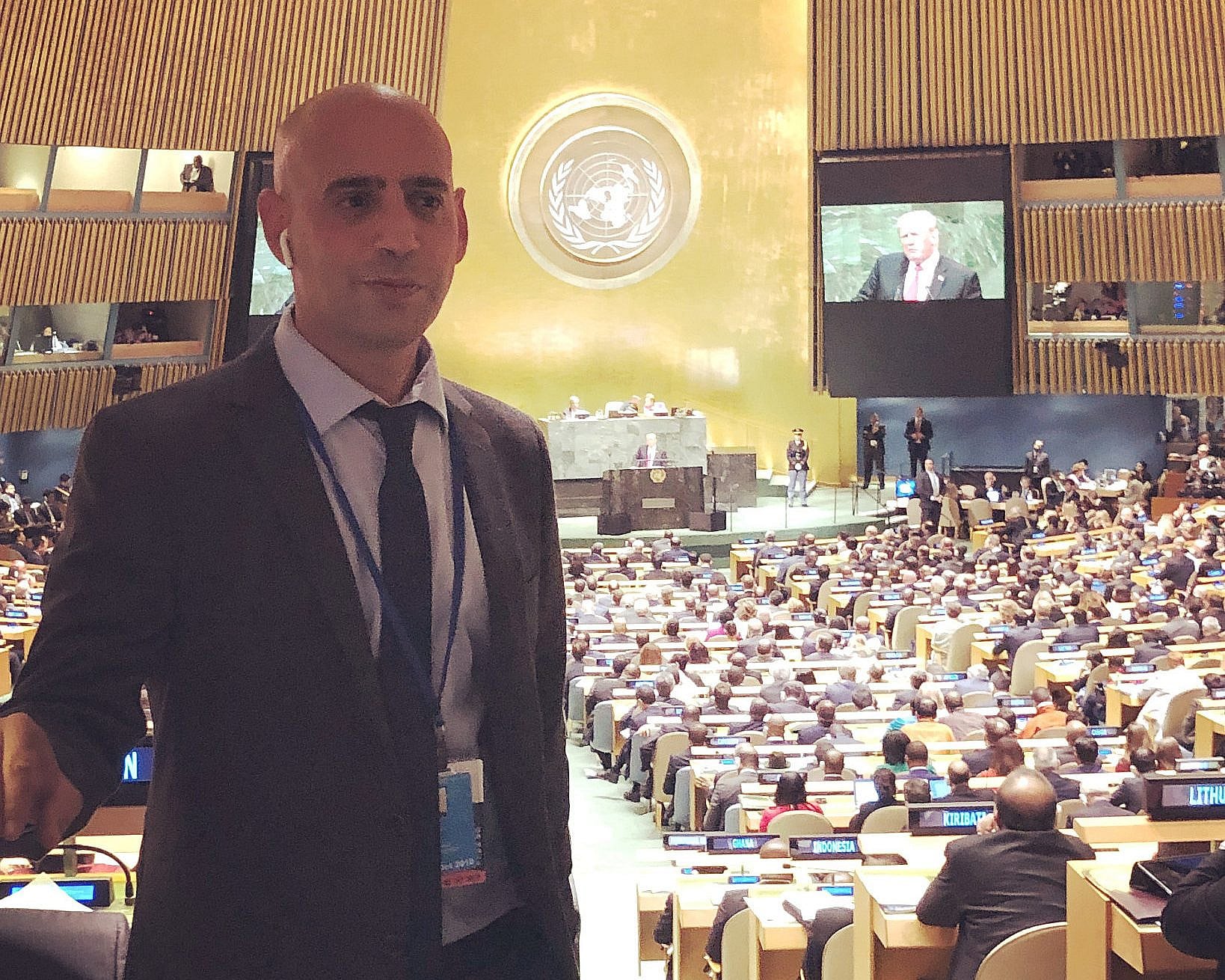
Shay Gal at the United Nations General Assembly hall in New York, during President Donald Trump’s address. (Photo courtesy of the subject) “Friendship is a strategic asset - but sovereignty means knowing when to say yes to alliance, and when to say no to illusion".
Why Israel’s friendship with America will not blur its red lines on Turkey
Israel’s alliance with the United States remains unshakable – but sovereignty means drawing lines even friends must respect. Turkey is where those lines now run deepest.
Israel and the United States share history, values, and security interests – yet an alliance is not an identity of interests or perceptions. The gap appears most clearly over Turkey. Washington sees Ankara as a NATO anchor, but one that often drags the alliance off course. It treats Turkey as a lever on Russia and Iran, yet one that turns into a brake, serving Ankara’s own balance of power. For the White House, Turkey is a pivotal actor in Syria, the Caucasus, and the Black Sea, but a pivot that spins around itself. Jerusalem sees something else: a regime whose leader prays for Israel’s destruction, whose courts issue warrants against its leaders, and whose institutions host and fund Hamas. These are not nuances — they are first principles.
Words reveal intent. On March 30, 2025, at Istanbul’s Büyük Çamlıca Mosque, President Erdogan prayed: “May Allah destroy and devastate Zionist Israel.” It was no slip — a broadcast Eid al-Fitr appeal that crowned years of Turkish patronage for Hamas: offices in Istanbul, passports for operatives, political protection intact. For any responsible Israeli government, these are policy red lines, not rhetoric.
The April 7 Oval Office meeting made the gap plain. “Erdogan is very smart,” Trump told Netanyahu. “Any problem you have with Turkey, I can solve — as long as you’re reasonable.” He even praised Ankara for “taking over Syria through surrogates.” Washington admires Ankara’s leverage; Jerusalem counts its costs. Friendship with America is a strategic asset, not a mortgage on judgment. Israel cannot be “reasonable” toward a power funding its enemies.
Turkey’s judiciary erased any illusion of restraint. On November 7, Istanbul prosecutors issued arrest warrants for Israel’s prime minister and senior officials on “genocide” charges. It was legal warfare disguised as morality — intimidating no one, absolving nothing, and proving why any foreign-imposed rapprochement would be a strategic mistake.
Gaza remains the immovable line. Ankara proposed sending troops under an international mandate; Israel’s answer is absolute: no Turkish forces in Gaza, under any flag. The reason is operational, not emotional: a state that shelters Hamas cannot be neutral on its battlefield. Allies may differ, but sovereignty demands Israel guard its red lines.
The Hamas–Turkey link is proven, not claimed. Reuters exposed Turkish passports for Hamas operatives years before October 2023; the US Treasury sanctioned Turkish networks channeling funds under “charity.” When Washington says “peacekeeping,” Israel hears infiltration. Skepticism here is prudence, not paranoia.
Syria is the second fault line. Washington values Turkey’s leverage over Assad, Russia, and Iran, seeing Erdogan as a broker. Israel sees another staging ground, terrain where Iranian proxies maneuver under a Turkish shield. Where America hears mediation, Jerusalem sees ground. That is geographic realism.
Mediterranean sovereignty tells the same story. The EU sanctioned Ankara for illegal drilling in Cypriot waters and rejected its 2019 maritime deal with Libya that erased Greek islands from the map. For Israel, partnership with Greece and Cyprus is no ornament but an axis of stability built on energy, intelligence, and rescue cooperation. In a sea challenged by revisionism, this triangle upholds the rules that keep trade and law afloat.
Northern Cyprus is a silent indictment. Fifty years after Turkey’s invasion, only Ankara recognizes the so-called republic. Yet US diplomacy still calls it “the area administered by Turkish Cypriots.” Israel, long versed in selective outrage, notes the omission.
Ankara’s Games, Jerusalem’s Rules
Washington’s “breakthroughs” often prove hollow. Kazakhstan’s entry into the Abraham Accords made headlines, not history. Relations with Israel — solid since 1992, from AMOS launches at Baikonur to oil refined in Haifa — needed no renewal. Jerusalem’s silence said it all: symbolism isn’t strategy. The move blurred America’s map. Kazakhstan anchors Turkey’s Middle Corridor, linking China to Europe through Ankara, not the Indo-Mediterranean IMEC connecting India, Israel, Greece, Cyprus, Saudi Arabia, Jordan, the UAE and the EU. By adding Astana — still tied to Moscow via the Eurasian Economic Union — Washington confused allies. Which path does it follow, Ankara’s or that of Jerusalem, Riyadh, Athens, Nicosia, Amman and New Delhi? The motive — access to uranium and rare earths — was clear; the cost higher: empowering Ankara’s reach while diluting IMEC’s coherence. As Red Sea turmoil and Iran-Houthi attacks stalled IMEC, Turkey’s corridor advanced. The lesson is simple: strategy requires clarity, not ceremony. Power lies not in headlines, but in choosing the map that leads to sovereignty.
Personalities shape policy. With Thomas Barrack as US ambassador in Ankara, the Trump administration channels Erdogan through a confidant close to the president. It may ease talks on F-35s or Syria. Israel will quietly support any outcome that restrains Iran, but not one that replaces it with a Turkish version. Israel will also reserve the right to reject any demand that endangers its security. Strategic gratitude does not erase strategic boundaries.
None of this diminishes the truth: Donald Trump has taken historic steps for Israel, from Jerusalem to the Golan, and most recently through the successful hostage release deal, a major achievement that earned him broad respect among the Israeli public. Yet friendship is not fealty. Should he ask Israel to reconcile with Ankara without a fundamental Turkish change — without the end of incitement, lawfare, and hostility toward Greece and Cyprus — Israel’s answer must be simple: sovereignty first. A true ally respects that word.
Until Ankara stops praying for Israel’s destruction, ceases to weaponize justice, severs its ties with Hamas, and respects the borders of its neighbors, reconciliation will remain theater. The same truth applies beyond Israel. Greece and Cyprus face the same pattern – provocation disguised as diplomacy, expansion masked as mediation. The European Union, too, must stop mistaking dialogue for deterrence and engagement for resolve.
Israel will defend its interests quietly, consistently, and without apology — just as Athens and Nicosia safeguard their sovereignty in the Mediterranean. True partnership with Washington — for Israel, for Europe, and for the edge democracies holding the frontier of the free world — means knowing when to say yes to alliance, and when to say no to illusion.
—
Originally published in Greek in Geopolitico, a platform powered by Savvas Kalenteridis, as “Ναι στη συμμαχία, Όχι στην αυταπάτη! Η φιλία του Ισραήλ με τις ΗΠΑ δεν θολώνει τις κόκκινες γραμμές για Τουρκία”. This essay now appears in English in a revised version translated by the author.
Related Topics
Related Posts