French-Israeli Visual Artist and Writer
Between Silence and Song: Emunah After October 7th
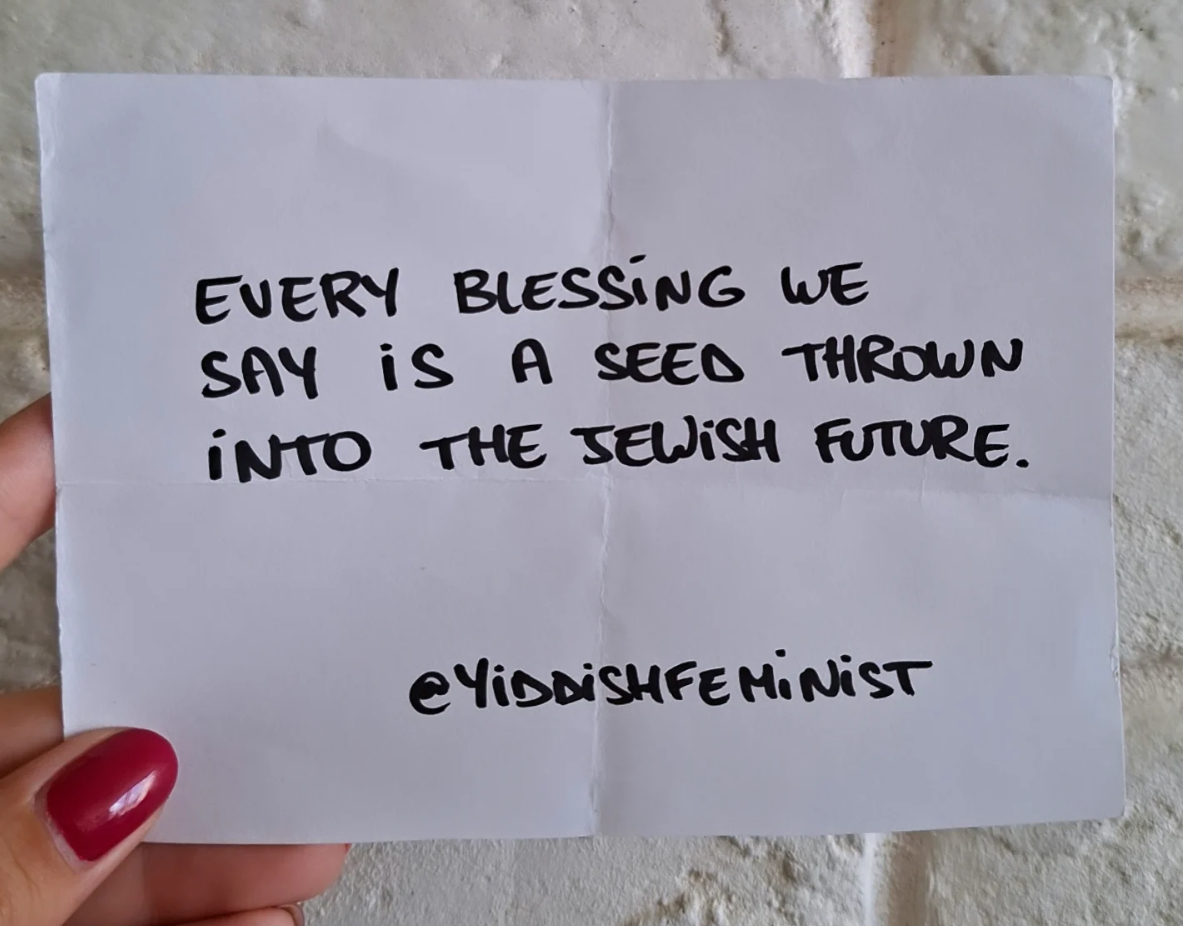
Credit: Morgane Koresh/ @YiddishFeminist
When gratitude feels complicated, and faith becomes less about belief than about endurance.
When the hostages came home, many of us whispered baruch Hashem – thank God.
In the days that followed, I spoke about it on my Instagram, and the same question kept appearing in the comments and private messages – gentle, honest, uneasy: If God is not to blame for the horrors, not for the Shoah, not for October 7, how can we suddenly thank Him when the light returns?
Can gratitude exist without explanation?
Can faith survive without protection?
I am not a scholar.
What follows are simply my reflections, shaped by my readings as a teenager and young adult about post-Shoah Judaism, and by my family’s own history as survivors.
The question of faith after horror has been a companion all my life, not as an abstract problem, but as an echo passed down in memory.
What Emunah Really Means
In Hebrew, emunah does not mean “faith” the way the West understands it. It shares a root with amen and ne’eman — trust, faithfulness, steadiness. It is not blind belief in a divine plan, but loyalty to a relationship.
To have emunah is not to say “I understand,” but “I remain.”
It is the quiet courage of staying in dialogue even when Hashem is silent – of continuing to say amen to life, even after everything in you has stopped expecting answers and understanding.
The Western Inheritance: Intervention and Protection
Part of our discomfort as Jews with God’s silence comes from an idea that isn’t really Jewish – the belief that divine love must mean divine intervention: guiding history, responding to prayer, opening paths, saving individuals… Perhaps not control, but the underlying framework is still one of divine agency.
That idea was shaped by Christianity and, through it, much of Western thought.
In that worldview, God proves love by stepping into history to save, to fix, to redeem.
Of course, our earliest texts are filled with moments that look like divine intervention: the sea splitting, the manna, the voice at Sinai.
But even the Bible itself evolves from overt miracles to hidden ones. By the time of Esther, God’s name never appears; salvation comes through human courage. Later Judaism carried that shift forward, teaching that the daily rhythm of life – breath, kindness, sunrise – is itself a miracle.
Where Christianity made intervention the proof of divine love, Judaism made endurance and partnership the sign of covenant.
Hashem’s greatness is not shown through control, but through covenant, through presence that endures even when we cannot feel it.
We do not expect Hashem to suspend nature, to stop every cruelty.
Instead, we seek to walk with Hashem through it.
In Jewish language, the miracle is not interruption but endurance: the fact that after everything, Am Yisrael Chai.
Hiddenness and Covenant
From a traditional point of view, God’s silence is not absence. The sages called it hester panim, the hiding of God’s face.
To praise God for good does not mean claiming He caused it; it means recognizing those moments when kindness, compassion, or justice reappear in the world, as if a hidden face briefly turned toward us again.
Blessing becomes not a statement of certainty, but a way of staying in relationship; of saying: I still choose to look for You.
The False Comfort of Blame
After the Shoah, some tried to explain the unexplainable. They said catastrophe came from moral imbalance. Too much assimilation, too little faith. But such logic wounds twice. It turns victims into culprits and mistakes cruelty for covenant. The pious and the secular died together, not for what they failed to believe, but for who they were. To say otherwise is to confuse God with the murderer’s logic, to sanctify evil instead of resisting it.
Rabbi Irving Greenberg wrote:
“No statement should be made that would not be credible in the presence of burning children.”
After Auschwitz, the task is not to justify God but to rebuild the world.
Our question is no longer “Why did this happen?” but “How do we live after it?”
Emunah in Defiance
Thinkers like Emil Fackenheim, Abraham Joshua Heschel, and Irving Greenberg refused both despair and easy answers. They taught that to praise after horror is an act of rebellion – a refusal to surrender meaning to those who tried to erase it. If God still speaks, they said, He speaks through human conscience.
To bring the hostages home, to comfort the grieving, to rebuild, to dance again…, these are all forms of prayer made of action. They are emunah in motion.
Emunah, Not Certainty
Maybe the question is not whether God deserves our praise, but whether we still dare to praise at all. Not because praise explains, but because it keeps our hearts open. Because Jewish history teaches that even in ashes, we choose life.
That choice is emunah: not belief that everything happens for a reason, but trust that life is still worth sanctifying.
To bless, to rebuild, to sing again, even through tears, is to declare that goodness still has a place in this world, and that we will keep making room for it.
Closing Reflection
Maybe praise is not for what happened, but for the fact that we are still here praise, to remember, to hope.
Between silence and song, we choose song.
Not because it answers,
but because it affirms.
Related Topics
Related Posts