
Peace Requires Justice. The Nobel Peace Prize Requires None
When Henry Kissinger, who oversaw devastating bombing campaigns in Vietnam, received the Nobel Peace Prize in 1973, two members of the Nobel Committee resigned in protest. When Yasser Arafat, leader of a terror organization, received it in 1994, another member resigned.
This year’s winner shows that the Norwegian Nobel Committee still has a few shocking surprises up its sleeve.
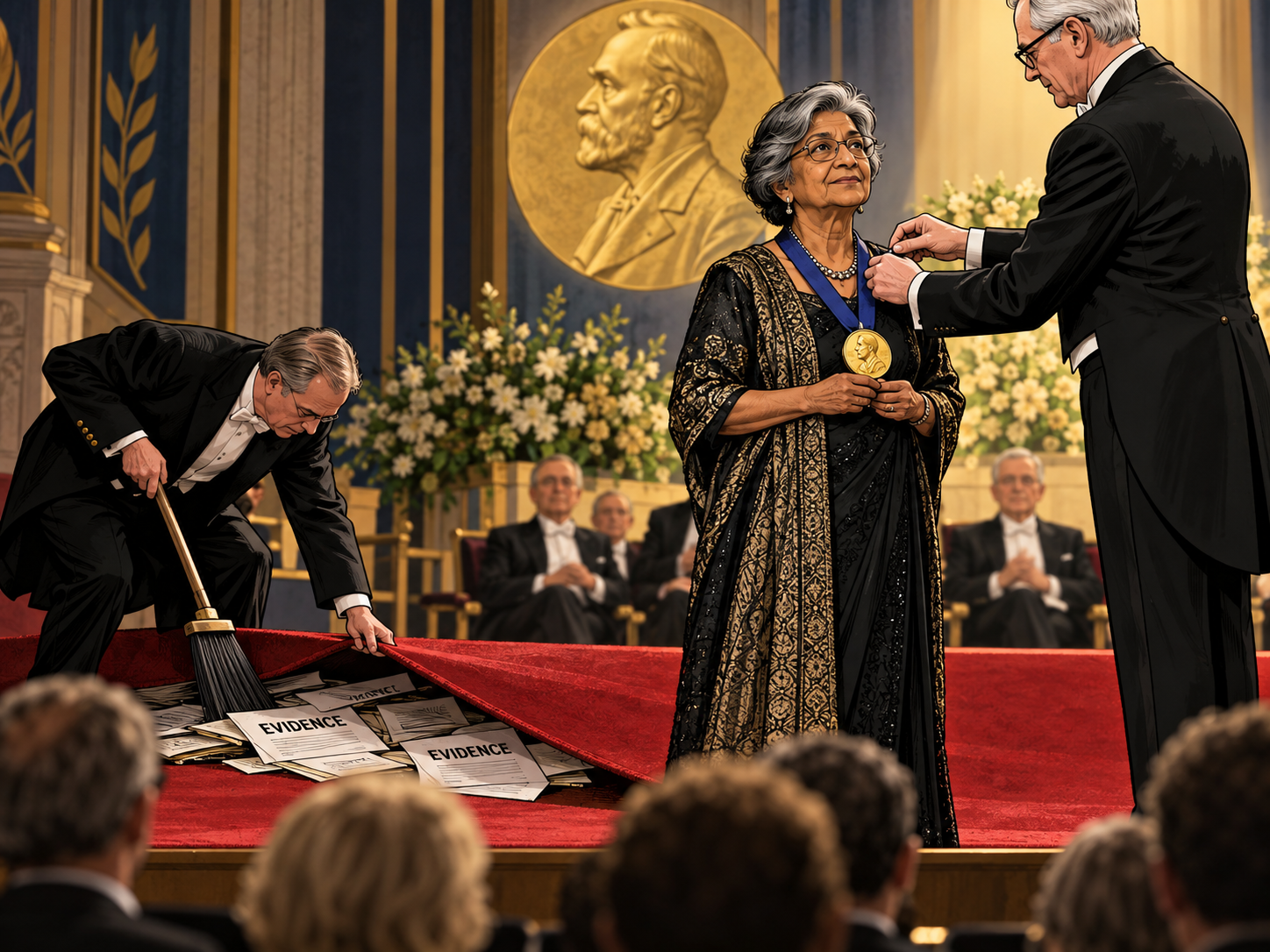
On October 9, 2026, the Nobel Peace Prize was awarded to Navi Pillay, the South African jurist whose distinguished career includes important contributions to international criminal law. Among her achievements was helping establish that rape and sexual violence can constitute genocide.
But Pillay also chaired the UN Commission of Inquiry that concluded in September 2025 that Israel was committing genocide in Gaza.
Yes, the same Israel that two years earlier had been brutally attacked. Hamas-led terrorists invaded Israeli communities, murdered civilians, committed sexual violence, burned homes, and kidnapped hundreds of people.
Pillay’s commission found that Hamas had committed serious war crimes, but it made no corresponding genocide determination. It reserved that most consequential legal conclusion for Israel.
So this year, the committee did not merely honor a controversial peacemaker. It honored a champion of international justice whose own application of that justice raises fundamental concerns.
Peace Requires Justice
The irony is sharpest in the committee’s own explanation. It praised Pillay’s integrity, her commitment to universal legal principles, and her contribution to international law, concluding: “Peace requires justice.”
I couldn’t agree more.
But justice also requires evidence, consistency, and the willingness to distinguish between what we believe and what can be established. Nowhere is that distinction more important than in an accusation of genocide. That is precisely the accusation Pillay made, without sufficient evidence to substantiate it.
Genocide is not simply a particularly brutal war. It is not defined by the number of casualties, the destruction of civilian infrastructure, or even the commission of war crimes. It requires a specific intent to destroy, in whole or in part, a protected group as such.
The International Court of Justice has held that when genocidal intent is inferred from a pattern of conduct, it must be the only reasonable inference. Pillay’s commission cited that very standard. It then concluded that an intent to destroy the Palestinians in Gaza was the only reasonable explanation for Israel’s actions.
The evidence in the report does not support that conclusion.
Take the fertility clinic that was damaged, destroying thousands of embryos, according to its Palestinian staff. From this, the commission inferred an intent to prevent Palestinian births. Yet it presented no evidence that the clinic was targeted for that purpose rather than damaged during military operations.
The commission also cited restrictions on humanitarian supplies as evidence of an intent to destroy the population. In drawing its conclusions, it disregarded the enormous quantities of food and other supplies Israel allowed in throughout the war. That does not prove every restriction was justified. But restrictions intended to pressure Hamas, even if unlawful, are not an intent to exterminate Palestinians.
And it cited reports of children killed by gunfire as evidence of a systematic policy to destroy the next Palestinian generation. Yet the report presents no evidence establishing who shot them, under what circumstances, or why. Without that, there is no basis for inferring a genocidal policy.
Nor did the commission adequately account for the broader context. Israel was fighting Hamas, an armed organization that operated from within densely populated civilian areas. Israel issued evacuation warnings, facilitated humanitarian assistance, and took measures intended to reduce civilian casualties.
None of this establishes that every Israeli action was justified. But it is relevant evidence, and it offers alternative explanations that justice cannot dismiss. The burden of proof lies with the accuser, and here the new laureate did not meet it.
When Justice Becomes Selective
Hamas’s record includes targeting children and the elderly, sexual violence, and hostage-taking. Its mission statement is the destruction of Israel, and its leaders keep declaring their intention to repeat October 7.
That is a smoking gun: deliberate atrocities against civilians, accompanied by continuous declarations of genocidal intent. The commission treated irresponsible statements by Israeli politicians, mostly aimed at domestic audiences, as evidence of state policy. Yet Hamas’s explicit and repeated declarations of intent did not lead it to a comparable genocide determination.
That asymmetry is hard to reconcile with the universal standards the Nobel Committee praised.
It is also a familiar human pattern. Motivated reasoning does not require people to invent evidence or consciously lie. It lets them sincerely believe they are following the evidence while interpreting it selectively to protect their existing beliefs and moral identity.
Expertise offers no immunity, as Pillay’s case shows. The more invested someone is in defending justice, the harder it may be to recognize when their judgment has strayed from its principles.
A year ago, I published an article titled “I’m Not a Genocide Scholar. And I Still Know This Isn’t One.” There, I argued that if everything is genocide, nothing is. An unsubstantiated genocide accusation can delegitimize a country, inflame hatred, distort international policy, and undermine trust in institutions entrusted with protecting victims of genuine atrocities, such as those committed by Hamas. It also risks emptying one of humanity’s gravest legal and moral concepts of its distinctive meaning.
Pillay’s historical contribution does not exempt her from present scrutiny. Someone who helped establish the legal meaning of genocide bears an exceptional responsibility to respect the evidentiary standards required to identify it. The Nobel Committee has rewarded people with histories, or futures, of violence for their contributions to peace. This year, it outdid itself, rewarding a defender of justice whose conduct undermines both justice and peace.
Peace does require justice. But when evidence becomes secondary to moral conviction, justice is not served, and peace cannot be achieved.