


Geopolitical Analyst: Bridging Somaliland & Israel to the world
Beyond Djibouti: South Korea Begins to Examine Berbera’s Potential
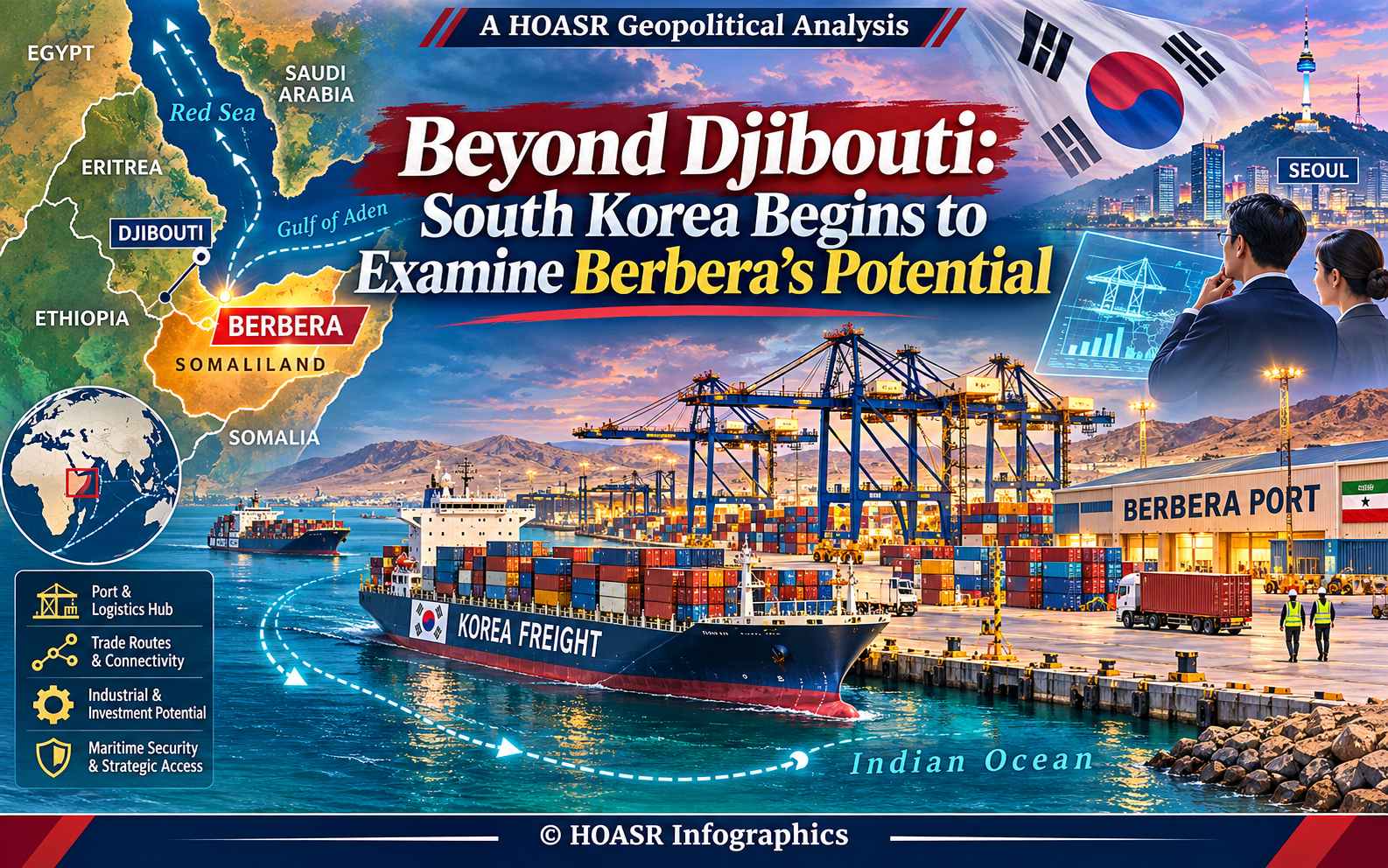
Beyond Djibouti: South Korean research examines Berbera's emerging commercial and strategic potential. © HOASR Infographics.
An emerging East Asian strategic perspective on Berbera suggests that Somaliland’s economic, diplomatic and maritime importance is increasingly attracting attention beyond its traditional international partners.
For decades, Djibouti has enjoyed a privileged position in the Horn of Africa as a commercial gateway and a military hub for some of the world’s most powerful countries.
Its strategic location near the Bab el-Mandeb Strait has enabled it to turn geography into revenue, diplomatic influence and international security partnerships.
However, the development of Berbera Port and Somaliland’s changing diplomatic position are introducing a new dimension to regional competition. This transformation is now attracting attention in South Korea.
In a research report published on August 22, 2026, Sangjun Lee, a research associate at South Korea’s East Asia Institute (EAI), examines the growing competition between Djibouti and Somaliland and its implications for South Korean foreign policy, maritime security and international trade.
Entitled Geopolitical Realignment in the Horn of Africa: The Djibouti-Somaliland Competition for Military Bases and South Korea’s Response, the report recommends that South Korea maintain its existing relationships with Djibouti while conducting preliminary assessments of Berbera as an alternative maritime and commercial gateway.
Although the report contains several factual inconsistencies and questionable assumptions about Somaliland, its broader significance should not be overlooked. Somaliland is entering the strategic discussions of an Asian industrial and technological power with considerable interests in international maritime trade.
From Diplomatic Isolation to Strategic Relevance
For much of the past 35 years, international discussions about Somaliland have concentrated on its political status and its relationship with Somalia. Its democratic achievements, institutional development and historical case for independence have often received less attention than the diplomatic preference for maintaining Somalia’s territorial unity.
However, international interest in Somaliland is increasingly driven by additional considerations. Governments, investors and researchers are examining its strategic coastline, port infrastructure, maritime security potential and access to the Ethiopian market.
Israel’s formal recognition of Somaliland on December 26, 2025, represented an important change in this diplomatic environment. The UAE’s substantial investment in Berbera has meanwhile provided Somaliland with modern commercial infrastructure capable of supporting wider international partnerships.
The South Korean report reflects this changing conversation. Somaliland is being examined not simply as a diplomatic question inherited from Somalia’s collapse, but as a potential participant in the international maritime economy.
Why South Korea Has an Interest in Berbera
South Korea’s economic success depends heavily on international trade, industrial exports, imported energy and secure maritime transportation. Its automobile, electronics, shipbuilding and manufacturing industries are deeply integrated into global supply chains.
Disruption in the Strait of Hormuz, the Gulf of Aden, the Bab el-Mandeb Strait or the Red Sea can therefore have direct consequences for South Korean businesses and consumers. Increased shipping distances, higher insurance premiums and unpredictable delivery schedules can affect the competitiveness of its industries.
The EAI report correctly identifies maritime security and supply-chain diversification as important South Korean interests in the Horn of Africa. However, it repeatedly suggests that South Korea has no direct military interests in the region.
That characterization overlooks an established Korean naval commitment.
South Korea has maintained its Cheonghae naval unit in the Gulf of Aden through rotational deployments since 2009. Its responsibilities have included protecting commercial shipping and contributing to international anti-piracy operations.
More recently, Reuters reported on November 5, 2026, that South Korea was planning to expand the unit’s operational area toward waters closer to the Strait of Hormuz.
South Korea is therefore not an entirely new security stakeholder in the region. Its existing maritime commitments provide a practical reason to examine additional logistics facilities, commercial ports and maritime cooperation opportunities.
Berbera could become part of that discussion without necessarily hosting a permanent South Korean military base.
Djibouti’s Success and Its Growing Vulnerabilities
Djibouti deserves recognition for successfully exploiting its geographical advantages. By hosting military facilities belonging to competing international powers, it has secured substantial economic benefits while maintaining important diplomatic relationships across geopolitical divisions.
Its ability to accommodate the United States, China, France, Japan and other international partners has made it an unusual example of pragmatic foreign policy.
However, the intensification of geopolitical competition in the Middle East and the Red Sea is testing that arrangement. Countries like the United States and China operating from Djibouti increasingly face security challenges that may not always produce compatible military objectives.
The South Korean report identifies this pressure as one of the principal reasons alternative facilities in Somaliland could become more attractive.
Yet Djibouti’s diplomatic experience also offers important lessons for Hargeisa. Hosting foreign military facilities does not necessarily require unconditional participation in the regional conflicts of those foreign powers.
An April 2026 assessment by the Critical Threats Project argued that Djibouti’s refusal to allow American bases to be used for attacks against the Houthis had reduced incentives for retaliatory attacks against installations on its territory.
Somaliland must also carefully consider the economic and security benefits of hosting foreign military partners alongside the potential risks of becoming directly involved in conflicts originating elsewhere.
Berbera Does Not Have to Replace Djibouti
One of the weaknesses of the South Korean report is its tendency to describe competition between Berbera and Djibouti as an almost zero-sum relationship, in which one port’s success necessarily comes at the expense of the other.
This overlooks the potential for regional economic growth and trade diversification.
Ethiopia’s dependence on maritime access creates an economic case for developing several commercial corridors. Alternative routes can provide greater flexibility, reduce vulnerability to disruptions and encourage competition in transport and logistics services.
The development of Berbera is therefore not necessarily a threat to Djibouti’s continued existence as a regional commercial center. It represents an alternative within an expanding regional economy.
Indeed, DP World’s existing shipping network already incorporates both Berbera and Djibouti into international commercial services.
For South Korean businesses, the availability of several ports could provide greater logistical flexibility and Berbera’s potential should be assessed through its commercial efficiency, infrastructure quality, security, operating costs and access to inland markets.
Looking at Somaliland Through an Outdated Diplomatic Framework
The EAI report’s most significant factual inconsistency concerns Somaliland’s international recognition.
Although it was published in August 2026, the report states in one section that Somaliland has not been formally recognized by any country. Elsewhere, it acknowledges Israel’s recognition while also discussing it as a potential future development.
These contradictory descriptions weaken its assessment of Somaliland’s diplomatic position.
Israel formally recognized Somaliland approximately eight months before the report was published. Israeli Foreign Minister Gideon Sa’ar subsequently made an official visit to Hargeisa on January 6, 2026.
Somaliland has already secured its first recognition from a United Nations member state. It is now in the process of securing wider recognition and consolidating its existing international partnerships.
Any balanced geopolitical assessment of its recognition must consider competing positions alongside Somaliland’s historical argument that it is restoring the independence it achieved on June 26, 1960, rather than establishing an entirely new political entity.
Assessing Somaliland’s Stability in Its Regional Context
The report also repeatedly refers to the reported defection of a Somaliland military commander in the Sanaag region as evidence of wider internal instability.
Territorial disputes and military defections are legitimate subjects of security analysis. However, assessing the investment and security environment of an entire country through a single incident risk producing an incomplete picture.
A more comprehensive assessment would examine the security conditions in Berbera and Hargeisa, the functioning of Somaliland’s institutions, its electoral history, the reliability of its commercial infrastructure and the geographical extent of its territorial disputes.
It would also compare those findings with the political and security conditions affecting other potential regional partners.
Nevertheless, despite its concerns about Somaliland’s internal situation, the EAI report acknowledges that the operational stability of Berbera Port is relatively high.
The Missing Taiwan Dimension
Another surprising omission is Somaliland’s relationship with Taiwan.
Given the report’s considerable attention to Chinese and Japanese maritime competition, one would expect a more substantial examination of Taiwan’s presence in Somaliland.
In 2020, Somaliland and Taiwan agreed to establish mutual representative offices, creating a significant diplomatic connection between the Horn of Africa and East Asia.
China’s military presence in Djibouti and its opposition to Taiwan’s international diplomatic relationships add another dimension to the strategic differences between Djibouti and Somaliland.
South Korea maintains important economic relations with China while also participating in security cooperation with the United States and Japan. Somaliland’s relationship with Taiwan forms part of the broader geopolitical environment Seoul would have to consider.
What South Korea Could Find in Somaliland
The opportunities available to South Korea extend well beyond military cooperation.
South Korea’s technological expertise, industrial capabilities and experience in economic development could provide the foundation for partnerships in port modernization, fisheries, renewable energy, vocational education, telecommunications and maritime services.
Its internationally competitive shipbuilding industry could also examine commercial opportunities in ship maintenance, marine engineering and maritime training.
Berbera’s development as an economic gateway creates potential opportunities for manufacturing, warehousing, distribution and access to neighboring markets.
In fact, the potential relationship between Somaliland and South Korea need not be defined exclusively by diplomatic recognition or military base agreements.
Understanding the South Korean Researcher’s Recommendations
The EAI report proposes a gradual approach to examining Somaliland.
In the short term, it recommends that South Korea’s Ministry of Foreign Affairs and Korea Trade-Investment Promotion Agency (KOTRA) offices in Nairobi and Addis Ababa monitor developments in Berbera.
Over the medium term, it recommends examining Berbera and Kenya’s Mombasa Port as alternative commercial gateways alongside Djibouti.
Its longer-term recommendation is to incorporate developments in the Horn of Africa more systematically into South Korea’s Indo-Pacific strategic framework.
These are recommendations from a South Korean researcher, not announcements of government policy. However, such research can contribute to the development of institutional knowledge that informs future diplomatic and commercial decisions.
For Somaliland, this represents an opportunity to present South Korean institutions with more comprehensive information about its investment environment, maritime capabilities, commercial infrastructure and development priorities.
The Scoop: Somaliland’s Strategic Horizon Is Expanding
For years, discussions about Somaliland’s future have largely concentrated on Washington, London, Addis Ababa, Brussels and the African Union. More recently, Dubai, Jerusalem and Taipei have become important centers of Somaliland’s international engagement.
Seoul’s emerging research interest introduces another geographical advantage to that conversation.
Djibouti demonstrated that a small country could achieve international strategic importance by capitalizing on its geographical position. Somaliland possesses comparable geographical advantages, but its circumstances, diplomatic relationships and economic ambitions are different.
The significance of the East Asia Institute report demonstrates that Somaliland and Berbera are becoming subjects of strategic research in countries whose economic interests extend far beyond the Horn of Africa.
International attention is not the same as diplomatic recognition, but it can create opportunities for relationships that previously received little consideration.
Berbera’s growing strategic relevance, its competition for influence and potential across the Red Sea is being examined far from the other side of the Indian Ocean.
The strategic conversation about Somaliland is moving eastward.
Related Topics
Related Posts