
Geopolitical Analyst: Bridging Somaliland & Israel to the world
Berbera Is Not the Threat: Debunking the Narrative Against Somaliland
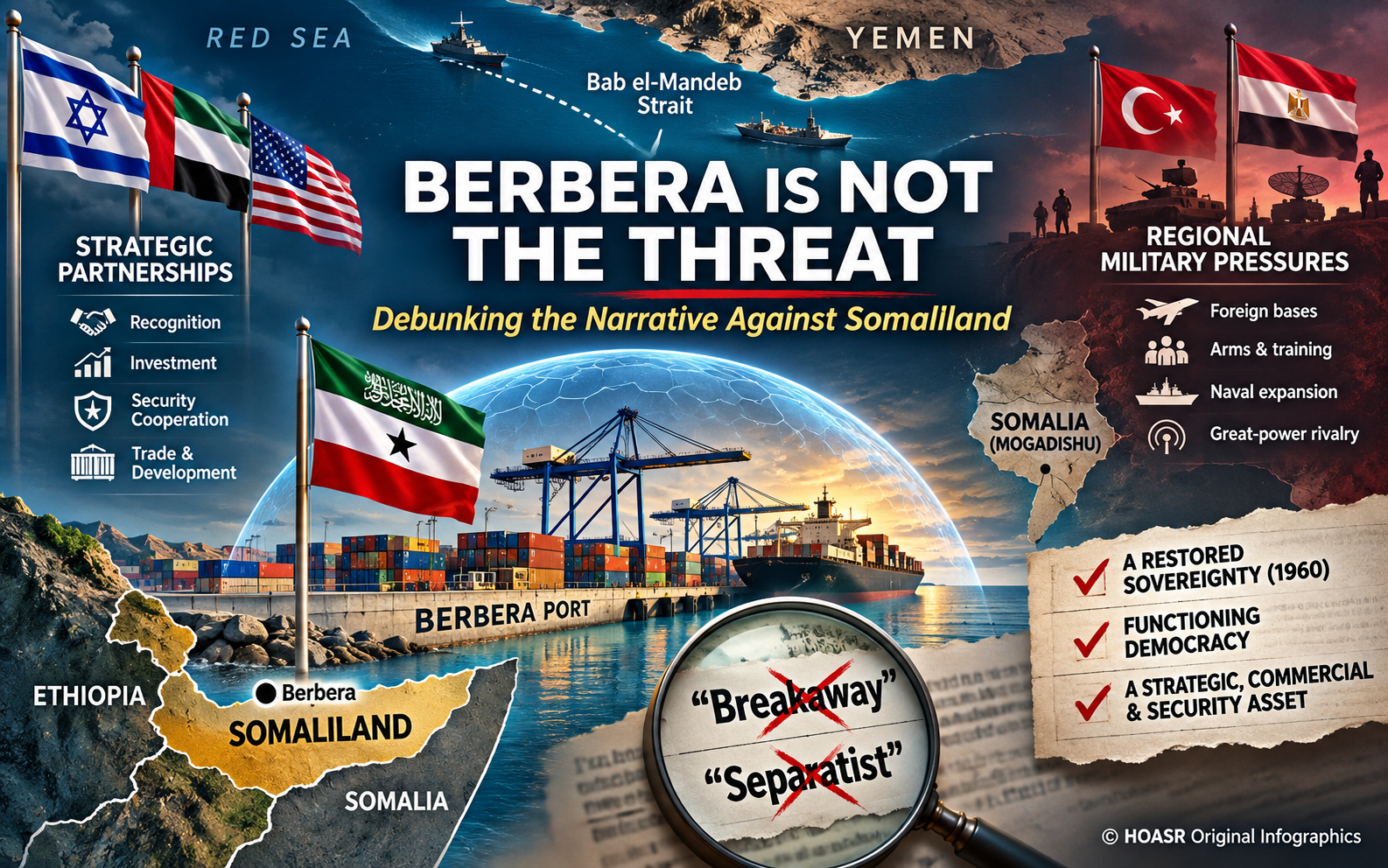
Berbera Is Not the Threat: Examining Somaliland’s strategic deterrence and the regional military pressures shaping its foreign policy. © HOASR Original Infographics.
Berbera did not create the geopolitical competition surrounding Somaliland. It has given Somaliland a greater ability to participate in that competition on its own terms.
The November 19, 2026, WPR article, entitled Somaliland’s Port Gambit Entails Regional Security Risks, deserves a serious geopolitical response. Its central argument presents Somaliland’s pursuit of international recognition and strategic partnerships through Berbera as a potential source of regional insecurity.
Yet it gives insufficient attention to the regional military developments that have encouraged Somaliland to strengthen its international relationships.
There is a fundamental problem with examining Somaliland’s defensive calculations without adequately examining the threats it is experiencing.
Türkiye’s expanding military presence in Somalia, Egypt’s strategic competition with Ethiopia, Mogadishu’s opposition to Somaliland’s international partnerships and the growing militarization of the Red Sea are not developments initiated by Hargeisa.
Somaliland is responding to a changing and dynamic geopolitical environment. To suggest that its response is itself the principal security problem risks confusing the consequences of regional competition with its causes.
The political language of “breakaway” and “separatist”
The first indication of the article’s political framing appears in its opening paragraphs. WPR describes Somaliland as a “breakaway republic” and subsequently as a “separatist territory.” These are the publication’s own descriptions, rather than simply quotations attributed to officials in Mogadishu.
For anyone familiar with Somaliland’s political and constitutional history, such terminology raises an immediate question: is the publication unfamiliar with Somaliland’s historical circumstances, or has it adopted the political vocabulary of governments opposed to Somaliland’s independence?
Somaliland was an internationally independent state on June 26, 1960, before voluntarily entering a union with the former Italian-administered Somalia on July 1. In 1991, following the collapse of that union, Somaliland declared the restoration of its independence.
There is a fundamental difference between restoring a previously independent state and establishing an entirely new separatist entity which is central to Somaliland’s legal and historical argument.
Readers cannot properly understand the recognition dispute without understanding that distinction.
When international publications repeatedly use the language of separatism without explaining this historical background, they risk reproducing the diplomatic narrative promoted by the usual governments opposed to Somaliland’s independence and sovereignty.
Mogadishu, Cairo, Ankara and Beijing have their respective reasons for opposing Somaliland’s recognition. Their political positions should be reported as positions, rather than subliminally incorporated into the terminology of supposedly independent geopolitical analysis.
International recognition remains contested, but historical facts are not erased by diplomatic preferences.
The Institute for Security Studies (ISS) has previously examined Somaliland’s exceptional historical circumstances, citing the African Union’s 2005 fact-finding mission.
More recently, an academic study challenges the conventional argument that recognizing Somaliland would encourage separatism throughout Africa.
Israel’s recognition of Somaliland on December 26, 2025, also introduced a new diplomatic reality. During his January 2026 visit to Hargeisa, Israeli Foreign Minister Gideon Sa’ar explicitly acknowledged Somaliland’s original independence in 1960, as documented by Israel’s Foreign Ministry.
An international publication writing about Somaliland in November 2026 should be capable of incorporating these developments into its political vocabulary.
Who is really changing the regional military balance?
The WPR article examines the possibility that American and Israeli military involvement in Berbera could expose Somaliland to regional conflicts. However, where is the equivalent examination of Türkiye’s extensive military involvement in Somalia?
Türkiye has spent years developing its military presence in Mogadishu, training Somali military personnel and expanding its involvement in Somalia’s maritime and security affairs.
Its ten-year defense agreement with Somalia, announced in February 2024, represented a substantial expansion of that relationship, as reported by Reuters.
The AP also examined the agreement against the background of Mogadishu’s opposition to Ethiopia’s proposed maritime access through Somaliland.
The Royal United Services Institute’s analysis, From Syria to Somaliland: Turkey-Israel Competition Reshapes Region (RUSI), places these developments within a much larger geopolitical competition extending from the Middle East into the Horn of Africa.
These are not hypothetical developments. Türkiye has an established military presence in Somalia, whereas many of the military arrangements involving Somaliland discussed by WPR remain theoretical.
Mogadishu maintains that Turkish military assistance is intended to combat terrorism and protect Somalia’s sovereignty. However, its definition of “sovereignty” includes a territorial claim over Somaliland.
Obviously that creates the growing security concern for Hargeisa, which has maintained separate governmental and security institutions for 35 years.
As I argued in my earlier analysis, Somaliland’s developing security relationships cannot be understood independently of the military capabilities being accumulated in Somalia.
An analysis that scrutinizes Somaliland’s prospective partnerships more extensively than Somalia’s existing military arrangements presents an incomplete picture of the regional security balance.
Egypt’s geopolitical interests cannot be ignored
Egypt’s growing involvement in Somalia is not simply an expression of solidarity with another Arab League member. It must also be understood within the context of Cairo’s long-running strategic dispute with Ethiopia over the Nile and the Grand Ethiopian Renaissance Dam (GERD)
Ethiopia’s access to Berbera would have economic and strategic consequences extending beyond Somaliland. It would diversify Ethiopia’s maritime trade, reduce its dependence on existing transit arrangements and strengthen its commercial position in the Horn of Africa.
Somaliland, in return, would gain transit revenues, employment, infrastructure development and additional diplomatic leverage.
The November 23 analysis published by The New Arab (analysis), examining Egyptian interests in the Somalia-UAE dispute, provides further context for understanding Cairo’s regional calculations.
Egypt’s opposition to Somaliland’s recognition, its strategic relationship with Mogadishu and its rivalry with Ethiopia are interconnected aspects of regional politics.
Yet again, WPR devotes comparatively little attention to how these competing interests affect Somaliland’s security strategy.
Understanding why certain regional governments oppose Somaliland’s international partnerships is just as important as examining why Somaliland pursues them.
Strategic ambiguity: The deterrence factor WPR underestimates
In my previous analysis on Somaliland’s air defense requirements, I have emphasized the importance of strategic ambiguity in Somaliland’s developing relations with Israel, the United Arab Emirates and potentially the United States.
Strategic ambiguity creates uncertainty in the calculations of governments contemplating military aggression.
An adversary cannot necessarily assume that an attack against Somaliland would remain a limited confrontation involving only Hargeisa and Mogadishu. International investments, diplomatic relationships and security partnerships create additional interests that must be considered.
The precise extent of Somaliland’s security arrangements with Israel and the UAE is not publicly known. However, the absence of publicly disclosed details does not mean that these relationships have no strategic significance.
WPR emphasizes the possibility that international military partnerships could make Somaliland a target. It gives considerably less attention to whether those partnerships could also discourage aggression.
Potential deterrence includes defensive capabilities, higher costs of aggression and international interests. Potential exposure includes external retaliation, regional entanglement and commercial disruption. Both potential consequences must be considered.
The purpose of deterrence is not necessarily to prepare for war. It is to influence the calculations of those who might otherwise consider military force an acceptable political instrument.
Somaliland’s historical experience makes this deterrence dimension especially important.
Why Somaliland’s need for air defense is historically justified
For Somalilanders, the question of air defense is not an abstract discussion about international military strategy.
In 1988, the military government of Mohamed Siad Barre used its armed forces against civilian populations in northern Somalia, including devastating aerial bombardments of Hargeisa and Burao during the campaign against the Isaaq population.
It is precisely that historical experience which continues to shape Somaliland’s understanding of national security.
Consequently, reports of Somalia acquiring additional military and aerial capabilities through international partnerships cannot reasonably be dismissed as irrelevant to Somaliland.
My earlier The Times of Israel analysis on Somaliland’s air defense requirements emphasized that the protection of civilian populations, commercial infrastructure and national institutions must remain central to its security policy.
Interestingly, Michael Rubin, interviewed in the WPR article itself, makes a related argument. He suggests that any American security arrangement involving Somaliland should include protection against missile and drone threats.
Mr. Rubin’s observation deserves greater attention than it receives in the article’s overall narrative.
Defensive cooperation and offensive military operations are fundamentally different. The acquisition of defensive capabilities does not automatically indicate an intention to participate in somebody else’s war.
The Houthi threat existed before Israel recognized Somaliland
Another weakness in the WPR narrative is the emphasis placed on Houthi retaliation because of Somaliland’s developing relationship with Israel.
There is no question that the Houthis represent a serious regional security threat. Their ability to disrupt international shipping has already affected maritime trade, insurance premiums and commercial operations across the Red Sea and Gulf of Aden.
However, that threat existed long before Israel recognized Somaliland. Somaliland did not create the conflict in Yemen, the confrontation between Iran and Israel or the attacks on international commercial shipping.
The International Institute for Strategic Studies, in its research (IISS), examines the much broader relationship between maritime insecurity, piracy, smuggling and competition for port access.
The possibility of Houthi retaliation against foreign military facilities in Somaliland is a legitimate concern. But it cannot be used to establish that international cooperation itself is the origin of Somaliland’s insecurity.
If Houthi threats are to be taken seriously, the discussion must also consider defensive capabilities, diplomatic engagement, maritime security cooperation and the protection of commercial infrastructure.
Otherwise, the argument risks giving armed groups an effective veto over the foreign policy choices of countries situated near the Red Sea.
Djibouti exposes the inconsistency in the narrative
In my previous geopolitical analysis, I have emphasized the importance of studying Djibouti’s management of competing international military interests.
Djibouti hosts military facilities belonging to several global powers, including the United States and China. It has nevertheless sought to preserve diplomatic flexibility and maintain relationships with governments that are themselves strategic competitors.
The presence of international military facilities in Djibouti is frequently examined as an expression of the country’s strategic importance. Why, then, should Somaliland’s interest in comparable partnerships be discussed predominantly as a dangerous geopolitical gamble?
There are important differences between the two countries, including Djibouti’s broad international recognition. Nevertheless, the comparison exposes the need for consistent analytical standards.
Somaliland could learn from Djibouti’s efforts to separate its national interests from the conflicts of its international partners. This includes examining the relationship between defensive cooperation, commercial port operations and restrictions on foreign offensive military activities.
The existence of geopolitical risks does not invalidate the strategic importance of cooperation. It establishes the need to manage that cooperation carefully.
Berbera is more than a bargaining chip
The WPR article’s treatment of Berbera as an instrument for obtaining recognition also fails to capture the full economic significance of the port.
In my earlier article, (TOI), I examined the importance of transforming diplomatic recognition into economic opportunities, institutional partnerships, investment and employment. Berbera is central to that process.
Its development represents years of infrastructure investment and cooperation between Somaliland and the UAE. The Berbera Economic Zone, the Ethiopian trade corridor and the port’s expanding logistics capabilities form part of a broader economic strategy.
A December 2025 evaluation commissioned by British International Investment (BII) identified tangible economic benefits from its investment in Berbera, including employment creation and increased economic value.
WPR cites figures showing that Berbera handled 135,000 twenty-foot equivalent units (TEUs) in 2024 against an annual capacity of 500,000 TEUs. This represents 27% utilization and 73% available capacity, not a forecast of future cargo demand.
These figures establish a commercial challenge, but they do not establish the failure of Berbera’s development strategy. The realization of its full potential depends on regional trade agreements, Ethiopian cargo volumes, competitive transport costs and improved maritime security.
Furthermore, when Mogadishu announced the cancellation of its agreements with the UAE, Reuters reported that DP World’s operations in Somaliland remained unaffected. This clearly shows that Berbera is not merely a military asset or a bargaining instrument.
Berbera is an economic development project upon which thousands of Somalilanders hope to build their future.
Somaliland’s political achievements deserve greater recognition
The WPR article acknowledges Somaliland’s institutional development and democratic record, but these achievements deserve a more substantial place in its geopolitical assessment.
Somaliland has established a functioning political system, organized competitive elections and achieved peaceful presidential transfers of power despite decades of limited international recognition.
Its achievements have not eliminated every political, security or territorial challenge. Nevertheless, they distinguish Somaliland’s institutional experience from that of Somalia.
Freedom House provides an independent assessment of Somaliland’s political institutions, while its Somalia assessment documents the considerable governance and security challenges that persist there.
These differences are relevant to international decisions concerning investment, maritime security and diplomatic engagement. Somaliland’s international relationships are not based exclusively on geography.
They are also based on the institutions and relative political stability that Somalilanders have developed over three decades.
In my (HOASR) editorial, I examined how formal recognition could provide a stronger legal and institutional foundation for international trade, investment and security agreements. The strategic significance of Berbera is therefore inseparable from the political institutions that govern it.
Somalia’s diplomatic contradictions
As I have argued in earlier editorials examining Mogadishu’s foreign security relationships, Somalia’s government faces a growing contradiction.
It considers its own extensive partnerships with Türkiye, Egypt and other foreign governments legitimate exercises of sovereignty. At the same time, it rejects Somaliland’s efforts to develop comparable international relationships.
Mogadishu’s objections to Somaliland’s partnerships with Israel and the UAE are presented as a defense of Somalia’s territorial integrity. Hargeisa, however, regards those objections as interference in its independent foreign policy.
This disagreement cannot be resolved by simply adopting Mogadishu’s terminology.
A credible geopolitical analysis should examine how the two governments exercise authority in practice, their different historical trajectories and the security consequences of their competing foreign relationships.
Somaliland’s political institutions, commercial agreements and international partnerships exist independently of Mogadishu’s approval. That practical reality is central to understanding the dispute, regardless of the positions maintained by governments that have not recognized Somaliland.
The Egab editorial collaboration deserves scrutiny
There is another aspect of the WPR article that deserves attention. Its closing editorial disclosure identifies Egab as a collaborator in the production of the report.
Egab was founded by Egyptian journalist Dina Aboughazala and operates as an intermediary between local journalists and international publications. Its activities include story development, editorial assistance and facilitating publication.
Given Egypt’s strategic interests in Somalia, its opposition to Somaliland’s recognition and the article’s particular geopolitical framing, the nature of this editorial collaboration calls for scrutiny.
The use of politically contested terminology, the relatively limited attention given to Egypt’s and Türkiye’s military relationships with Somalia, and the emphasis on the dangers arising from Somaliland’s foreign partnerships collectively raise questions about the editorial approach.
The concern is not established by the nationality of the people involved, but by the narrative that emerged from the collaboration.
Readers are entitled to question whether the editorial process adequately reflected Somaliland’s historical experience, its national security concerns and the strategic calculations of the regional governments opposing its recognition.
The Scoop: Somaliland is responding to regional insecurity, not creating it
The central weakness of the World Politics Review article is its disproportionate emphasis on the risks associated with Somaliland’s developing international partnerships.
It asks whether American and Israeli strategic interests could expose Somaliland to regional conflicts. It gives considerably less attention to whether Somaliland’s existing security environment makes defensive partnerships increasingly important.
Türkiye’s military expansion in Somalia predates Israel’s recognition of Somaliland. Egypt’s strategic rivalry with Ethiopia predates Somaliland’s current diplomatic relationship with Jerusalem. Houthi attacks on maritime shipping predate President Irro’s international diplomatic initiatives.
Somaliland did not create these regional contradictions. It is attempting to navigate them while protecting its institutions, developing its economy and pursuing broader recognition.
In my earlier analyses, I have argued that Somaliland’s developing international relationships introduce strategic uncertainty into the calculations of actors that might contemplate coercion or military aggression.
That deterrence dimension deserves the same analytical attention as the possibility of external retaliation.
International military cooperation involves risks. So does diplomatic isolation. Foreign military access may create vulnerabilities, but the absence of credible defensive arrangements may also leave a country exposed.
A serious geopolitical analysis must examine both possibilities rather than treating Somaliland’s search for security as the principal source of insecurity.
Somaliland’s foreign policy should be understood through its history, its national interests and the regional realities confronting it, not merely through the political vocabulary of governments that oppose its existence as an independent state.
Related Topics
Related Posts