Geopolitical Analyst: Bridging Somaliland & Israel to the world
Maryan Jama and the Freedom to Understand Israel in Somaliland
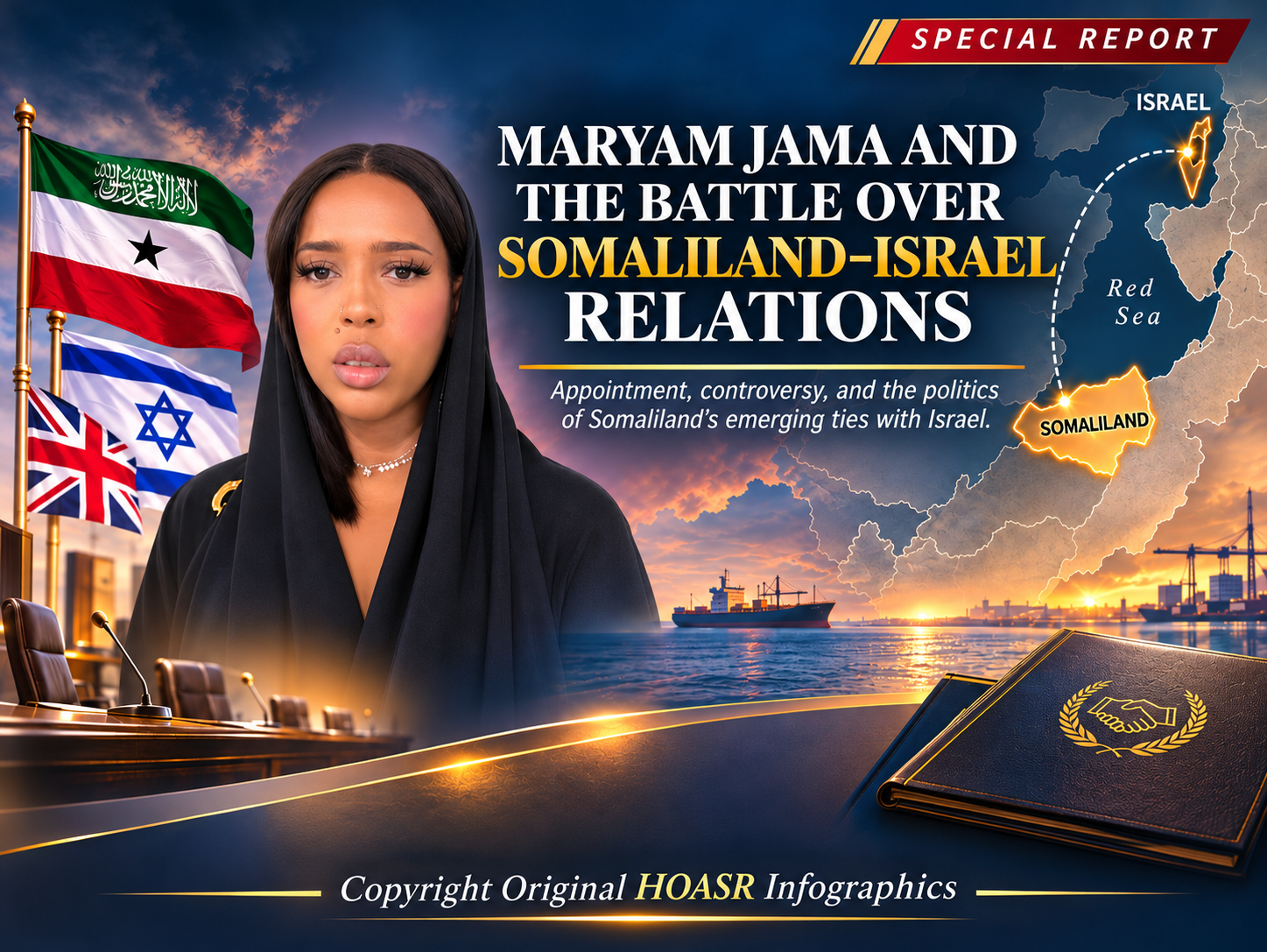
Maryam Jama and the wider political debate surrounding Somaliland-Israel relations. Original HOASR editorial illustration.
A Somaliland woman’s journey from independent discovery to international advocacy brings a personal dimension to a debate that has occupied Horn of Africa Strategic Review (HOASR) for months: the place of religion, knowledge, national interest and public diplomacy in Somaliland’s relations with Israel.
When Israel recognized Somaliland on December 26, 2025, the news reached people who had spent much of their lives waiting for a government to acknowledge their country’s independence in my earlier analysis of The human story behind the recognition
But for Maryan Jama, the decision also raised a personal question. How much did she really know about the country that had recognized Somaliland? What followed was a journey of inquiry, new friendships and public advocacy that would eventually place her at the center of a controversy over relations with the Jewish state.
In a November 25 interview with journalist Danielle Greyman-Kennard, The Jerusalem Post documented Jama’s changing views, her advocacy and the threats she says she has received. Her account is also available through an indexed republication of the interview.
Nearly a year after recognition, her experience offers a way to understand how a foreign policy decision can affect the lives of people far beyond the offices of presidents and diplomats.
What interests me about Jama’s story is how closely it relates to issues I addressed in HOASR between May and August 2026, long before her recent appointment as CEO of the British branch of the Abrahamic Movement.
I wrote then about the consequences of hatred, the danger of religious propaganda, the importance of independent education and the strategic logic of recognition. Those articles provide a framework for understanding the debate now surrounding her.
Shared historical experiences and the search for understanding
One particularly significant aspect of Jama’s interview was her reference to the historical experiences of Somalilanders and the Jewish people.
For Somalilanders, the atrocities committed against the Isaaq population known as the Isaaq Genocide under the Siad Barre military regime remain central to the country’s collective memory. The destruction of Hargeisa and Burao, mass killings and displacement continue to influence Somaliland’s understanding of sovereignty, national security and self-determination.
For Jewish communities, the Holocaust and October 7 remains a defining historical experience that profoundly shaped the development of modern Israel as well as recent Jewish attitudes towards national security.
Indeed, these histories are totally different in their circumstances, scale and context. Nevertheless, dialogue between the two societies can encourage a deeper understanding of the consequences of persecution, atrocities, genocide, displacement and the loss of political protection.
Such dialogue also need not prevent either society from acknowledging the suffering of Palestinians or engaging seriously with the unresolved Israeli Palestinian conflict. Historical understanding is most valuable when it encourages empathy rather than becoming another instrument of political division.
The freedom to learn without surrendering identity
Jama’s earlier perceptions, she explains, were shaped largely by media coverage. Recognition encouraged her to explore Israeli history, Zionism and Jewish society through research and conversations.
She did not need to accept every Israeli government policy to learn about Israel. Nor does an interest in another society require an abandonment of her own religious or national identity.
In my June 2 editorial, Somaliland: Statecraft, Religion, and the National Interest, I examined the danger of reducing diplomatic decisions to questions of religious loyalty. The central argument was that Somaliland’s government has responsibilities for security, prosperity and external relations that can be pursued while respecting the country’s Islamic identity. Diplomatic engagement with states of other faiths is common across the Muslim world.
Education is not indoctrination
On July 3, I wrote about Somaliland secondary school graduates who had called for greater attention to Israel’s history and geography in the curriculum. Their question was straightforward: if students learn about countries that have never recognized Somaliland, why should they not also learn about a country that has?
I discussed the educational merits of that proposal in Education Is Not Indoctrination: Why Studying Israel Should Be a Legitimate National Conversation.
The students were asking for knowledge, not a change of faith. Jama’s experience brings the same issue into adult public life. People can study Israel’s political institutions, technological achievements, history and conflicts while retaining their own personal beliefs.
They can examine Zionism and Palestinian nationalism, challenge the arguments of both and arrive at conclusions of their own. The freedom to study Israel is not a demand that people endorse its policies or surrender their faith.
The value of education is that it gives people the tools to decide what they think, instead of treating unfamiliar societies as abstractions. A society that values education has room for these debates and people to people conversations.
When disagreement becomes personal
Jama says she has faced death threats and accusations of attempting to introduce a new religion into Muslim communities. She rejects that characterization of her work. Among her public critics is British academic David Miller, whom the interview identifies as associated with Iran’s state-backed Press TV.
His accusation that the movement promotes Zionism and his language about excluding its members from public life saying: its participants should be “hounded out of public life.” illustrate the intensity of the dispute.
In my June 21 editorial, Somaliland Antisemitism Propaganda: Defending Unity After Israel Ties, I examined how foreign policy disagreement could be turned into religious hostility and internal division. I also stressed the importance of preserving constitutional freedoms and separating criticism from incitement.
Jama’s account makes that constitutional freedoms particularly relevant today: opposition to normalization is a political position, while threats against people expressing their views are a matter of personal safety.
The British setting recalls another HOASR editorial. Following an attack on Jewish men in North London, I wrote A Line Must Be Drawn: Against Hate, Violence, and the Politics of Division on May 2.
Its central concern was the progression from prejudice and collective blame to the normalization of hostility. That principle applies equally to hatred directed at Jews, Muslims or individuals who seek dialogue across religious boundaries. It also leaves enough room for evidence-based criticism of Israel and its policies.
Why the relationship is being contested
The debate cannot be understood solely through religion. Somalia’s federal government rejected Israel’s recognition, as Reuters reported on December 26, 2025. The Organization of Islamic Cooperation subsequently adopted a resolution opposing recognition.
In contrast, Hargeisa maintains that its restored sovereignty in 1991 entitles it to establish its own foreign relationships. These competing positions have international consequences. Jama believes some of the hostility directed at her originated in Somalia.
I examined the political risks of recognition during President Irro’s June visit to Israel in Somaliland, Israel, and the New Red Sea Alliance: Recognition, Risk, and Geopolitical Reality. My argument was that Somaliland’s diplomatic choices needed to be assessed in the context of the changing security environment around the Red Sea, rather than solely through the reactions of other governments.
The controversy surrounding Jama highlights a related question: how will citizens discuss those choices in a highly polarized information environment?
On August 7, drawing on Asher Lubotzky’s research for the Italian Institute for International Political Studies, I explored Israel’s strategic reasoning in Why Israel Chose Somaliland as Its Strategic Partner in the Horn of Africa and the Red Sea. The article considered maritime security, the Houthi threat and the renewed relevance of Israel’s Periphery Doctrine.
These interests help explain why diplomatic recognition took place when it did. They also clarify why the partnership should be discussed in terms of tangible national interests, rather than reduced to assumptions about religion.
A new role for a Somaliland woman
Jama’s institutional biography describes her as a political analyst, media founder, doctoral student and diaspora representative. These are the organization’s descriptions, not independent confirmation of her academic credentials or an official diplomatic appointment.
Her November 20 appointment to lead the British branch of the Abrahamic Movement was reported while the branch was still being established. The announcement offers a starting point for understanding her new responsibilities.
Her expressed hope that more women will take part in leadership, diplomacy and peacebuilding deserves attention in its own right. Somaliland women have contributed to reconstruction, commerce and reconciliation.
However, Jama’s public role raises questions about the space available to women who pursue international careers and express independent political opinions.
From recognition to human connections
The Abrahamic Movement, led internationally by Israeli author and communications strategist Tom Wegner, describes itself as an initiative promoting coexistence and cooperation across religious and cultural boundaries. Its membership extends beyond Israel and Somaliland, incorporating individuals from several Muslim-majority societies.
It is important, however, to distinguish the Abrahamic Movement from the Abraham Accords. The former is a civil society organization; the latter refers to formal diplomatic normalization agreements. Jama’s appointment is an organizational leadership position, not an official diplomatic appointment by the Somaliland government.
Somaliland’s constitutional framework identifies Islam as the state religion and prohibits the promotion of other religions in the country. That makes it particularly important to separate diplomatic relations and private dialogue from promotion of other religions (proselytization).
A citizen’s support for cooperation with Israel is not in itself evidence of religious conversion or an attempt to convert others. Conversely, civil society organizations have a responsibility to explain their activities and comply with applicable law.
Jama’s hopes extend to tourism, visits by Jewish communities, business cooperation and greater diplomatic contact. Civil society can complement those state-level channels through academic exchanges, professional networking and cultural understanding.
The responsibility of emerging friendship organizations
As more friendship associations and advocacy organizations emerge, the question of institutional accountability becomes increasingly important.
The Abrahamic Movement’s announcement of Jama’s appointment came while its British branch was still being established, according to Faith & Freedom News.
Its legal registration, governance arrangements, funding sources and relationship with other Somaliland–Israel friendship organizations are matters of legitimate public interest.
Civil society organizations can operate independently while maintaining constructive relations with government institutions. Clear organizational mandates help prevent confusion between private advocacy, commercial representation and official diplomatic authority.
Transparency would also help address public concerns about religious objectives and foreign political affiliations. Publishing institutional objectives in both Somali and English could provide Somalilanders with a clearer understanding of what such organizations seek to achieve.
The Scoop: Recognition is a relationship between people
Maryan Jama’s experience ties together the arguments I made in HOASR over the preceding six months. The May editorial examined the dangers of hatred; the June articles looked at social cohesion and the geopolitical risks of recognition; the July analysis defended the value of learning; and the August article explored Israel’s strategic interests.
Her story brings these themes into the life of one Somalilander who chose to investigate her assumptions and become involved in public diplomacy.
Every Somalilander has a different story and may not have reached the same conclusion as Jama. What is important is that different conclusions should be discussed without intimidation, collective blame or accusations unsupported by evidence.
Recognition created an official relationship between Hargeisa and Jerusalem. Its wider significance will depend on the institutions, investments, educational opportunities and human connections that develop over time.
Recognition established a relationship between two governments. The next chapter will be written in the experiences of their citizens: in the projects they undertake, the conversations they have and the ability of people with different beliefs to engage with one another without fear.
Editorial note: My earlier HOASR editorials are contextual analysis, not independent verification of those allegations.
Related Topics
Related Posts