
A Moroccan Journalist
Beyond normalization: Morocco and Israel institutionalize a strategic bargain
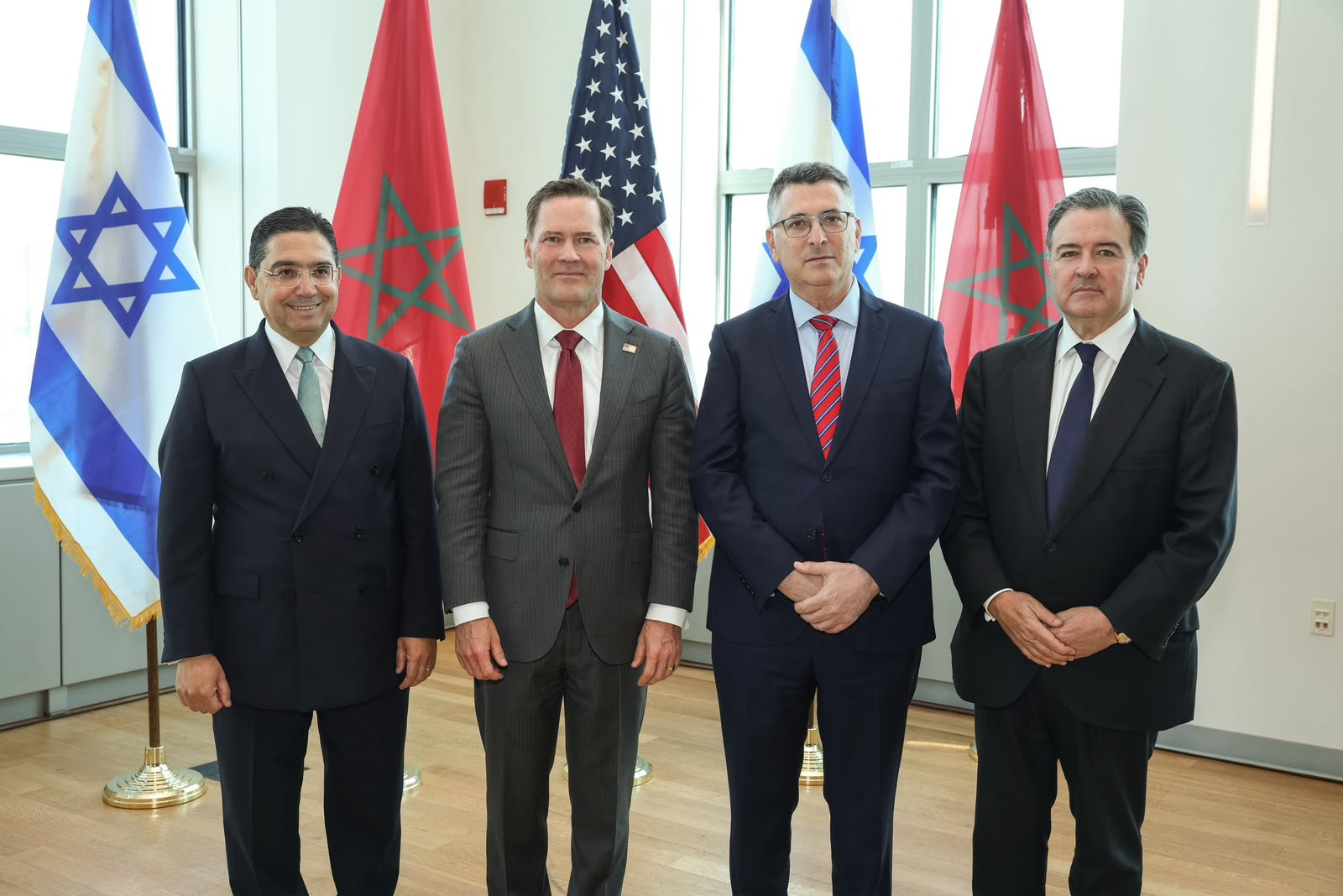
Israeli Foreign Minister Gideon Sa’ar, US Ambassador to the UN Mike Waltz, US Ambassador to Morocco Richard Duke Buchan III, and Moroccan Foreign Minister Nasser Bourita meet to discuss the upgrade of diplomatic relations between Morocco and Israel on September 16, 2026. (Photo credit: Israeli Foreign Ministry)
The move from liaison offices to embassies is less a diplomatic revolution than the delayed completion of the 2020 compact – and the clearest evidence yet that the relationship has survived its hardest political test.
Morocco and Israel’s decision to elevate their liaison offices into embassies is easy to describe as another Abraham Accords milestone. It is more revealing to see it as a verdict on the durability of a relationship subjected to war, public anger, and prolonged diplomatic caution.
At a US-convened meeting in New York, the two governments reportedly signed a declaration that went well beyond the embassy upgrade, agreeing to appoint ambassadors, broaden air links, allow Moroccan carriers to return within weeks, complete investment-protection and double-taxation agreements by the end of 2026, and resume reciprocal senior-level visits.
True to an established communications pattern, Israel was once again the first to disclose an agreement involving an Arab partner, with the news emerging just one day after Washington hosted a gathering marking the sixth anniversary of the Abraham Accords – a sequence that lent the upgrade both symbolic weight and unmistakable diplomatic choreography.
The operative word, however, is agreed: embassies have not yet become an accomplished institutional fact. Appointments, accreditation, and implementation must follow.
That distinction is not pedantic. The December 2020 tripartite declaration already envisaged “full diplomatic, peaceful and friendly relations,” reopened liaison offices, and stated an intention to proceed toward embassies. The New York package is therefore not a second normalization. It is the delayed institutional completion of the first – an attempt to translate a politically negotiated opening into a thicker, more routine and less reversible relationship.
The historical context sharpens the point. Morocco and Israel maintained liaison offices from 1994 until Rabat closed them during the Second Intifada in 2000. Their reopening in 2020 restored a familiar formula; full ambassadorial representation would move beyond it. An embassy brings a diplomatic hierarchy, greater consular capacity, denser bureaucratic contact, and a higher political cost for rupture. It converts an exceptional channel, managed heavily from the top, into ordinary statecraft.
The relationship’s endurance rests on strategic reciprocity. Morocco gains access to Israeli defence technology, intelligence cooperation, innovation, tourism, and commercial networks. Above all, the wider compact reinforced Rabat’s position on the Western Sahara: Washington recognized Moroccan sovereignty in 2020, and Israel followed in 2023.
The tripartite joint statement circulated by several sources reiterates that position, arguing that any other path would merely prolong an unacceptable status quo and that an urgently needed resolution would not only bring peace to the region, but also unlock greater prosperity and integration across Africa. UN Security Council Resolution 2797, adopted last October, had already moved in the same direction by further elevating Morocco’s autonomy proposal as the framework around which negotiations should proceed.
Israel gains a consequential Arab and African partner, Atlantic access, security cooperation, and the legitimacy furnished by Morocco’s distinctive religious and historical authority. Deep Moroccan-Jewish ties give this relationship a social vocabulary that other normalization agreements cannot readily reproduce. The Morocco-US-Israel joint declaration from the same meeting also recognized the special and enduring ties between the Moroccan monarchy and Moroccan Jewish communities around the world. Yet heritage supplies legitimacy; interests supply staying power.
Gaza provided the severest stress test. Moroccan streets witnessed sustained opposition to normalization, visible diplomacy cooled, and air connections were disrupted. Rabat nevertheless refused to sever relations. In March 2024, it used the Israeli channel to send forty tonnes of aid into Gaza through a land crossing – an instructive demonstration that access can serve Palestinian needs as well as bilateral strategy. Meanwhile, security cooperation continued, culminating in a joint military work plan for 2026. The pattern was one of compartmentalization: public symbolism was restrained, substantive channels were preserved.
This is why Foreign Minister Nasser Bourita’s renewed support for a two-state solution should not be dismissed as ceremonial language. King Mohammed VI chairs the Al-Quds Committee, and Palestine remains embedded in Morocco’s religious diplomacy, domestic politics, and conception of regional legitimacy. Rabat’s formula is not normalization in place of Palestine; it is cooperation with Israel alongside an explicitly independent Palestinian position. The contradiction is managed, not resolved.
Nor can public opinion be treated as background noise. Arab Barometer found Moroccan support for normalization falling from 31% in 2022 to 13% after October 7. An elite compact can endure without mass enthusiasm, especially where strategic foreign policy is concentrated in the monarchy. But it will remain politically cold – and vulnerable to renewed violence in Gaza, annexationist moves in the West Bank, or provocations in Jerusalem. Embassies can institutionalize relations; they cannot manufacture public consent.
The economic clauses are therefore central, not decorative. The two sides have signed roughly thirty agreements since 2020, but investment protection and double taxation – the legal plumbing of durable commerce – remain unfinished.
Restored Moroccan flights, easier investment, and reciprocal ministerial visits are designed to create constituencies with a material stake in continuity. US officials may celebrate trade growth of roughly 500% since 2020, but percentages from a low base can flatter. The real task is to turn episodic transactions into an ecosystem of firms, travellers, researchers, and officials for whom rupture would carry tangible costs.
Washington’s presence in New York also matters. The United States remains architect, convener, and implicit guarantor of the 2020 bargain. Yet no new American concession was announced. This was consolidation, not a fresh geopolitical transaction. Coming amid electoral calendars in both Morocco (September 23) and Israel (October 27), the emphasis on deadlines, agreements, and institutions appears intended to insulate bilateral ties from changes of government and short-term political theatre.
The most defensible reading, then, lies between triumphalism and dismissal. This is neither a new peace nor mere optics. It is strategic institutionalization: an effort to make a controversial relationship administratively normal and economically useful after it proved politically resilient.
The decisive tests will be concrete – named ambassadors, exchanged credentials, functioning embassies, restored flights, and completed treaties. If those follow, Morocco and Israel will have moved from a relationship sustained chiefly by leaders and security interests to one embedded in institutions and constituencies. That would make normalization harder to reverse, even as reconciliation between Israeli policy and Moroccan public opinion remains unfinished.
Related Topics