
Bridging faith. Defending truth. Confronting hate
Beyond the Statement: Regent University and Israel After October 7
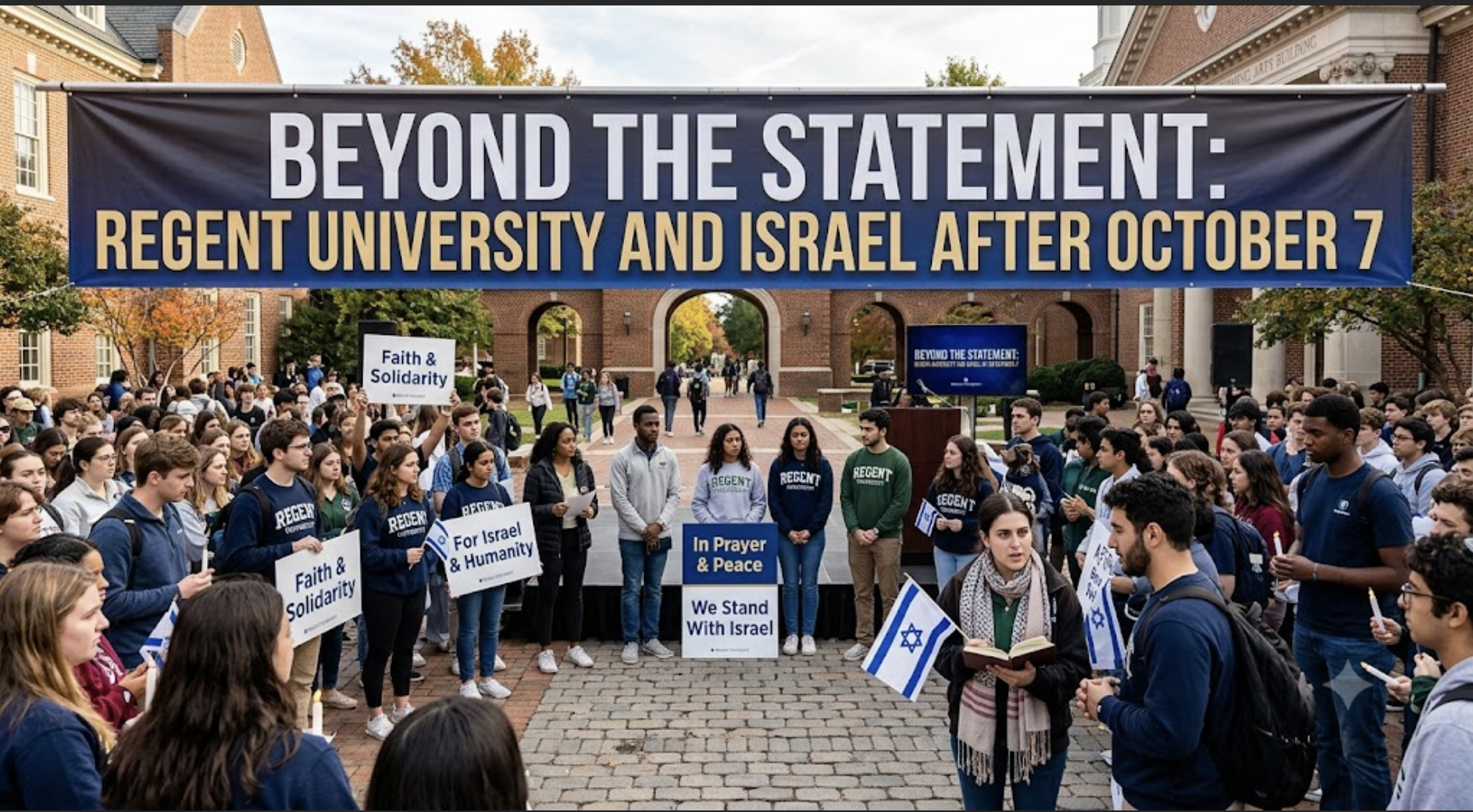
Image created from Google Gemini by Tim Orr
After October 7, much of the discussion about universities centered on their official statements. People wanted to know who condemned Hamas, who addressed antisemitism, who spoke about Palestinian civilians, and who chose not to say much at all. That made sense. A public statement is often the first thing people see when they are trying to understand an institution. But statements have limits. They are usually written quickly, revised by several people, and shaped by concerns that extend well beyond the issue itself. Regent University deserves a closer look because its response was larger than a single statement. The more revealing story is not only what Regent said, but what it went on to build.
Taken as a whole, Regent’s public record points in a consistent direction. The university has spoken clearly in support of Israel, condemned antisemitism without hesitation, and invested in educating its community about Israel and the Jewish people. It has said much less about Gaza as a humanitarian crisis, Islamophobia, or Palestinian political aspirations. That does not mean those subjects were absent from classrooms, private conversations, or pastoral care. It simply means the public evidence points much more strongly in one direction than the other. Judged by what the university has chosen to say and do publicly, the pattern is clear.
The first major piece of evidence came on November 20, 2023, when Chancellor Gordon Robertson signed Regent University’s “Statement on Antisemitism.” The statement said Regent “stands unwaveringly” against antisemitism on college campuses and used the International Holocaust Remembrance Alliance definition of antisemitism as its reference point. It grounded the university’s position not only in campus safety, but also in Christian theology, religious liberty, freedom of conscience, and the protection of Jewish students and communities. The statement quoted both Jewish and Christian scripture and argued that antisemitism violates principles at the heart of Christian faith. That makes it different from a generic university statement against hatred. Regent was not just saying antisemitism is unacceptable; it was saying a Christian university has a theological reason to oppose it.
That distinction matters. Regent did not present antisemitism as simply one concern among many on campus. It treated antisemitism as something that directly implicates Christian moral responsibility. Many universities stopped short of framing the issue that way. That choice also reveals how Regent understands its own role. Regent never claims to speak from a position of neutrality. It speaks openly as a Christian university, grounding its public witness in convictions about Jewish dignity, religious liberty, and moral responsibility.
At the same time, the limits of the statement should be named clearly. Regent’s November 2023 statement was never intended to address every aspect of the Israel-Hamas war. It did not offer a detailed account of Gaza, Palestinian civilian suffering, ceasefire debates, Islamophobia, or Palestinian rights. Its center of gravity was antisemitism and Jewish safety. That does not make the statement inadequate. It simply defines what the statement set out to do. It should be read on its own terms rather than asked to answer questions it was never written to address. A serious analysis has to respect both what Regent said and what it did not say.
As a stated the other day in my article, Wheaton College took a stance that was diamterically opposed to this one.
The decisive move came later, in May 2024, when Regent announced the creation of the Institute for Israel Studies inside the Robertson School of Government. This is where the record becomes more unusual. Statements come and go. Creating an institute is something different. An institute brings faculty, courses, public events, research, and long-term institutional investment. It signals that a subject has become part of the university’s ongoing life rather than a response to a single moment. Regent described the institute as focused on the history, culture, society, and politics of contemporary Israel.
Chancellor Robertson said it amplified Regent’s commitment to Israel, and Dean Michele Bachmann said the coursework would help students understand the Jewish state and the Jewish people’s right to their land. That is not vague language. Regent gave its support for Israel a formal academic home.
As I argued in my article a few days ago, Wheaton College responded to the post-October 7 environment in a way that was almost the mirror image of Regent’s approach. Wheaton sought to preserve institutional neutrality by distancing itself from explicit political commitments, emphasizing the university’s role as a place for dialogue rather than advocacy. Regent made a different judgment. Rather than narrowing its public voice, it expanded it. Rather than limiting itself to a carefully worded statement, it established an institute, developed programming, hosted public events, and incorporated Israel more intentionally into its educational mission. Whether one agrees with Regent’s decision or prefers Wheaton’s model is ultimately a separate question. The empirical point is that the two universities adopted fundamentally different understandings of what institutional responsibility required after October 7. Wheaton treated restraint as a virtue of higher education. Regent treated institutional commitment as one.
The most significant development in this story is not simply that Regent University expressed support for Israel. Many institutions issue statements after major events. Regent went further. It embedded that commitment into the life of the university itself. I think the best way to describe this is institutionalized conviction. A belief became something more durable than a public declaration. It took organizational form.
That is what makes Regent’s Israel Institute so important. The institute is not an event series created in response to October 7, nor is it a temporary initiative tied to a particular news cycle. It represents a long-term investment. Through courses, public lectures, student opportunities, and scholarly programming, the university has made Israel a continuing part of its educational mission. Whether one agrees with Regent’s position or not, the institutional significance is difficult to miss. The university chose to make support for Israel part of what it teaches, studies, and publicly promotes.
The institute’s own description reinforces this point. It characterizes the academic environment after October 7 as one increasingly shaped by anti-Israel propaganda and antisemitism. From that starting point, it defines its purpose in straightforward terms: to educate Christian scholars, students, and pro-Israel activists about Zionism and contemporary Israel. There is very little hedging in that language. At a time when many universities emphasize neutrality or frame every issue as one perspective among many, Regent makes no attempt to disguise where it stands. It presents support for Israel as something worthy of sustained study, public engagement, and Christian reflection. That is an unusual move in higher education today. More importantly, it shows that Regent’s commitment extends well beyond official statements. The university has built an academic institution around that conviction, making Israel part of its ongoing educational mission rather than simply its public messaging.
Regent’s events show the same pattern. In March 2025, the Israel Institute hosted The institute’s programming reflects the same pattern. It invited Danny Danon, Israel’s Permanent Representative to the United Nations, to speak at an Israel Symposium on campus. In March 2026, it brought former Congresswoman Elaine Luria to Regent for a conversation about antisemitism, political unrest, and support for the Jewish people. By themselves, individual events can be dismissed as isolated decisions. Over time, however, they begin to reveal something more. Universities communicate their priorities not only through official statements but through the people they invite, the conversations they sponsor, and the subjects they return to again and again. Regent has consistently chosen to invest its attention in Israel, antisemitism, Jewish security, and Christian support for the Jewish people. That recurring focus suggests more than a response to current events. It reflects an institutional priority that has become part of the university’s public identity.
The student side of the record may be even more revealing. In October 2025, Regent reported that students traveled to New York City to visit the Consulate General of Israel and attend an October 7 commemoration at the United Nations. The group included undergraduate, graduate, and law students, along with leaders from Christians United for Israel, the Regent Israel Public Affairs Committee, and Turning Point USA. Students heard from people directly affected by October 7, including a survivor of the music festival attack and an Israeli tank commander. Regent’s article said the trip gave students a deeper understanding of Israeli culture and a stronger passion to advocate for Israel. That is not just academic exposure. It shows Regent presenting pro-Israel advocacy as part of student formation.
The record also includes a humanitarian dimension, although it is directed primarily toward Israel. Following the Hamas attacks, Regent’s Ukraine Institute of Education in Psychology and Counseling provided trauma-stabilization training for psychotherapists working in Israel. According to the university, more than 140 Israeli therapists completed the training and were able to begin assisting survivors within two weeks. That response broadens the picture. Regent did not limit itself to public statements or symbolic expressions of solidarity. It also contributed professional expertise in trauma care and counseling. At the same time, the publicly available record focuses almost entirely on Israeli victims. I found no comparable institutional initiatives addressing Palestinian trauma. That asymmetry is worth noting because it is consistent with Regent’s broader institutional emphasis throughout this period.
The evidence also has limits, and those limits should be respected. The Center for Christian Thought & Action has published essays defending Israel’s military campaign against Hamas and criticizing early recognition of a Palestinian state. Those articles help illuminate the intellectual climate surrounding Regent, but they should not be treated as official university policy. Each includes a disclaimer stating that the views expressed are those of the authors and do not necessarily represent Regent University. That distinction matters. The strongest evidence for Regent’s institutional position comes from sources that speak directly for the university: its official statements, the creation of the Israel Institute, university news releases, and the events Regent has chosen to sponsor. Those are the clearest indicators of the university’s public commitments.
One feature of Regent’s record deserves mention because it says as much as what the university chose to emphasize. Its public engagement has consistently focused on Israel, antisemitism, Zionism, Jewish security, and Christian support for the Jewish people. By comparison, there is relatively little official attention to Palestinian civilian suffering, Islamophobia, Palestinian Christians, Palestinian political aspirations, or humanitarian concerns in Gaza. That observation is not intended as criticism. It is simply an accurate description of the public record. The evidence points to a university whose engagement is centered on Israel rather than on the Middle East as a whole. Regent’s concern is not framed as a broadly humanitarian response to every dimension of the conflict. It is framed as a Christian commitment to Israel and a sustained response to antisemitism.
In some ways, that selectivity makes the evidence easier to interpret. An honest assessment does not require pretending that Regent has addressed every aspect of the Israeli-Palestinian conflict with equal attention. It clearly has not. What it has done is speak with unusual consistency about Israel and the rise of antisemitism after October 7. More importantly, it has translated those commitments into lasting institutional form. The creation of the Israel Institute, the programming it has sponsored, and the educational opportunities it continues to develop all point in the same direction. Regent did more than issue a statement during a moment of crisis. It built an institutional framework designed to carry those convictions into the future. That is what ultimately distinguishes Regent from many other universities and makes it an important case study in institutional commitment.
The broader lesson extends beyond Regent itself. Universities are defined by more than the statements they release after a crisis. Public declarations matter, but they are only one part of the story. An institution’s priorities also become visible in what it funds, what it teaches, whom it invites to campus, the opportunities it creates for students, and the conversations it chooses to sustain over time. Those are the places where convictions become durable. Judged by that standard, Regent presents a remarkably consistent record. Its official statements, academic initiatives, public events, and educational programming all point in the same direction.
Taken together, the evidence supports a favorable but measured conclusion. Since October 7, Regent has developed a public posture that is unmistakably pro-Israel and explicitly opposed to antisemitism, grounding both in its Christian identity. It has reinforced that commitment through the Israel Institute and through ongoing educational and public programming rather than allowing it to remain a one-time response to a tragic event. At the same time, its official public record gives considerably less attention to Gaza, Palestinian suffering, or Islamophobia. Recognizing that imbalance does not weaken the analysis; it makes it more accurate. What ultimately distinguishes Regent is not simply the position it adopted, but the way it embedded that position in the life of the university. Its convictions became part of its institutional identity, giving them a permanence that extends well beyond any single news cycle.
Related Topics
Related Posts