Beyond Uranium: The Ghost of the AMIA Bombing
The dust may have settled after the latest exchange of fire, but the silence is deceptive. The prevailing sentiment in Israel today is that the war with Iran remains unfinished. As long as the Ayatollah regime stands, this conflict is merely a parenthesis in a sentence that has yet to be fully written.
The threat has not disappeared; it has mutated. Reports indicate that Iran now possesses approximately 460 kg of enriched uranium, a figure that stifles any hope for diplomatic containment. Added to this is a haunting uncertainty: the true extent of the damage to their ballistic missile program following recent operations remains unclear, as does the degree to which their financial capacity has been diminished. Iran continues to dominate the Strait of Hormuz, turning a vital international shipping lane into a toll booth to fund its global network of terror.
We all know why Israel desires and needs regime change. It is not a matter of political preference; it is a matter of survival. Across the political spectrum, there is a consensus that one cannot coexist with a theocracy that has made the annihilation of the “other” its raison d’être, using proxies to besiege Israel’s borders. But for me, the threat of the Iranian regime was not born in the Middle East. It began on a street in Buenos Aires three decades ago.
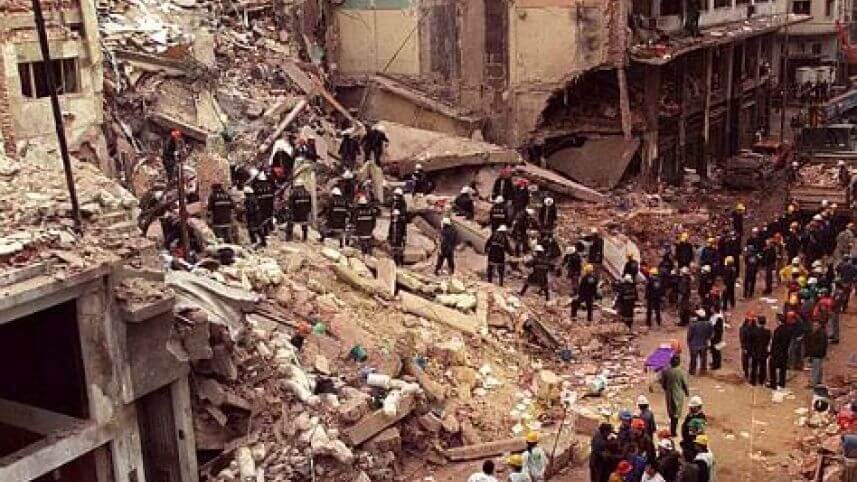
This is the same regime that, on the morning of July 18, 1994, decided that time should stand still on Pasteur Street. The explosion at the AMIA Jewish community center was more than a burst of debris and shattered glass; it was an attack that tore the fabric of a nation and exposed its vulnerabilities. With 85 people murdered, it remains the deadliest attack on Jews outside of Israel since the Holocaust. After years of investigation, Argentine justice was clear: the bombings of the Israeli Embassy (1992) and the AMIA (1994) were state-sponsored decisions, planned in Tehran and executed by Hezbollah. This is not a conspiracy theory; it is a fact proven in judicial files and backed by international intelligence.
Growing Up Between Bollards
For those of us who grew up in the Argentine Jewish community, the Iranian regime was never a geopolitical abstraction; it was a physical presence. My childhood and youth were marked by constant security: the “pilotes”, concrete bollards, at the gates of every synagogue, security checks at schools, and metal detectors at every community event.
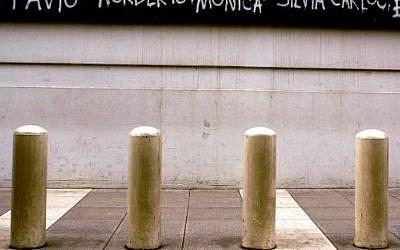
I grew up attending annual commemorations where the plea for justice felt like a cry into a vacuum. We remembered the victims, but deep down, we knew Iran would never hand over those responsible. The regime did not merely refuse to cooperate; it transformed impunity into a badge of honor.
Today, men with Interpol Red Notices for the AMIA bombing do not just walk free; they govern. The case of Ahmad Vahidi is the most grotesque example: the man sought by Argentine justice for his role in the 1994 massacre has served as Minister of Defense and Minister of the Interior. Most recently, he was appointed as a senior commander within the Islamic Revolutionary Guard Corps (IRGC). Iran mocks the world by placing alleged mass murderers in the highest seats of power.
The war is indeed unfinished. The regime remains, exporting its ideology of death and refining its nuclear capabilities. In the absence of immediate options to dismantle the Islamic leadership’s worldview, reducing their capacity to act on their intentions is a vital step forward. If we cannot, for now, dismantle the structure of evil, then limiting its reach, drying up its finances, and degrading its arsenal is the only viable path. It is not the definitive peace we dream of, but it is the necessary wall to ensure that the horror of 1994 does not find a new stage in 2026.