
Bibi – Being in charge of everything — and responsible for nothing
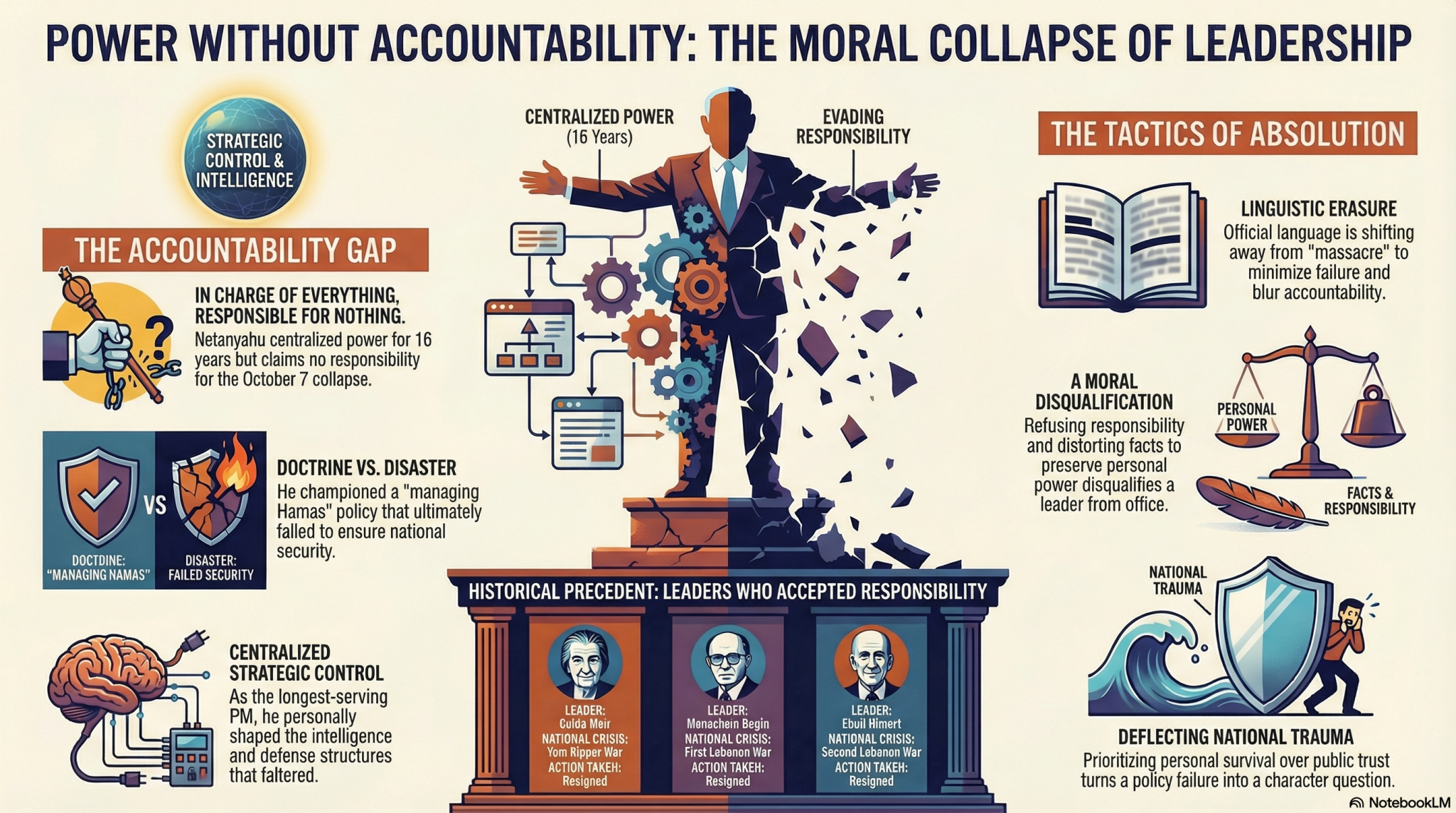
There is something profoundly absurd about a leader who claims to oversee every lever of national power, who boasts of unmatched experience and unrivaled security credentials — yet insists he bears no responsibility when the greatest intelligence and security catastrophe in Israel’s history occurs on his watch.
That absurdity now defines Prime Minister Benjamin Netanyahu’s evolving account of October 7, 2023.
As Israelis continue to grapple with the trauma of that day — when Hamas terrorists breached the border, slaughtered civilians in their homes, burned families alive, raped, kidnapped, and executed innocents in a coordinated assault — Netanyahu has increasingly sought not only to deflect blame, but to reshape memory itself.
Words matter. And recently, the word “massacre” has begun to disappear from official statements and talking points. The linguistic shift is not incidental. It is part of a broader effort to dull the moral clarity of what occurred, to transform a cataclysmic failure into an unfortunate episode in an endless conflict, rather than a singular, preventable collapse of policy, deterrence, and leadership.
October 7 was not merely another round of violence. It was not a “security incident.” It was not a tragic surprise in an otherwise functioning system.
It was a massacre.
More than 1,200 people were murdered, most of them civilians. Entire communities were overrun. Israel’s vaunted border defenses failed. Intelligence warnings went unheeded. Forces arrived hours late to towns under attack. Command structures faltered. These facts are not partisan talking points; they are the lived reality of survivors, soldiers, and grieving families.
Yet Netanyahu’s public posture suggests a different reality: one in which responsibility lies everywhere except with the man who has served longer than any prime minister in Israel’s history, who centralized power to an unprecedented degree, and who personally shaped Israel’s Gaza policy for more than a decade.
You cannot govern a country for sixteen years, appoint its security chiefs, dictate its strategic doctrine, weaken internal checks, and then claim you are merely a bystander when that doctrine implodes.
Leadership is not a ceremonial title. It is a moral contract.
Netanyahu championed a policy of “managing” Hamas rather than defeating it. He presided over years in which Qatari cash flowed into Gaza with Israeli approval. He framed Hamas as a contained problem and the Palestinian Authority as the greater threat. He argued that quiet could be bought, deterrence outsourced, and the status quo sustained indefinitely.
That worldview collapsed on October 7.
Trying to erase the word “massacre” is not merely semantic maneuvering. It is an attempt to minimize the scale of failure — and therefore to minimize accountability. If the event becomes smaller, blurrier, more abstract, then the failure becomes easier to disperse. Responsibility turns into an unfortunate fog instead of a chain of decisions.
But Israelis are not confused about what happened.
They remember hiding in safe rooms while terrorists tried to break in. They remember pleading for help that did not arrive. They remember watching live feeds of executions and abductions. They remember that the state — their state — was absent in their darkest hour.
And they see, now, a prime minister who is not preparing the ground for accountability, but for absolution.
This is the deeper disqualification.
Mistakes, even catastrophic ones, do not automatically bar someone from public office. Democracies understand that leaders can fail. What disqualifies a leader is the refusal to accept responsibility for failure — especially one of this magnitude. What disqualifies a leader is the willingness to distort language, blur facts, and redirect blame in order to preserve personal power.
Every previous Israeli prime minister who presided over a national disaster ultimately accepted responsibility. Golda Meir resigned after the Yom Kippur War. Menachem Begin stepped down after Lebanon. Ehud Olmert resigned amid corruption and the fallout from the Second Lebanon War.
They did not claim omnipotence in success and impotence in failure.
Netanyahu’s approach suggests something more troubling: that there are no limits to what he will say, frame, or recast to remain in office. When the instinct after national trauma is not reflection but narrative control, not accountability but survival, the issue ceases to be one policy failure. It becomes a character question.
A democracy cannot function if its leader believes that holding power and evading responsibility are compatible goals.
If October 7 becomes a tragic but vague “event,” then no reckoning is required. No conclusions must be drawn. No lessons must be internalized. And most importantly, no one at the top must step aside.
That is dangerous.
Israel will eventually hold commissions, publish reports, and assign formal responsibility. But before the legal findings and the historical volumes are written, a simpler moral truth already stands.
A leader who was truly “in charge of everything” on October 7 must accept that he was responsible for what happened.
A leader who refuses to do so — and instead seeks to edit memory itself — has demonstrated that preserving his own position outweighs preserving public trust.
That is not merely a political failing.
It is a disqualification.
And no amount of revision can turn a massacre into a footnote — or responsibility into someone else’s burden.