The views expressed herein are solely mine.
Black History Beyond One Villain
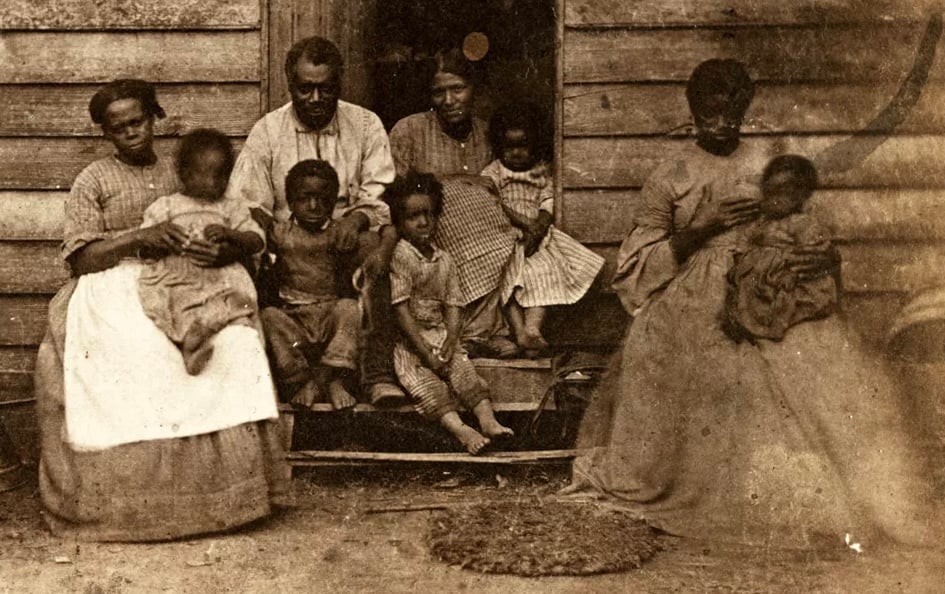
Enslaved family at the Gains' house in Hanover County-Virginia Library of Congress.
Historical pain deserves evidence, not mythology.
Accordingly, when segments of the Black American discourse on slavery compress a complex, global system into a single racial culprit, analytical precision is often sacrificed for emotional catharsis. This is not a moral failure; it is an interpretive one. Slavery was real, brutal, and foundational to modern wealth formation—but it was neither invented nor sustained by one race alone.
The historical record, as established by mainstream scholarship, demonstrates unequivocally that slavery and mass coercion were global institutions practiced by multiple civilizations across centuries.
Imperial Japan’s conquest of East Asia, for example, relied extensively on forced labor, sexual slavery, and mass killing in Korea, China, and Southeast Asia. Similarly, the Mongol conquests depopulated vast regions through systematic slaughter and coerced subjugation on an unprecedented scale.
The Ottoman Empire institutionalized enslavement and child conscription, while European empires fused racial slavery with colonial extraction and plantation economies across the Atlantic world.
In parallel, Arab-Islamic empires sustained long-running slave trades spanning Africa, the Mediterranean, and the Indian Ocean. Long before the Atlantic slave trade reached industrial scale, African and Arab networks were already capturing, transporting, and selling enslaved Africans across the Sahara, the Red Sea, and the Indian Ocean basins.
Historians such as Paul Lovejoy, John Ralph Willis, and Ronald Segal estimate that between 10 and 18 million Africans were exported through Islamic-world routes between the seventh and nineteenth centuries. Other scholars, including Murray Gordon, argue that when mortality during capture, transport, and forced labor is incorporated, total demographic loss may exceed 25–30 million. While the precise figures remain debated, the magnitude of the system is not.
This broader context does not absolve Europe; it completes the historical picture.
Noting this, it is also essential to highlight that African polities were structurally involved in these systems. The Kingdom of Dahomey, the Ashanti Empire, and coastal intermediaries in Senegambia and the Bight of Benin captured and sold rival populations as part of formal state revenue structures—facts documented by Africanist historians themselves.
Ergo, although Europeans expanded demand and racialized slavery in the Americas, they did not operate in a vacuum. Slavery endured because African suppliers, Arab traders, and European buyers formed an integrated global market.
Another uncomfortable but well-documented reality is that enslavers were not exclusively white.
According to the 1830 United States Census, approximately 3,775 free Black Americans owned enslaved people, collectively holding about 12,760 individuals in bondage. By 1860, historians such as Carter G. Woodson estimated that roughly 10–15% of free Black households in parts of the Deep South owned slaves. This does not indict Black Americans as a group; it indicts slavery as an institution so normalized that it corrupted anyone granted legal access to it.
Conversely, the scale of abolitionist action—led largely by white actors—is often minimized or erased in contemporary memory.
Following Britain’s abolition of the slave trade in 1807 and slavery itself in 1833, the British state devoted an estimated 2% of annual national income for decades to enforcing abolition.
Stemming from this policy, the Royal Navy’s West Africa Squadron seized more than 1,600 slave ships and liberated approximately 150,000 Africans through sustained maritime campaigns along the African coast.
Although comparable abolitionist movements emerged across Europe and the northern United States, their success was neither inevitable nor cost-free; rather, abolition constituted a politically contested and economically burdensome moral choice—one that, notably, did not materialize as an endogenous mass movement within continental African societies during the same period.
This fuller historical context is indispensable when evaluating a phrase frequently invoked in American discourse: that Black Americans “built America.”
In one clear and defensible sense, the claim is accurate. Enslaved Africans and their descendants generated immense wealth through coerced labor in agriculture, infrastructure, ports, and early industry, materially underwriting American economic development. To deny this is to deny the historical record.
The phrase becomes historically imprecise, however, when “built” is expanded to imply authorship of political institutions, constitutional design, or sovereign governance. Enslaved people were legally excluded from legislating, voting, or governing. Their contribution was foundational labor under coercion, not institutional authorship. Recognizing this distinction does not diminish injustice; it clarifies it. Precision strengthens the moral case rather than weakening it.
Hence, insisting on analytical clarity is not pedantry; it is an ethical responsibility. History told in full—rather than filtered through racialized blame—reduces resentment and resists political weaponization. Selective memory breeds selective grievance, obscuring the multiracial coalitions that ultimately dismantled slavery and replacing moral clarity with tribal accusation.
The academic record is not an adversary of justice; it is its foundation.
Slavery was sustained by many hands and dismantled by many hands too. Black history—and American history more broadly—is stronger, not weaker, when it is told in its entirety.
Related Topics
Related Posts