CEO of Time to Stand Up for Israel
Blaming Israel When Journalists Fall
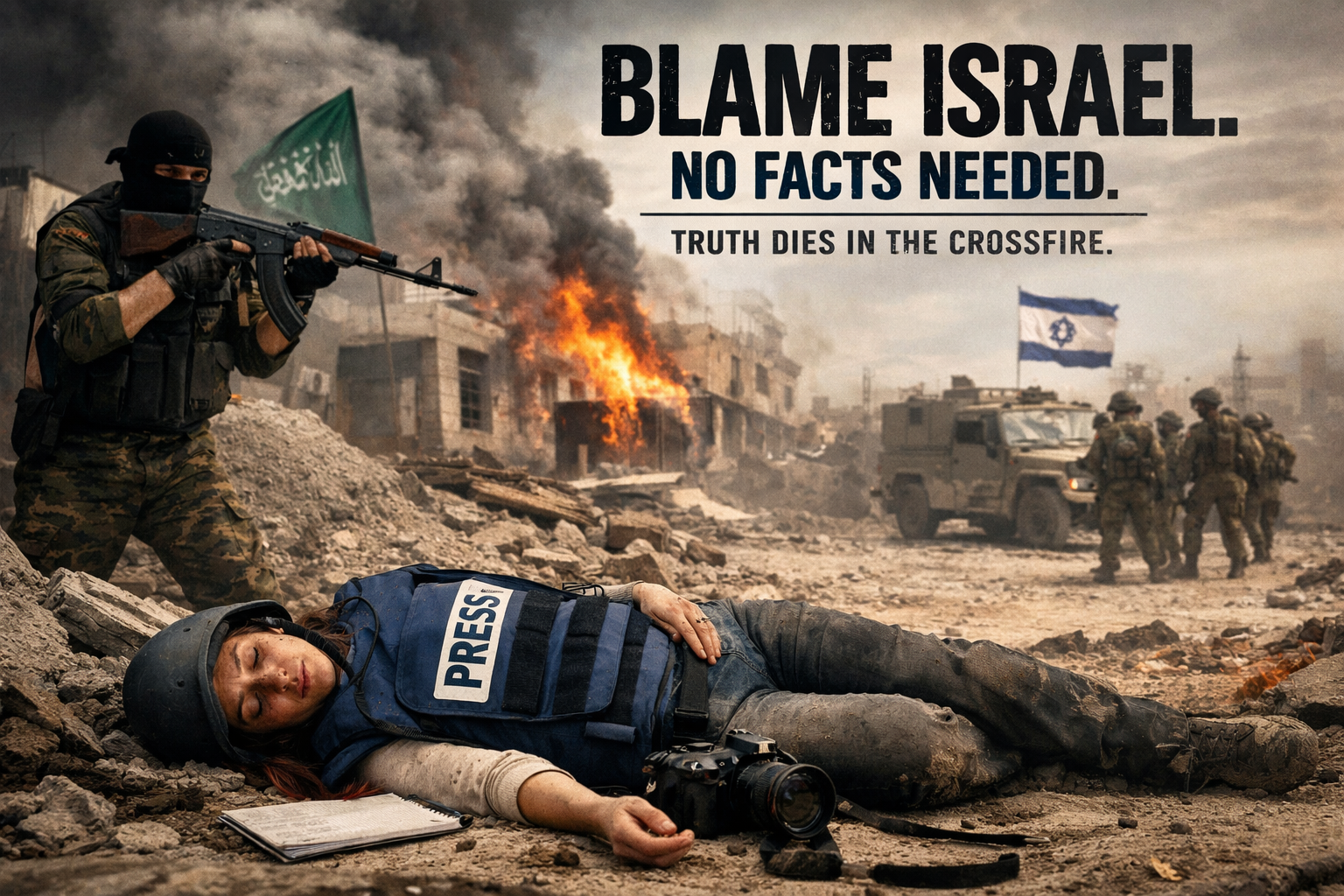
Photo Credits: Sabine Sterk (AI)
In today’s media landscape, a troubling pattern has emerged. Whenever a journalist is harmed in a war zone involving Israel, the immediate global reaction is to assign blame to Israel first and ask questions later. This reflexive judgment says more about international bias and the complexity of modern warfare than it does about the facts on the ground.
War reporting is inherently dangerous. Journalists enter active combat zones where bullets, rockets, and chaos do not distinguish between civilians, fighters, or media personnel. Under the Geneva Conventions, journalists are considered civilians and are protected as long as they do not take part in hostilities. This is an important legal safeguard. However, it is not a shield that makes them immune to harm, nor does it grant them a unique protected status like that of the Red Cross.
This distinction is today totally ignored in public discourse. A journalist in a war zone is not a neutral humanitarian actor. They are civilians operating in an environment where civilians tragically get hurt. When violence erupts, especially in dense urban combat like Gaza, the reality is that responsibility is not always clear in the moment.
A known example illustrates this dynamic. A female journalist was killed in Gaza during an active shooting situation. Almost immediately, headlines and commentary pointed fingers at Israel. Yet early reports and subsequent information indicated that Israeli forces were not even present in that specific neighborhood at the time. Despite this, the narrative had already taken hold globally. Retractions and clarifications rarely receive the same attention as the initial accusation.
This is not an isolated case. In multiple incidents over the past years, journalists have been caught in crossfire between Israeli forces and armed groups such as Hamas. Urban warfare, especially when militants operate within civilian populations, creates a fog of war where attribution is complex. Still, Israel is frequently singled out as the default culprit.
Another uncomfortable reality is rarely discussed. The title of journalist is not a legally regulated profession. Anyone can claim to be a journalist. In conflict zones, this becomes a serious issue. There have been documented cases where individuals working under media organizations were also affiliated with militant groups. When a person participates in hostilities, they lose their civilian protection under international law, regardless of their profession or title.
This is particularly relevant in discussions around certain media outlets operating in Gaza and Lebanon. Allegations and evidence have surfaced over the years suggesting that some individuals associated with media organizations have also been members of groups like Hamas or Hezbollah. If a person is actively involved in militant activity, they are no longer protected as a civilian. They become a legitimate military target under the laws of armed conflict.
This does not mean that every journalist in Gaza or any conflict zone is a militant. Far from it. Many are brave professionals risking their lives to report the truth. But it does mean that the blanket assumption that every casualty labeled as a journalist is an innocent civilian is not always accurate.
Israel, like any sovereign nation, has the right and obligation to defend its citizens. It operates within a complex legal and operational framework, often under intense scrutiny unmatched by any other country. Its military conducts investigations into incidents, including those involving journalists. While criticism is valid and necessary in any democracy, it should be grounded in facts, not assumptions.
The expectation that Israel can conduct military operations against groups embedded within civilian areas without any civilian casualties is unrealistic. No military in the world has achieved this standard. Yet Israel is judged as if it should.
If journalists want to maximize their safety, the principle is clear. Remain a journalist. Do not become part of the conflict. Do not align with militant groups. The moment that line is crossed, the protections afforded under international law no longer apply.
The tragedy of journalists killed in war should never be minimized. Each loss is significant and deserves investigation and accountability. But turning these tragedies into automatic indictments against Israel undermines both truth and justice.
In war, reality is complex. Narratives should be as well.
Related Topics
Related Posts