
Blockading Iran hoists it by its own petard
The blockade of Iran, declared by President Donald Trump at half past eleven in the morning Eastern Time this Sunday 12 April, is a very good thing. The idea has been proposed not only by John Solomon, editor in chief of the website Just the News, whose article of 11 April was linked to by Trump, but also by me, in a Substack article of 1 April. The President will not have had the opportunity to read what I wrote, partly because Ynetnews reneged on their commitment to publish my piece – a shame, but a minor detail compared to the great issues at hand.
Mr. Solomon proposed that the President “reprise his successful blockade strategy to choke an already teetering Iranian economy.” I proposed, and repeat here, a similar idea but with a wider reach:
the U.S. Navy can easily seize any Iranian tanker sailing on the open ocean. Such seizures would be as simple as the seizure of the Russian-flagged Bella 1 tanker by U.S. forces this January, since tankers have no capacity to resist. This measure should be used on a broad scale, and it would be quite reasonable to expand it into an operation rolling up the entire ‘shadow fleet’ of 1,484 tankers.
It would be better, as I had hoped, if the blockade was combined with “relentless attacks on the regime’s armed forces,” but instituting a blockade while maintaining the cease-fire carries its own advantage. Iran does not like the blockade imposed on it? It can return to war. Iran wants to stop Israel’s operations in Lebanon and have its frozen assets released by America? It can return to war. Iran’s favourite habit of threatening violence is now a danger to the regime more than it is to anyone else. Its weakness, reflected in its obvious reluctance to go through with its current threats, is there for all to see.
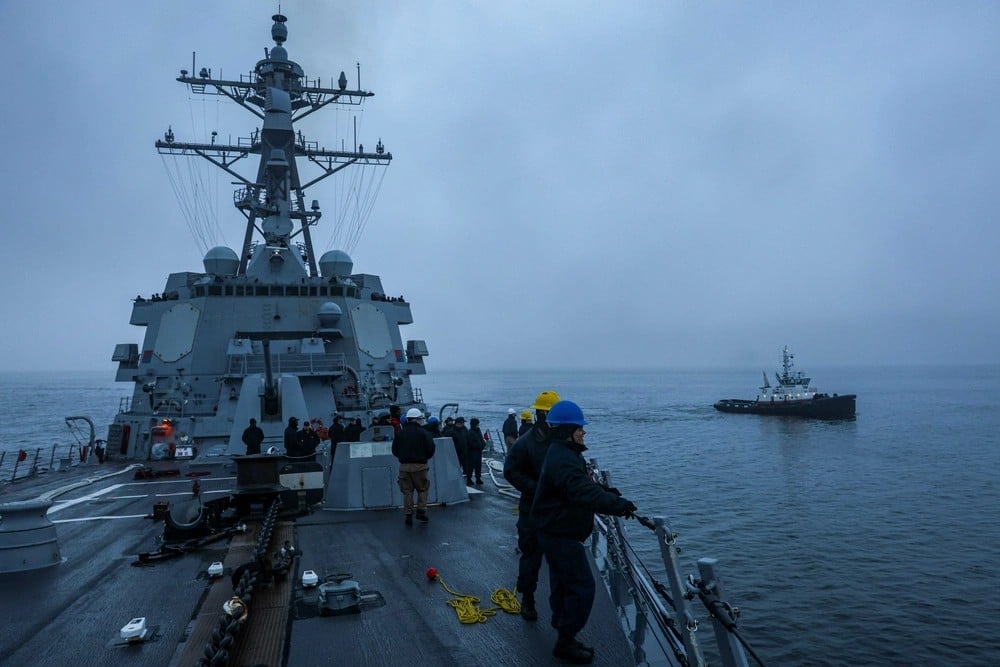
Sending two destroyers, the USS Michael Murphy (DDG-112) and USS Frank E. Petersen Jr. (DDG-121) to begin the task of clearing the Strait of Hormuz is a helpful addition to the imposed blockade. This is not for technical reasons. The capacity of these ships to engage in mine countermeasures tasks, the modern military term for minesweeping, is limited. Their AN/SQQ-89A(V)15 Anti-Submarine Warfare (ASW) Combat System can in fact detect “floating, tethered, or bottom-attached mines,” but the impressively large AN/WLD-1 Remote Minehunting System (RMS) can be carried only by six U.S. Navy destroyers, not including either the Murphy or the Petersen. That system, too, can only identify mines, rather than destroy them. The destroyers are more useful for an entirely different task.
The presence of the warships has already caused the Iranians to issue a “last warning,” in the style of Maoist Chinese “serious warnings” of the 1960s, to which the U.S. Navy quickly learned to attach no special significance. The Iranian Revolutionary Guards have a choice either to engage in empty bluster, or to return to war. Let them choose, while Iran’s economy chokes and America’s oil export volumes reach new records. It is not a coincidence that Trump wrote about the empty tankers heading for American shores the day before he announced the blockade of Iran.
—
If you found what you read above interesting and substantive, do read more and subscribe to my Substack, The New World Crisis.