
Blood On Their Hands
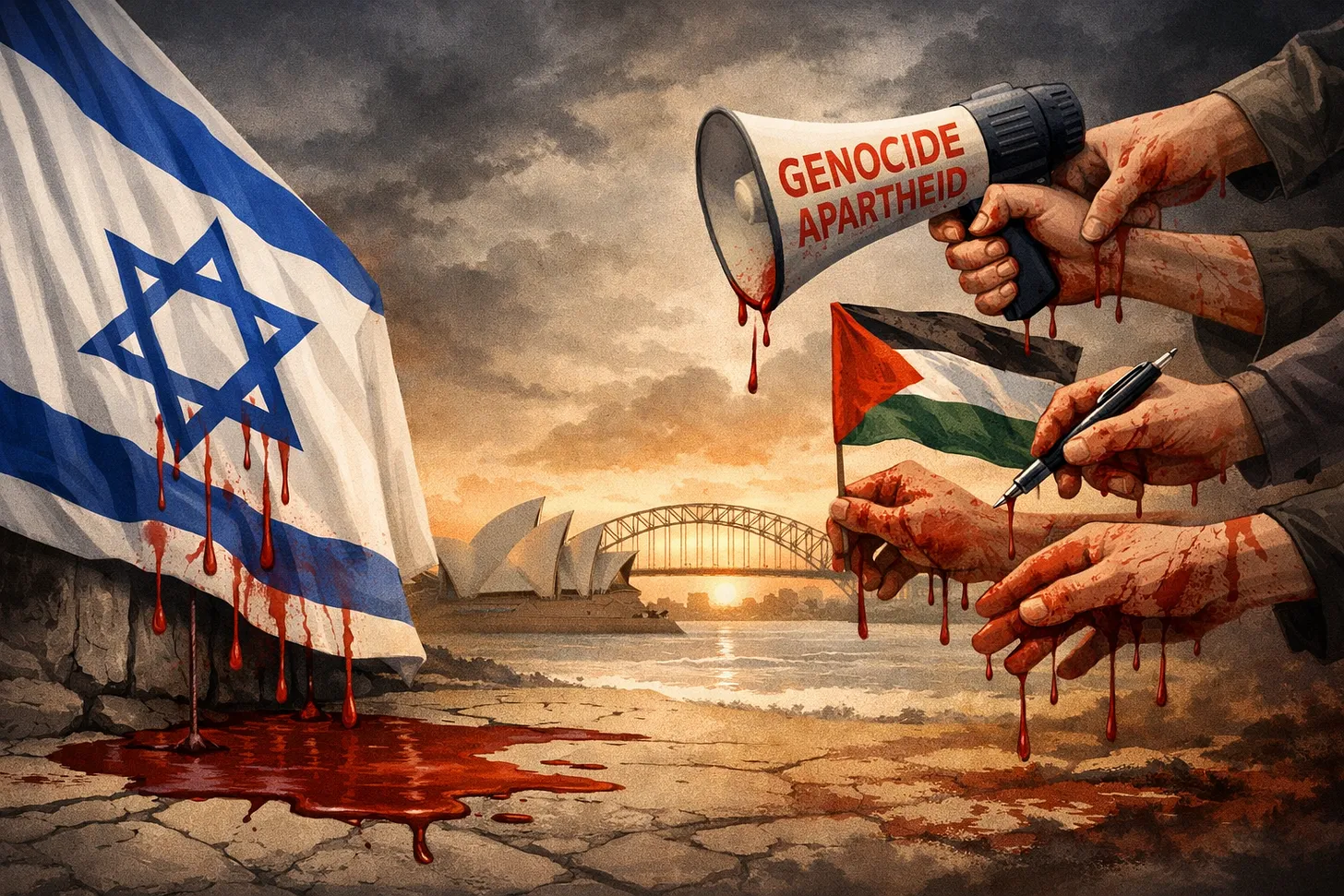
Bondi Beach is not Israel.
It is not Gaza.
It is not a checkpoint, a settlement, or a war zone.
It is a public beach in Australia. And Jews were attacked there because they were Jews.
In fairness, much of the initial reporting was clear and unambiguous. Political leaders and law enforcement described the attack for what it was: antisemitic violence. Condemnations were swift. The language, at least at first, was direct. No one seriously disputed that Jews had been targeted as Jews.
But even in these early hours, a familiar reflex began to surface—not always loudly, not always maliciously, but predictably. The conversation widened almost immediately. The focus drifted from antisemitism itself to broader themes: social cohesion, geopolitical grievance, the danger of “division,” the need to understand anger and context. Some coverage folded the attack into a generalized climate of hate or unrest. Some responses pivoted quickly to foreign policy, to Gaza, to Israel—before the blood on the sand had even dried.
This is not yet the grotesque justification that often follows such attacks. It is something subtler and more dangerous: the impulse to explain before absorbing, to contextualize before condemning, to soften moral clarity with atmosphere. That instinct did not begin at Bondi Beach. It arrived there fully formed.
This violence did not come out of nowhere. It was not the result of “heightened tensions” or an unfortunate spillover of a distant war. It followed months—years, really—of rhetorical conditioning in which violence against Jews was normalized, rationalized, and laundered into legitimacy by institutions that now insist they bear no responsibility.
They do. They all have Jewish blood on their hands.
Long before the slogans reached the streets, the moral groundwork had already been laid. The philosophical inversion that now defines so much Western discourse on Israel and Jews did not originate with campus radicals alone. It was incubated by influential thinkers who reframed moral agency itself—casting history as destiny, power as guilt, and Jewish sovereignty as original sin.
Few figures have been more influential in this regard than Ta-Nehisi Coates. A darling of the political left, Coates did not call for violence, but his framing helped mainstream a worldview in which Jews—particularly Israeli Jews—are rendered almost exclusively as avatars of power, while Palestinians are treated as actors without agency. In such a framework, violence is never judged on its own terms. It is explained, contextualized, and ultimately excused.
From that intellectual soil grew a more aggressive strain of delegitimization—one that insists Israel is not merely wrong, but illegitimate. Not merely flawed, but criminal. Not merely engaged in a tragic war, but committing “genocide” and enforcing “apartheid.”
These words are not descriptive. They are accusatory by design.
They are promoted not only by fringe activists, but by mainstream figures and organizations: by Amnesty International and Human Rights Watch, which have applied uniquely expansive definitions to Israel while ignoring far more blatant atrocities elsewhere; by UN special rapporteurs whose fixation on Israel borders on obsession; by prominent academics, journalists, and progressive politicians who repeat these charges with confidence, and without consequence.
The purpose of this language is not critique. It is delegitimization.
To accuse a Jewish state of genocide is to invoke the ultimate moral crime in modern history and pin it, recklessly, on the world’s only Jewish nation. To brand Israel as apartheid is to equate Jewish self-determination with racial supremacy. These claims are not merely disputed; they are structurally designed to strip Israel of moral standing and to collapse the distinction between Israeli policy and Jewish identity itself.
And that collapse has consequences.
When Israel is framed as a genocidal entity, violence against Israelis becomes resistance. When Israel is framed as an apartheid state, Jews everywhere become representatives of a criminal regime. Diaspora Jews, be they students, families, or beachgoers, are no longer civilians. They are symbols. Targets. Proxies.
This is how rhetoric migrates from op-eds to protest chants, from faculty lounges to street violence.
The mainstream media bears responsibility for clearing the fog through which this ideology traveled. Outlets like The New York Times and The Guardian repeatedly treated antisemitic violence as a reaction rather than a crime, something to be explained, contextualized, and softened rather than named. Jewish victims were anonymized. Jewish fear was framed as political posture. Every act of violence arrived with a perfunctory intro clause: after months of war… amid rising anger… following Israeli actions…
Cause and effect were inverted. Incitement became response. Murder became commentary.
Social media accelerated the process. Platforms like TikTok, Instagram, and X amplified content praising “resistance,” flattening morality into engagement metrics. Videos celebrating Hamas circulated freely while Jewish users reporting threats were told the content did not violate community standards. Only after Jews were attacked did platforms issue carefully worded condemnations without naming the ideology they had allowed to metastasize.
Political leaders, particularly on parts of the left, failed to draw moral red lines. Some repeated the language of genocide and apartheid themselves. Others insisted that condemning antisemitism must be paired with condemning Israel, as though Jewish safety were contingent on ideological symmetry. When Jews warned where this was heading, they were accused of bad faith.
Universities compounded the failure. Prestigious institutions such as Harvard, Columbia, NYU, and their counterparts in the UK and Australia, hid behind free-speech absolutism while Jewish students were harassed and threatened. Faculty statements reframed mass murder as “decolonial resistance.” Administrators who discipline swiftly in other contexts suddenly discovered paralysis.
This was not powerlessness. It was will.
At this point, defenders retreat to inevitability. Speech is messy. Emotions run hot. Violence is the work of lone actors. No one could have known.
Bullshit.
In his essay “Blood on Their Hands,” Andrew Fox describes a chain of permission—the process by which violence is not ordered, but prepared. First through euphemism. Then moral inversion. Then abstraction. Murder becomes “context.” Victims become symbols of power. Agency dissolves into theory. Once violence is justified in principle, Fox argues, someone will eventually apply it in practice.
Not necessarily in Gaza.
Not necessarily in Israel.
But wherever Jews are visible, accessible, and symbolically available.
Bondi Beach fits that pattern with devastating precision.
The attacker bears responsibility for his actions. But he did not invent the moral universe in which those actions felt defensible. That universe was constructed—by intellectuals who erased agency, by activists who delegitimized a Jewish state, by journalists who inverted cause and effect, and by institutions that taught an entire generation that Jewish power negates Jewish innocence.
This is why claims of surprise ring hollow. Jews warned what “globalize the intifada”meant. They warned what “genocide” and “apartheid” rhetoric would unleash. They warned that history was repeating itself, only faster this time.
They were dismissed as hysterical. As manipulative. As obstacles to justice.
Jewish blood is not symbolic.
It is not theoretical.
And it is not absolved by intent.
It is the consequence of permission.
And as Fox makes plain, blood does not only stain the hands of those who wield weapons. It stains the hands of those who built the moral architecture that made those weapons feel justified.
Bondi Beach was not the beginning.
It was the moment the chain was complete—and the bill came due.