
Book review – Between Torah and Derech Eretz
A few months ago, a collector from Israel went around with the attached tzedakah card. The card described an impoverished family whose children were sleeping on the floor. It then explained that the father learns Torah all day, resulting in his son being forced to leave Israel to raise funds for the family.
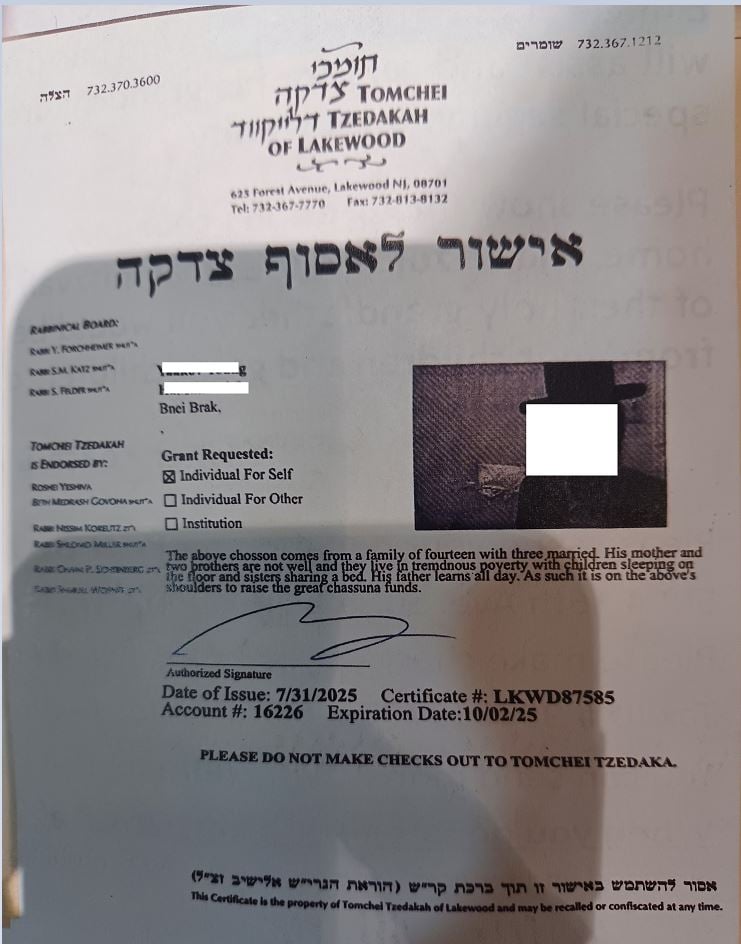
The question is uncomfortable: Does this describe a deep man of faith who has devoted himself completely to Torah, or a father who has abandoned his family and responsibilities, including those detailed in his kesubah?
That is one of the fundamental questions that Rafael Dembovsky attempts to address in Between Torah and Derech Eretz: A Hashkafic and Halachic Analysis of the Torah im Derech Eretz and Torah Only Viewpoints (Mosaica Press).
Few questions in contemporary Orthodox Jewish life are as consequential, or as contentious, as the proper relationship between Torah study and engagement with the wider world. Should a Jew devote himself as fully as possible to Torah and minimize involvement with secular society? Or should Torah be combined with education, a profession, and meaningful participation in the broader world?
While this is a complicated question with profound implications, it is not new. As Dembovsky demonstrates, its roots go back to the Talmud.
In Berakhot 35b, the Gemara recounts the famous dispute between Rabbi Yishmael and Rabbi Shimon bar Yochai. The Gemara discusses the apparent contradiction between “This book of Torah shall not depart from your mouth” (Joshua 1:8) and “You shall gather in your grain” (Deuteronomy 11:14).
Rabbi Yishmael understands these verses as establishing a model in which a person combines Torah study with a worldly occupation. Rabbi Shimon bar Yochai takes a more radical position: If a person spends his time plowing, sowing, and harvesting, what will happen to his Torah? If the Jewish people do God’s will, he argues, others can perform their work; if they do not, they will have to do it themselves.
The Gemara then records that many followed Rabbi Yishmael’s approach and succeeded, while those who followed Rabbi Shimon bar Yochai’s approach did not succeed. That would seemingly settle the debate. But as anyone who has learned a few chapters of Talmud knows, it is rarely that simple.
One of the book’s central strengths is its recognition that this is not merely a debate about whether someone should go to college and work for a living or remain in yeshiva and allow others to provide for him. The underlying issue is much deeper: What does Judaism consider the ideal life of a Jew? How should a person balance spiritual aspiration with the realities of living in a physical world? And perhaps most importantly, is engagement with the world merely a concession to practical necessity, or can it itself be part of an authentic Torah life?
Dembovsky approaches these questions through the Talmud and later rabbinic authorities. Along the way, he examines fundamental aspects of Jewish life, including Torah study, secular studies, and the relationship between bitachon and hishtadlus.
The term used in the title, Torah im Derech Eretz, is often associated with the philosophy of Rav Samson Raphael Hirsch. But the broader concept of derech eretz has a longer, more complicated history in rabbinic literature.
So what exactly is derech eretz? The definitions range from earning a livelihood and behaving appropriately to participating in society and engaging with broader worldly knowledge.
Rav Hirsch famously developed Torah im Derech Eretz into a comprehensive philosophy of Orthodox Jewish life, arguing that Torah should guide a Jew’s engagement with the world rather than remain confined to the study hall.
That makes the book particularly timely. The question it addresses is not confined to nineteenth-century Germany or twenty-first-century America. It continues to play out in Jewish communities around the world, in debates over education, higher education, professional careers, military and national service, economic responsibility, and the role of secular knowledge.
Even within communities that strongly favor full-time Torah study, questions of livelihood and worldly responsibility remain unavoidable. The Talmudic debate between Rabbi Yishmael and Rabbi Shimon bar Yochai, for example, has long served as a foundational source for discussions about combining Torah study with work.
One opponent of Rav Hirsch’s philosophy was Rav Baruch Ber Leibowitz. While he had enormous respect for Rav Hirsch personally as a great Torah scholar and tzaddik, he strongly disagreed with, or at least rejected as a general Torah ideal, Rav Hirsch’s Torah im Derech Eretz educational philosophy.
Dembovsky raises an intriguing possibility regarding this opposition: Rav Hirsch wrote primarily in German, while Rav Baruch Ber lived in Eastern Europe. It is therefore possible that Rav Baruch Ber was unable to read Rav Hirsch’s writings, or had limited access to them, and may have had to rely on the testimony of others. If so, some opposition to Rav Hirsch’s philosophy may have rested on an incomplete understanding of what Rav Hirsch actually taught.
The broader point matters. Intellectual and ideological disagreements can sometimes be intensified when people encounter a position indirectly, through descriptions or criticisms provided by others rather than through the original writings themselves. The recent Slifkin affair is a textbook example.
The book does not treat the larger debate as a contest in which one side possesses all the answers. Instead, Dembovsky seeks to understand the intellectual and spiritual logic behind both positions. That is an important contribution in an era when discussions of Orthodox ideology can easily become exercises in labeling: Modern Orthodox, yeshivish, Haredi, Torah im Derech Eretz, Torah Only, and more.
Ultimately, perhaps the book’s greatest value is that it treats disagreement itself as worthy of serious study. Rather than asking only, “Which side is right?” Dembovsky asks readers to understand why intelligent, sincere Torah Jews have reached different conclusions about the ideal relationship between Torah and the world.
Chapter 6 is particularly fascinating. It examines the relationship between the ghetto and emancipation and provides a powerful historical case study of the competing approaches.
For much of the second millennium, European Jewry faced restrictions designed to isolate them from wider society. Jews were forced to wear certain types of clothing, limited in the professions they could enter, and required to live in ghettos. While Fiddler on the Roof may have romanticized aspects of Jewish life during this period, the reality was often far harsher, an experience that few of us would want to live through.
These circumstances contributed, in part, to the fascinating and unusually sharp rabbinic debate surrounding Napoleon’s invasion of Russia in 1812. The question was not simply political: Which ruler would ultimately be better for the Jewish people’s spiritual future?
Rav Shneur Zalman of Liadi famously supported Tsar Alexander I. He clearly recognized that life under the Tsar was brutal, but he believed that Napoleon’s apparent liberalism and support for emancipation posed far greater spiritual danger. Napoleon might give Jews greater wealth, civil rights, and freedom, but Rav Shneur Zalman feared that this freedom would lead to assimilation and weaken Jewish attachment to Torah.
Several major Chassidic leaders took the opposite position and favored Napoleon, including the Chozeh of Lublin, the Maggid of Kozhnitz, and the Yehudi HaKadosh.
As the book details, Rav Hirsch similarly supported emancipation. His vision was that Judaism should not be confined behind ghetto walls; rather, Torah should enable the Jewish people to engage with the broader world and realize their spiritual potential within it.
This historical episode illustrates one of the book’s most important themes. The question is not simply whether freedom, secular education, professional life, or engagement with the broader society are inherently good or bad. Rather, the same development can present different spiritual opportunities and dangers depending on one’s circumstances, priorities, and understanding of Torah.
For anyone interested in the history of Torah im Derech Eretz, contemporary debates about Torah study and professional life, or simply the larger question of what it means to live a complete Torah life, Between Torah and Derech Eretz is a substantial and worthwhile contribution.
It is not a book designed merely to settle an argument. It is a book designed to make the reader think more carefully about the argument itself, and about the assumptions that underline both sides.
That may ultimately be its greatest contribution. In a Jewish world increasingly divided by ideological labels, Dembovsky reminds us that serious disagreements among Torah Jews deserve something better than slogans.
As to slogans, Rav Yehuda Amital was deeply suspicious of sisma’ot, religious slogans and clichés, especially when they reduced complicated religious ideas to simplistic formulas. One of his most pointed statements came in the aftermath of the Rabin assassination, where he noted that “We’ve raised a generation on slogans and clichés. Our youth is incapable of dealing with a complex reality.”
This was a major theme in Rav Amital’s thinking. He believed that Judaism demands moral seriousness, intellectual honesty, and the ability to live with complexity. Slogans can be attractive precisely because they eliminate the need to think.
Dembovsky has articulately written an excellent work of intellectual honesty and a willingness to understand why sincere and learned people can look at the same Torah and the same world and arrive at very different conclusions. For those who want a serious look without simplistic slogans, this is a worthwhile read.