
Book review: Emotional Landscapes in Tanakh
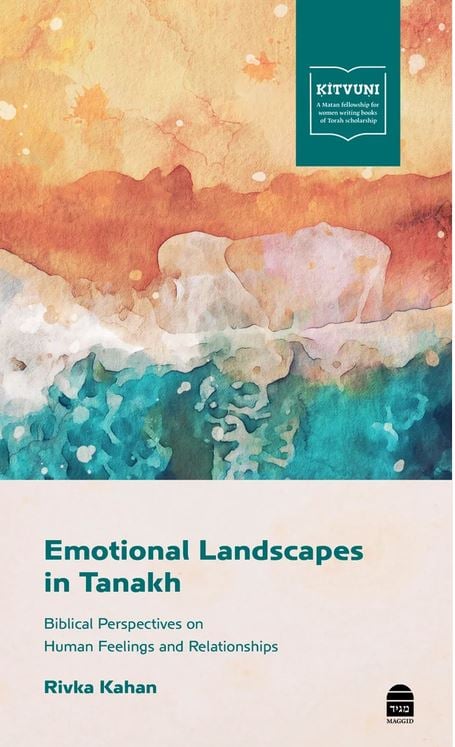
When I first saw the title Emotional Landscapes in Tanakh: Biblical Perspectives on Human Feelings and Relationships (Maggid Books), I was not sure what to expect. Feelings, relationships, and the language of emotional life can seem distinctly modern topics.
Tanakh, by contrast, is often approached through its narratives, laws, theology, and enduring moral teachings. Would examining emotions add something substantial to the study of biblical texts, or would it impose contemporary categories on a very different world?
Author Rivka Kahan makes a persuasive case here that feelings and relationships are, in fact, central to the biblical narrative. She doesn’t attempt to make Tanakh sound modern. Rather, she invites the reader to pay closer attention to the human experiences that are already present in its stories. This includes the inner lives of biblical personalities, the motivations behind their choices, the complicated relationships that shape their actions, and more.
Her approach significantly enriches the way we read familiar passages. A biblical narrative may move quickly from one event to another, but the people within it are not merely figures carrying the plot forward. They are individuals whose decisions take place in an emotional and relational world.
Looking carefully at that dimension (which a cursory read often misses) encourages readers to pause over what a character may be feeling, what motivates a response, and how relationships influence the course of events. It also reminds us that concise biblical accounts contain considerable human complexity.
Kahan is particularly well positioned to explore this subject. She teaches at Midreshet Tehillah in Israel and is a fellow in the Kitvuni Fellowship at Matan. Her background combines substantial classroom teaching with serious academic training in Tanakh. That combination matters: teaching requires an ability to make texts accessible and engaging, while academic study demands care, discipline, and close attention to the text. The meeting of those strengths creates a book that is both thoughtful and readable.
Her approach encourages a reader to move beyond the straightforward narrative without losing sight of the narrative itself. The goal is not to replace the plain account with speculation, nor to assume that every character’s psychology can be reconstructed with certainty. It is to recognize that the text offers many opportunities to consider human motivation and emotional complexity, and to approach them with sensitivity and intellectual care.
This is a challenging endeavor, as attempts to reconstruct the psychology of biblical personalities have often produced more speculation than insight. Perhaps one of the more controversial examples is Samuel Levine’s book Was Yosef on the Spectrum?: Understanding Joseph Through Torah, Midrash, and Classical Jewish Sources.
In this work, Levine considers whether Yosef exhibited characteristics associated with Autism Spectrum Disorder (ASD), using a contemporary psychological framework to explain aspects of Yosef’s behavior and interpersonal relationships that might otherwise appear puzzling or counterintuitive.
However, this approach has a fundamental problem. Although Levine is an accomplished professor of law and scholar of Jewish law, his academic credentials are in law and rabbinic studies, not psychology or clinical practice. His published academic qualifications do not indicate formal training in psychology, psychiatry, or the clinical assessment of autism.
Consequently, he ventures into a specialized discipline in which he has not established professional expertise. The result is an analysis that relies too heavily on speculative psychological interpretations and attempts to impose modern diagnostic categories on a biblical personality based on inherently limited textual evidence. Whatever the intellectual appeal of the exercise, the conclusions are not sufficiently grounded in either clinical methodology or the available biblical sources.
Fortunately, Kahan avoids this methodological pitfall. Rather than imposing contemporary psychological frameworks on biblical personalities or venturing into disciplines beyond her expertise, she approaches the subject with appropriate scholarly restraint.
Her analysis is firmly grounded in the biblical text and its classical commentators, and she carefully distinguishes what the sources establish from what might merely be conjectured. The result is a book that is intellectually engaging and genuinely insightful without relying on speculative psychological interpretations.
The book opens by exploring the relationship between fear and faith. A common perception is that a person of faith, particularly one of the patriarchs, should be free from fear. However, she cites Abarbanel, who argues that fear is a natural and instinctive human response that cannot simply be willed away. More importantly, fear, like other emotions, can be channeled into strengthening one’s relationship with God. Indeed, Abarbanel suggests that without fear, a person’s relationship with God would be diminished, lacking depth and substance.
Kahan’s perspective also has value for readers who have studied Tanakh for many years. Familiarity can breed complacency, making even a profound story feel settled. After reading Biblical narrative for decades, we know what happened, who the central figures were, and what lesson is commonly drawn.
This is an age-old issue, with Rashi quoting Sifrei Devarim on Devarim 26:16: “Every day they should be new in your eyes, as though you were commanded regarding them on that very day.”
The underlying message is beautiful: Torah learning should never become routine or mechanical. Even when studying the same passage for the hundredth time, one should approach it with the excitement and freshness of discovering it for the first time.
An emotional reading can reopen the discussion. It asks us to consider not only what a person did, but the relationships and feelings that may help us understand the action’s significance. In doing so, it can make well-known narratives feel newly relevant without diminishing their timeless character.
Kahan skillfully demonstrates the emotional depth woven throughout the biblical text. From Job’s anguish as he grapples with the problem of theodicy, to Yosef’s apparent struggle to forgive his brothers, to Aharon’s silence in the face of his sons’ deaths, the biblical narratives offer a remarkably rich and nuanced portrayal of the human emotional experience.
The book’s title may initially suggest a contemporary framework, but the questions it raises are hardly new. Human beings have always experienced love, conflict, loyalty, disappointment, fear, ambition, and the tensions that arise in relationships. Tanakh speaks to those realities, even when it does not describe them in the vocabulary of modern psychology. Kahan’s subject offers readers another way to notice the depth of that human material.
This is an insightful read for those who enjoy looking beyond the basic sequence of biblical events and exploring the psychology, motivations, and emotional complexity of biblical personalities. It invites readers to approach familiar texts with renewed attention, to see not only the events being described, but also the human beings living through them.