
Book review – Ezra-Nehemiah: Retrograde Revolution
For many years, my sister-in-law Jane has spent parts of her summer at the Matan Women’s Institute for Torah Studies (Matan, an acronym for Machon Torani l’Nashim), a Jerusalem-based midrasha.
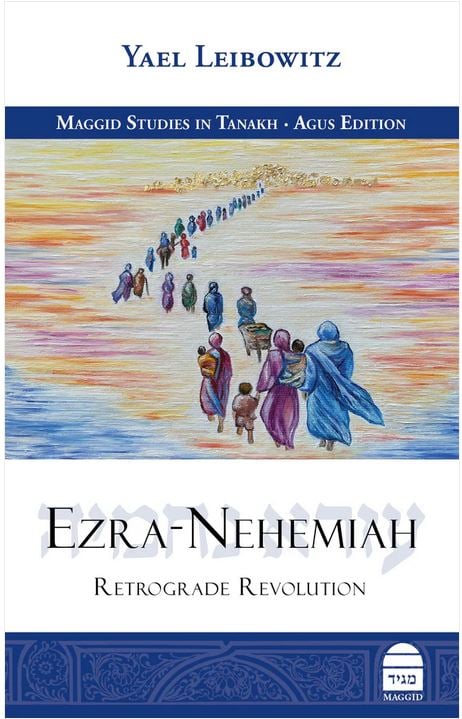
Yael Leibowitz, a teacher at Matan, recently published her book Ezra-Nehemiah: Retrograde Revolution (Maggid Books). After reading it, it becomes clear why Jane values her time at Matan so highly.
The Kitvuni Fellowship, part of Matan, aims to promote the publication of high-level Torah scholarship by women. Leibowitz is a fellow in the program, and hers is the first English book to be published, with the others being in Hebrew.
Ezra-Nehemiah was originally one book, but was later divided into two. The book of Ezra details the Jewish return to Israel in the 6th and 5th centuries BCE, after the 70-year Babylonian exile. While permission was granted to build the second Temple, the process and construction were not smooth sailing by any stretch of the imagination.
Ezra the scribe was the leader of the generation, and one of the most well-known challenges he faced was dealing with the many intermarried Jewish men.
The book of Nehemiah is a first-person account by Nehemiah, the cupbearer to the king of Persia. He returned to Jerusalem to become the governor of Judah and led the rebuilding of Jerusalem’s walls. He, along with Ezra, was instrumental in revitalizing Judaism in the aftermath of the destruction of the First Temple.
In this insightful book, Leibowitz analyzes how Ezra-Nehemiah shapes our understanding of Israel’s restoration. She identifies the challenges that arose from the unique circumstances in which Ezra-Nehemiah was written and how the historical actors of the time addressed them.
Many people assume that the books of Ezra-Nehemiah, along with other books of Tanach, are in part historical works. Leibowitz writes that not only is Tanach not a work of science or psychology, but despite its façade, it is not a work of history either.
She observed that, as we think of it today, history writing did not exist as such in the ancient world. The way we think of historical writing, as an attempt to record facts in a coherent, objective, and comprehensive way for posterity, did not really begin until the Greek historian Herodotus, of the 5th century BCE. Until then, wars and major events might have been recorded, but the expectations were very different. And to a large part, history comes down to Napoleon’s famous remark, “What is history but a fable agreed upon?
So what is the function of works like Ezra-Nehemiah? To answer this, she writes that Tanach enables us to make sense of our individual place within society and of that society’s place in relation to God. Furthermore, the Tanach contains wisdom literature that seeks to answer perennial questions about suffering, loss, love, fulfilment, and much more.
In 1958, Prime Minister David Ben-Gurion sent a letter to fifty-one Jewish intellectuals asking them to define Jewish identity. The “who is a Jew?” question was not new; Ezra faced it in his era.
Cyrus permitted the Jews to return, but only some went back to Israel. One result was the need to redefine what it meant to belong to the nation of Israel. Leibowitz writes that to understand why a partial return would provoke such a need, one must understand what “being an Israelite” meant in the pre-exilic period. The terms “Israelite,” “Judean,” and “Jew” evolved in complex and important ways, as did the distinctions between nation, ethnos, and religion.
The events of Ezra-Nehemiah occurred about 2,600 years ago, yet their themes and struggles are strikingly similar to those of today. Ezra-Nehemiah, though one of many books in Tanach, might be the most important to read now.
Ezra-Nehemiah comprises 23 chapters. Rather than providing a line-by-line commentary, the book examines key themes and lessons.
A substantial portion of Ezra-Nehemiah concerns the construction of boundaries around the Judean community. Zerubabbel erects a boundary between the community of Temple builders and those beyond it. Through his intermarriage ban, Ezra reinforces the boundary, shielding Judean families and, by extension, the entire community from foreign influences.
As for Nehemiah, one of his first actions upon reaching Jerusalem was to repair the city’s broken walls. It is an important task both from a practical perspective and symbolically.
As to the title of this book, it at first seems to be a contradiction in terms. Retrograde means moving backward, while revolution means a new system. While Ezra and Nehemiah were innovators, neither of them nor the society around them recognized them as such. The greatness of Ezra and Nehemiah lay in their ability to effect a retrograde revolution.
In some ways, this is reminiscent of the story in Menahot 29a. In that narrative, Moshe finds himself at the back of Rabbi Akiva’s study hall, where Rabbi Akiva is explaining the Torah in a manner so incomprehensible to Moshe that he becomes weak. However, Moshe is revitalized when he learns that Rabbi Akiva’s learning comes from Sinai.
The message is that Rabbi Akiva’s new teachings simply extend the Torah from Sinai. There is no contradiction in newness when it comes from the old. The retrograde revolution of Ezra and Nehemiah allowed Jews to return and restart.
When discussing the flexibility in the Oral Law, Rabbi Mordechai Becher quoted the late Rav Nota Schiller, Rosh Yeshiva of Ohr Somayach, who said, “We change enough to stay the same.” This is a similar observation of retrograde revolution.
The current situation in Israel is an example of retrograde without revolution. Many in the Charedi sector are stuck in a past that no longer exists. Leaders who would follow the example of Ezra or Nehemiah would do a lot for the nation.
Rabbi Joseph Soloveitchik said that if he were to add to Maimonides’ 13 Principles of Faith, his 14th principle would be that the values and legal constructs of the Torah are timeless and have absolute relevance to every generation and location.
Leibowitz articulately shows how it’s not just the values and legal constructs of the Torah that are timeless, but also what it means to be a great leader. Ezra and Nehemiah lived during one of the most turbulent times in Jewish history. But, to a degree, it’s hard to find a time in Jewish history that wasn’t turbulent. She shows how Ezra, as a religious leader, and Nehemiah, as a lay leader, accomplished what the people needed at the national level.
Composer Gustav Mahler observed that “tradition is not the worship of ashes, but the preservation of fire. Leibowitz has written a most engaging work showing what it takes to preserve that religious fire.