Book review: Renewing the Old, Sanctifying the New
Visual acuity refers to the sharpness or clarity of vision. It measures how well a person can see fine details at a specific distance. Usually, it is measured at 20 feet via the Snellen eye chart (fun fact – since its inception in 1862, more copies of the Snellen Chart have been sold in the United States than any other poster), which measures visual acuity.
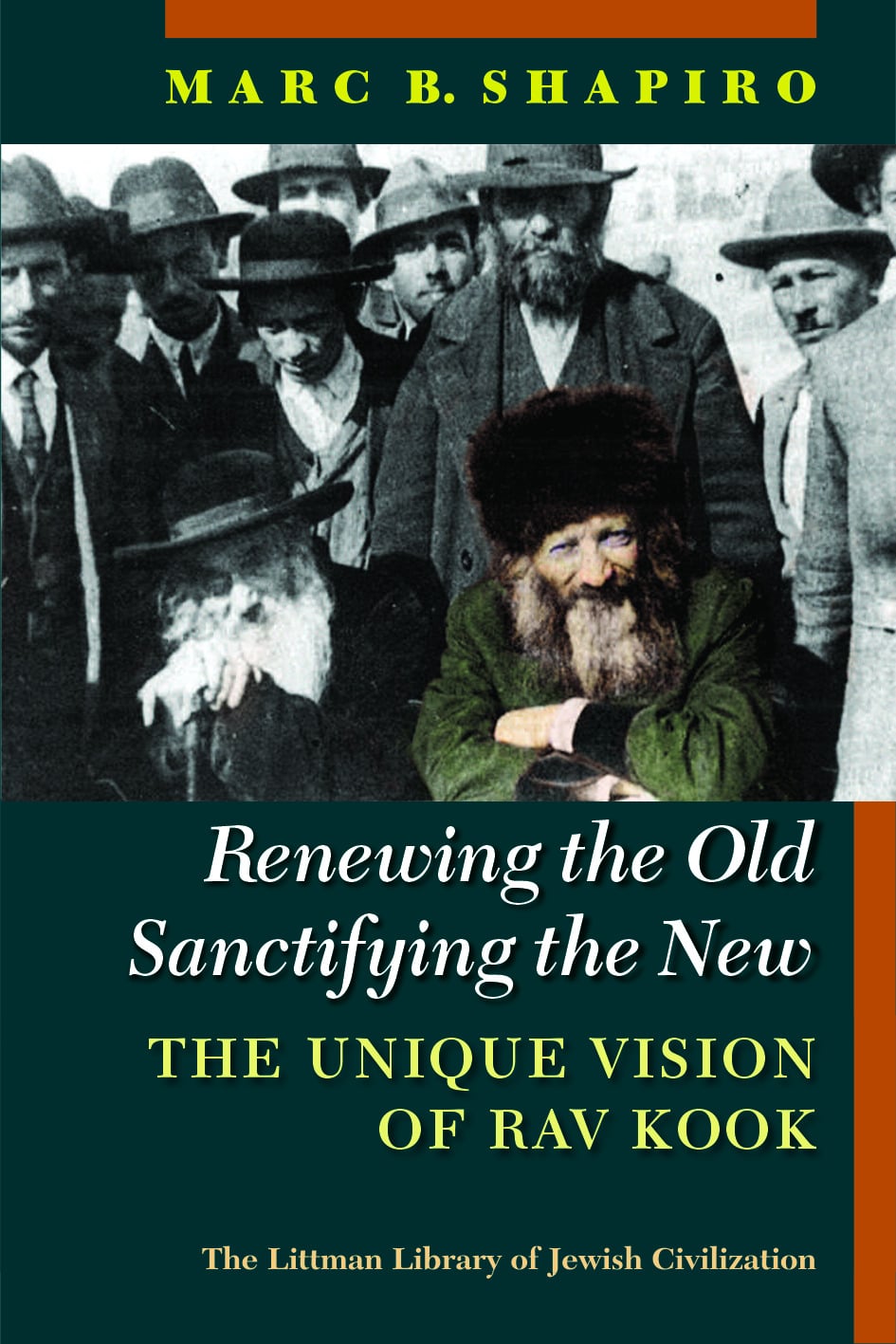
The notion of vision in the title of Renewing the Old, Sanctifying the New: The Unique Vision of Rav Kook by Rabbi Dr. Marc Shapiro (Littman Library of Jewish Civilization) is particularly relevant to Rav Kook. As Shapiro writes in this excellent book, Rav Kook saw with his perfect spiritual vision Jewish history in its totality.
Shapiro opens with a simple question: What was it about Rav Kook that allowed him to be so original? Born in 1865 in what is today Latvia, he had a traditional upbringing and, like many of the brightest students of the time, went to the prestigious Volozhin Yeshiva. Often called the Harvard of yeshivas, the use of Harvard now should not be laudatory, but somewhat pejorative.
Shapiro’s intention in the book is to analyze select passages in the writings of Rav Kook and to discuss the broader implications of his ideas.
For those who have never read Rav Kook and don’t understand why there is such excitement every time a new work of his is published, Shapiro suggests the reader take a volume of Rav Kook’s writings and sit with it for an hour, just going through it page by page. Odds are that the reader will be hooked. The originality and the power of his writings are breathtaking.
It’s not like Rav Kook lived in a physical environment that would enchant his soul, like the Alps of Switzerland, the Grand Canyon, or the stunning fjords of Iceland. Born in Griva, then part of the Russian Empire, this is an area that was black and white. Colored fruits were rarely seen there. Yet it is out of this bland horizon Rav Kook’s new world view found its formulation.
As to the idea of Rav Kook’s vision, he wrote over 120 years ago in Linevukhei HaDor that the single-minded focus on the study of Talmud and halacha, which is beneficial for some people, has dangerous consequences for others. He saw that as a significant reason for the rejection of traditional Judaism among the young and called for a re-evaluation of priorities in traditional Judaism.
Rav Kook was a Talmudist par excellence, yet he understood clearly that expecting every yeshiva student to spend their day studying text in a foreign language, with no initial semblance of organization, a complete lack of modern punctuation, and more, might not exactly light their spiritual fire. Jump to 2025, and Rav Kook’s prescient observation has been, sadly, validated.
The chapter on The Problem of Heresy is particularly interesting. Often called a heretic himself by the old Yishuv establishment, Rav Kook astutely recognized that doubt is a part of people’s religious struggle, and refused to label the doubter a heretic.
Rav Kook also took the approach, seemingly against Maimonides, that unwitting heresy does not render a person a heretic. The most famous expositor of this position is the often-quoted opinion of Rav Chaim Soloveitchik when he said that “nebuch an apikorus iz oich an apikorus” (an unfortunate heretic is still a heretic). Before anyone jumps to conclusions, Rabbi Netanel Wiederblank writes in Illuminating Jewish Thought: Faith, Philosophy, and Knowledge of God, Volume 1, that this position of Rav Chaim never appears in any of his published writings.
What indeed may have aroused the ire of the old Yishuv is Rav Kook’s position that many who are heretics from the standpoint of halacha, nevertheless possess souls that are connected to God in a hidden fashion. Rav Kook saw that one must look at the entire person, which will often lead to the conclusion that, despite their heretical beliefs, they should not be treated as outcasts in the traditional manner.
In this engaging book, Shapiro has added another remarkable work to his long line of scholarship. Rav Kook was born in an era and location that produced countless geniuses. Yet of those, he is one of the very few whose words might even be more relevant today than when they were written. Contrast that with Rav Samson Raphael Hirsch, whose approach of Torah im Derech Eretz is today questioned as to its relevancy.
Shapiro concludes that so much of what Rav Kook taught remains timely, relevant, and spiritually inspiring. Yet we cannot deny that in some cases, his significance lies not in the solutions he offers, but in the fact that he was brave enough to raise important issues.
This is a truly remarkable book about an amazing man. Subtitled The Unique Vision of Rav Kook, to say that Rav Kook was unique is an understatement. For those who want to start to understand one of the most important rabbinic figures of the last 200 years, Renewing the Old, Sanctifying the New will do just that.