
Strategic Intelligence Consultant & Insights Advisor
Britain’s Cyprus Bases, an Akrotiri Drone Strike & the 1960 Promise
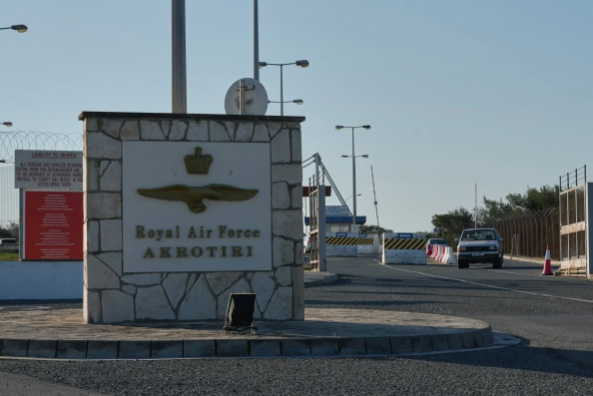
Akrotiri Base (credits Instagram)
On the night of 1 March 2026, as Iran retaliated against US-Israeli strikes that had begun two days earlier — and barely an hour after Prime Minister Keir Starmer announced that American forces could use British bases for defensive operations — an Iranian-made Shahed-type drone, launched from Lebanon with responsibility still disputed between Hezbollah and IRGC operatives, struck RAF Akrotiri, a British sovereign military base on the southern coast of Cyprus. The damage was limited. There were no casualties. Two additional drones were intercepted the same day, and Greek F-16s downed two more headed for Cyprus days later. And yet, in the space of a single night, the strike laid bare something that six decades of legal texts, parliamentary assurances, and diplomatic choreography had managed to obscure: that Britain holds sovereign territory on a Mediterranean island it once colonised, uses it as a launchpad for wars that are not Cyprus’s wars, and has never convincingly demonstrated that it can — or will — make the island safer when the consequences of those wars come home.
I write this not as an abstraction. My identities bind me to multiple histories at once: Greek, Cypriot, Jewish, and British. The 1960 settlement that created the Republic of Cyprus and retained Britain’s Sovereign Base Areas is not merely a bundle of legal texts to me. It is the architecture that shaped a homeland, a constitutional promise, and — through Akrotiri and Dhekelia — the continuing presence of British sovereignty on Cypriot soil. The drone that hit Akrotiri in March forced me to do what many Cypriots have done for decades: trace the line from the treaties Britain signed, through the crises it navigated, to the risks it now externalises — and ask whether the United Kingdom has ever truly carried the burden that comes with its extraordinary privilege.
For readers of the Times of Israel, this story matters beyond Cyprus. It is, at its core, about what happens when a Western power retains sovereign military infrastructure in a strategically explosive neighbourhood, uses it for operations connected to the very conflicts shaping Israel’s security environment, and then struggles to protect even its own perimeter — let alone the civilians living in its shadow. If that sounds familiar, it should.
The 1960 Settlement: Not Decolonisation, But an Engineered Bargain
Cyprus’s independence in 1960 was not a clean break from an empire. It was a tightly engineered settlement, negotiated by Britain, Greece, and Turkey, and accepted — with varying degrees of enthusiasm — by the leaders of the Greek Cypriot and Turkish Cypriot communities. The package paired a complex power-sharing constitution with an international treaty architecture designed to freeze Cyprus’s orientation: no union with Greece, no partition between communities. And, crucially, it included the retention by Britain of two areas of continuing British sovereignty — the Sovereign Base Areas at Akrotiri and Dhekelia.
The legal foundations are unusually explicit. Under the 1960 Treaty of Establishment, Cyprus’s territory is defined as the island except the two SBA areas, which “shall remain under the sovereignty of the United Kingdom.” This was not a lease. Britain insisted on sovereignty, not mere basing rights, and it did so early and publicly. In the February 1959 parliamentary statement on the “Cyprus agreement,” the British government listed its “requirements” as the retention of two areas under full British sovereignty, with whatever rights were necessary for their effective military use, and guarantees by Greece, Turkey, and Cyprus for their integrity.
The exchange of notes accompanying the treaty removed any ambiguity about disposition: Britain stated that it did not intend to relinquish sovereignty or effective control, and Cyprus undertook not to demand relinquishment. But if Britain ever chose to divest, the territory would revert to Cyprus. This is not a lease model. It is retained sovereign territory by treaty, with a reversionary clause that only activates at Britain’s discretion.
The Guarantee That Was Never Guaranteed
Parallel to the SBA arrangements, the 1960 Treaty of Guarantee created the obligation — or, as the legal argument runs, the option — that would define Britain’s credibility for generations.
Greece, Turkey, and Britain “recognise and guarantee” Cyprus’s independence, territorial integrity, security, and the constitutional state of affairs. Cyprus pledged not to pursue union with any state or promote partition. The guarantor powers pledged to prohibit activities aimed at either.
The enforcement mechanism is Article IV, and it contains the ambiguity that has fuelled debate for over sixty years. In the event of a breach, the three guarantors “undertake to consult together” on necessary measures. If concerted action proves impossible, each guarantor “reserves the right to take action” with the “sole aim” of re-establishing the state of affairs created by the treaty. Note the language carefully: “reserves the right.” Not “shall act.” Not “is obligated to intervene.” The door is open — but it is not a command.
This textual structure is the foundation for the disputes that followed. One reading treats “guarantee” as implying a robust obligation to defend the constitutional order when it comes under threat. Another reads Article IV as permissive — a discretionary power that permits non-use of force while still complying through consultation and diplomacy. The gap between these readings is the gap in which Cyprus’s modern tragedy was born.
The Tests: 1963, 1967, 1974
The first test came quickly. In 1963–64, intercommunal conflict forced the settlement’s machinery into crisis. Evidence from released documents indicates that Britain arranged ceasefires and subsequently transferred peacekeeping responsibility to the United Nations — partly because it did not want a long-term role as internal security manager, and partly because American officials perceived Britain as insufficiently concerned with the island’s future beyond the safety of the SBAs. By 1964, the United States had effectively taken over the guarding of Western interests in Cyprus from Britain.
The pattern was already visible: a classic post-imperial optimisation. Britain sought to preserve its sovereign base footprint while avoiding entrapment as the primary manager of Cyprus’s internal constitutional breakdown. This was not identical to abandoning Cyprus. But it was a narrowing — a compression of the guarantor ethos into crisis diplomacy plus residual military presence.
By 1967, when another major crisis erupted, the documentary record shows American-led mediation through Cyrus Vance, with Britain present but no longer dominant. The guarantor mantle was thinning.
Then came 1974 — the major test case, the one that still defines the island’s wound. On 15 July, a military coup backed by the Greek junta overthrew President Makarios, shattering the constitutional order the treaties were designed to protect. Five days later, Turkey invaded, citing its rights under Article IV. Britain’s response, as described by Foreign Secretary James Callaghan in the Commons on 22 July, focused on achieving a ceasefire, preventing escalation, safeguarding British dependants and tourists (many concentrated in the sovereign base areas), and convening negotiations in Geneva under Resolution 353.
What Britain did not do was use force — not to reverse the coup, not to stop the invasion, not to prevent the de facto partition that followed Turkey’s second offensive in August. The ceasefire diplomacy continued. Nationals were evacuated. Talks were convened. But the constitutional state of affairs that the Treaty of Guarantee was designed to protect was destroyed, and a division was entrenched that persists to this day.
Were there options? The released record and later scholarship suggest that military contingencies were discussed internally, but they were constrained by alliance politics and feasibility. An LSE analysis cites evidence that US policymaking rapidly focused on shaping a “new balance of forces” — an approach that required other parties not to use force — effectively scuttling British intentions for military action. A Callaghan telegram from Geneva to Harold Wilson reportedly conveyed that the United States would not consider military action against Turkey and that warnings and threats were judged unhelpful. The House of Commons Select Committee on Cyprus later concluded that Britain had “a legal right, a moral obligation, and the military capacity to intervene.” The Labour Government did not accept this conclusion. The debate has never been settled.
My own view, stated plainly: on the spirit of the 1960 settlement, Britain’s 1974 posture reads as a failure. The guarantor framework was designed to prevent union or partition and to preserve the constitutional state of affairs. Both were destroyed. Britain’s record — ceasefire diplomacy, evacuation, convening talks, but no coercive enforcement — may be legally defensible under a permissive reading of Article IV. But it was strategically decisive in demonstrating that guarantor commitments did not translate into protection when it mattered most.
I can understand the constraints. Alliance politics, the fear of a disastrous war with Turkey on NATO’s southeastern flank, the shadow of Suez, the impossibility — perhaps — of British troops fighting on Cyprus again. But understanding constraints does not dissolve disappointment. It merely gives disappointment its shape.
Akrotiri in the 2020s: A Regional Launchpad
Whatever the guarantor role has become, the SBAs have continued to evolve — not as instruments of Cypriot security, but as forward operating platforms for British power projection in the Middle East.
The RAF’s own description of Akrotiri is frank: it is a “Permanent Joint Operating Base” used as a “forward mounting base for overseas operations in the Middle East,” supporting “operations in the region to protect the UK’s strategic interests.” The UK government’s operational reporting documents airstrike missions flown from RAF Akrotiri against targets in Iraq and Syria. In early 2024, the SBAs were used as a base for UK strikes against Houthi targets in Yemen, generating local protest and acute governmental sensitivity — Cyprus publicly stressed it had “no connection or involvement” with those operations.
The UK government also acknowledged using the SBAs for humanitarian support to Gaza and for surveillance flights to search for hostages taken on 7 October 2023, while stating it did not provide military support to Israel and controlled what information it passed on. Since October 2023, approximately 1,000 additional service personnel were deployed to the SBAs and the eastern Mediterranean for contingency planning and humanitarian objectives.
For the Times of Israel readership, the significance here is direct. The same base infrastructure that sits on Cypriot soil — generating political risk for Nicosia — has been operational in the same theatre as the conflicts shaping Israel’s security since 7 October. The surveillance flights over Gaza, the Houthi strikes, the regional posture — all run through Akrotiri. Cyprus bears the political and now physical consequences of proximity to operations in which it has no voice and no formal consent mechanism. The UK has stated there is “no formal requirement” to clear flights with Cyprus, even while claiming it “routinely engages” and may inform Cyprus “where appropriate.”
Nothing in the 1960 SBA declaration confines UK operations to the defence of Cyprus itself. As a pure legal reading, expeditionary use is compatible with the declared “main objects,” so long as the SBAs remain military bases and the UK complies with the cooperative and non-colonial constraints. But the guarantor treaty’s political meaning — Britain as a protector of Cyprus’s security — becomes impossible to sustain if Cyprus experiences the risks of expeditionary operations without credible protective benefit beyond base perimeter defence and diplomatic statements.
Of course, my Jewish faith and close affiliation with the State of Israel lead me to support operations that enable the Jewish state to prevail over its adversaries, safeguard its security, and contribute to greater stability in the region and beyond. The question, however, is whether the United Kingdom offers anything in return to the Republic of Cyprus — whether stemming from its international obligations, its legacy as a former colonial power, or its status as a (presumed) ally in the Eastern Mediterranean.
March 2026: When the Risk Became Real
In June 2024, Hezbollah rhetoric explicitly threatened Cyprus in connection with perceptions of its role — or permissiveness — toward Israeli military activity. At the time, the threats seemed primarily rhetorical. By March 2026, they were not.
The immediate trigger was the US-Israeli strikes on Iran that began on 28 February 2026. The following day, on 1 March, Starmer announced that the UK would allow American forces to use British bases — specifically RAF Fairford in England and Diego Garcia in the Indian Ocean — for defensive strikes against Iranian missile sites. He initially stressed that the UK would not join offensive action and that Cyprus-based facilities were excluded from the arrangement. Iran’s retaliation was swift and broad, targeting US and allied installations across the Gulf. The drone that hit Akrotiri — an Iranian-manufactured Shahed, launched from Lebanon, though no party has claimed responsibility and attribution remains contested between Hezbollah and IRGC operatives — struck the base’s runway at approximately midnight on 1–2 March.
The strike operationalised what earlier threats had implied: the SBAs reduce Britain’s distance to Middle Eastern theatres, but they also reduce the distance of those theatres’ retaliation options to Cyprus. The UK responded by deploying HMS Dragon, a Type 45 air-defence destroyer, along with Wildcat helicopters armed with Martlet counter-drone missiles — though the destroyer did not depart Portsmouth until 10 March, a delay that drew pointed questions about Royal Navy readiness. Politically, following direct contact between Starmer and Cypriot President Nikos Christodoulides on 21 March, the UK emphasised that the bases in Cyprus would not be used for any offensive military operations and pledged enhanced preventive measures.
The strike itself is evidence that, at least at the time of the incident, deterrence and force protection were insufficient to prevent a drone impact on a high-value sovereign UK installation — this despite the deployment of additional F-35 fighters, radar systems, and counter-drone defences to Akrotiri in the weeks preceding the strike. The defences were in place; the drone still got through. The rapid dispatch of further capabilities — a destroyer, armed helicopters, additional personnel — suggests the UK judged even its reinforced pre-strike posture inadequate for the threat environment. Against a backdrop of heightened European alert, with Greece scrambling frigates and F-16s and France deploying a frigate with anti-drone systems, Britain’s visible reinforcement actions read as reactive stabilisation rather than confident deterrence. The comparison matters politically because Britain is not merely a neighbour or ally — it is the sovereign power responsible for the defence of its own territory inside Cyprus.
And the political communications fragility was on full display: with Cyprus publicly affirming it was “not involved” and did not intend to be part of military operations, while Britain simultaneously acknowledged conducting military operations from the SBAs in other theatres. The bases can generate strategic exposure for Cyprus even when Cyprus is not party to the operational decision.
The Credibility Problem Is Now Structural
The pattern across six decades is consistent. Britain has systematically preserved and exploited the sovereign military utility of the SBAs while narrowly interpreting — and at times operationally sidelining — the guarantor ethos that the base presence politically depends upon.
In 1960, Britain fulfilled its legal design: sovereignty retained, cooperation secured, financial support provided. But the tension was embedded from the start. In the 1960s crises, the guarantor role compressed into crisis diplomacy as the UK shed its peacekeeping burden. In 1974, the role collapsed entirely under the weight of alliance constraints and the political costs of enforcement. In the 2020s, the SBAs function as an expeditionary hub whose value to Britain is precisely its proximity to the Middle East — yet that same proximity externalises risk onto an island that has no say in the operations launched from its soil.
The credibility problem is structural. Each time Britain responds primarily with reactive base-defence measures and political reassurance, it reinforces a perception that the SBAs are a launchpad first and a security guarantee second. That is precisely the inversion that fuels public anger — not only among Cypriots, but among anyone who believes that sovereignty should carry responsibility, not merely utility.
What I Want — and What Britain Owes
I do not want Britain to leave Cyprus in anger, or for Cyprus to become a theatre in which Britain’s credibility is slowly bled out. I want Britain to recover seriousness — to treat its sovereignty in Cyprus not as a relic to be defended only when its own perimeter is struck, but as a continuing responsibility that should make the island safer, not more targetable.
The legal texts are clear enough about what Britain wanted in 1960: sovereign space for military bases, retained indefinitely unless Britain chose otherwise. What has been far less clear, across decades, is whether Britain has carried the burden that comes with that choice.
Now, in the drone era, the contradiction feels sharper, almost cruel: the base is valuable enough to be used as a forward platform for distant wars, yet even with F-35s on the tarmac and radar systems scanning the horizon, a single Shahed-type drone still penetrated the perimeter — leaving Cypriots to live with the anxiety, the escalation risk, and the political consequences of decisions they did not make.
For the Times of Israel readership, this story carries a familiar resonance. The question of what great powers owe the smaller states entangled in their strategic footprint is not unique to Cyprus. It echoes in every alliance relationship where security guarantees are tested by events. It echoes in the eastern Mediterranean, where the geometry of conflict now links Israeli operations, Iranian proxies, British bases, and Cypriot sovereignty in a single volatile arc. Britain has not “kept faith” with Cyprus in the way many Cypriots reasonably infer from the moral logic of 1960: if you keep sovereign military territory on the island, and you are a guarantor of the island’s constitutional order and security, you should be the actor that makes the island safer when crises peak — not the actor whose territory makes the island a more attractive target.
And I still hope that the United Kingdom can become, again, a state that carries power with moral clarity: not naively, not sentimentally, but with the disciplined courage of responsibility. That would mean a posture in Cyprus that is strategically coherent, legally honest, and politically respectful — one that can explain, without evasions, what the bases are for, what risks they impose, and what Britain will do, concretely, when those risks arrive at Cyprus’s doorstep. Because if the drone that struck Akrotiri taught us anything, it is that the risks are no longer theoretical. They are here. And the question is no longer whether Britain has the right to act from Cyprus. The question is whether Britain has the honesty to acknowledge what that presence costs — and the courage to make it worth the price.
Related Topics
Related Posts