
Founder & Principal, Line of State
October 7 Exposed the Security Cost of Israel’s Settlements in the West Bank
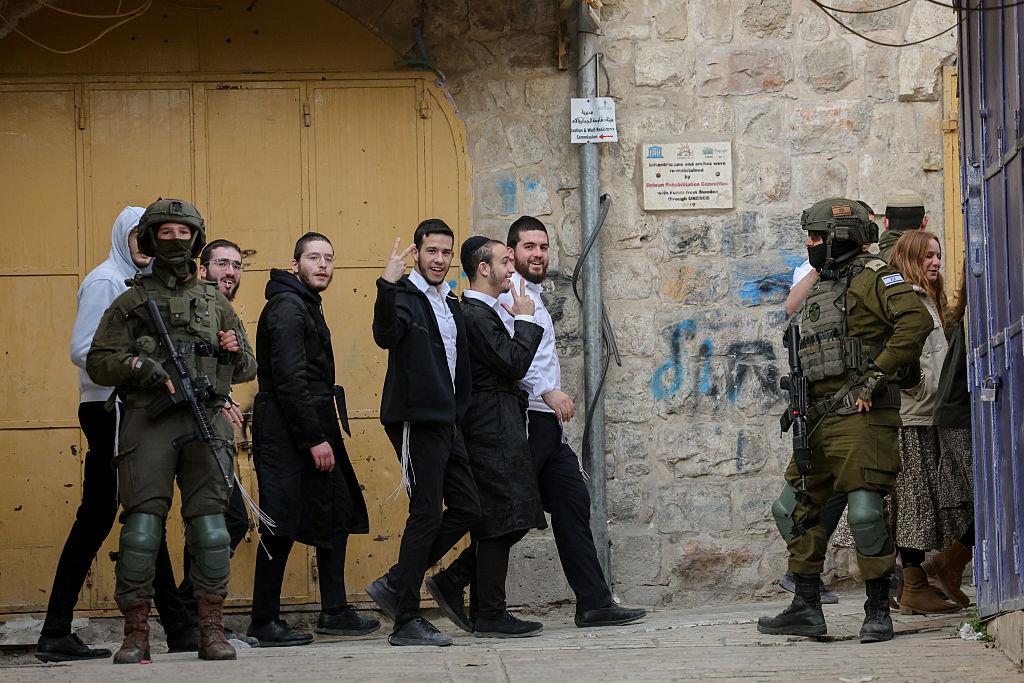
Israeli security forces guard as Jews tour in the West Bank city of Hebron, on January 31, 2026. Photo by (Wisam Hashlamoun/FLASH90)
Israel built more than settlements in the West Bank. It built a standing military obligation, then sold that obligation as security. Successive governments also preserved Palestinian division and accommodated a Qatari-funded Hamas whose survival served Ankara and Tehran. October 7 demands a reckoning beyond battlefield failure: which forces were tied down, what Gaza lost, and who chose to preserve the policy despite its cost?
Only 671 combat troops were available to the Gaza Division on the morning of October 7, 2023: four understrength battalions on routine security duty, whose combined fighting strength equalled roughly two full battalions. [1] In the West Bank, the IDF had maintained 23 battalions since August 2023, against the usual 13. Two days before the attack, amid tensions in Huwara, a West Bank town, forces serving as a General Staff reserve in the Gaza area were also redeployed to the West Bank.
In the West Bank, the IDF must thwart Palestinian terrorism while also confronting settler violence against Palestinians and Israeli security forces. Responding to that violence has even led to the cancellation of military operations, including arrest operations.
The public is sold the settlements as a security asset. Israel’s security cabinet, the IDF General Staff, Shin Bet leadership and the Knesset Foreign Affairs and Defense Committee’s classified subcommittees know the operational calculus: the settlement enterprise is no defensive force; it imposes a defence mission. The IDF protects hundreds of settlements and sites across predominantly Palestinian areas, secures roads, junctions, civilian movement and the seam zone along the separation barrier, and ties down battalions, intelligence assets, reserves and command attention at the expense of other missions.
Before the 2005 disengagement, several thousand Israelis lived in enclaves, including Gush Katif, within the Gaza Strip, amid a Palestinian population of more than a million. Rockets were fired then, too. [2] The presence of those settlements did not deter their launchers. Defending them required the IDF to operate deep inside hostile territory, secure access roads and maintain outposts, adding vulnerabilities. October 7 did not retroactively turn that burden into a security asset. Gush Katif did not protect Israel. The IDF protected Gush Katif.
In the West Bank, another mechanism mitigates this burden: security coordination with the Palestinian Authority. It enables information exchange, coordinated action between Israeli and Palestinian forces, and Palestinian counterterrorism efforts against organisations including Hamas and Palestinian Islamic Jihad. [3] Israel deepens its control rather than distributing responsibility more widely.
Settlements do not defend Israel. The reckoning is how much of its own security Israel sacrifices to defend them. For those who regard settlement as a divine commandment and part of the redemption of the Land of Israel, even that price is no reason to change policy.
“The Palestinian Authority is a burden and Hamas is an asset,” Bezalel Smotrich said in 2015. In security terms, the equation is reversed. The logic was that a weak Palestinian Authority in the West Bank and Hamas ruling Gaza prevent a unified Palestinian counterpart, allowing Israeli governments to defer a decision on the settlements’ future.
For years, Netanyahu defended the transfer of Qatari funds into Gaza, which, with Israel’s approval, financed Hamas’s rule. In 2019, he even presented the separation between Hamas and the Palestinian Authority as part of his strategy. Israel did not build a way to replace Hamas. It built a way to live with it: ruling, funded and deterred only in Israel’s eyes.
Qatar became the indispensable mediator with the government it financed, and Israel relied on it to manage relations with that government. The Qatargate affair adds suspicions of criminal wrongdoing involving the promotion of Qatari interests by figures close to the prime minister.
Turkey declares its support for a Palestinian state along the 1967 borders, yet acts as a patron of Hamas’s separate, armed rule in Gaza. [4] Iran financed and armed Hamas and Palestinian Islamic Jihad, consolidating its influence through both. [5] Tehran does not need a Palestinian state. It needs a Palestinian front.
Israel, Turkey and Iran thus converge on the same outcome: Palestinian division persists and Hamas grows stronger. When Israel’s adversaries achieve their objectives through Israeli policy, the one who miscalculated is not sitting in Ankara or Tehran. He is sitting in Jerusalem.
A demilitarised Palestinian state reverses the equation in Israel’s favour: a single authority monopolising armed force weakens Hamas, denies Iran a front and Turkey leverage, and frees Israeli forces to defend Israel’s borders.
An Israeli state commission of inquiry will have to confront decision-makers over the years with the reckoning: how many battalions, reservist days, reserves, and intelligence and collection assets were allocated to the West Bank; what share went to counterterrorism and what share to settlement defence; and what was lost to the defence of Israel’s Gaza border communities. And why, when the cost was known and alternatives existed that would have exacted a lighter toll on Israel’s security, was preserving the settlements given priority over Israel’s security?
–
Originally published in Hebrew in Maariv on October 18, 2026, under the title “7 באוקטובר חשף את המחיר הביטחוני של ההתנחלויות”. This English edition was translated and adapted by the author.
–
Related by the same author:
- “Jerusalem’s Decision to Refrain from the Sharm El-Sheikh Peace Summit”, The Times of Israel, October 16, 2025.
- “With Law, Without Illusions: Rabin, Leadership and Responsibility”, The Times of Israel, November 3, 2025.
- “No Hands on Soldiers”, The Times of Israel, November 16, 2025.
- “Turkey Does Not Support Palestinians. It Uses Them”, Israel Hayom, April 28, 2026.
- “Turkey’s Fidan Wants to Write the Region’s Rules. Israel Is Writing Ankara Out.”, The Times of Israel, May 31, 2026.
- “An Armed Fringe Is Not Defending Israel. It Is Hijacking the State”, The Times of Israel, July 26, 2026.
- “Being Pro-Israel Means Knowing the Settlements Are Not Israel”, The Times of Israel, September 15, 2026.
- “The Election Will Decide Whether Jerusalem Becomes Ankara”, The Jerusalem Post, September 24, 2026.
–
[1] Yoav Zitun’s Ynetnews report on the IDF Operations Directorate investigation records 671 soldiers across 14 companies in four routine-security battalions. A separate account of the IDF’s Gaza Division investigations, reported by Emanuel Fabian in “Entire Gaza Division was overrun for hours, and IDF didn’t know it; 767 troops faced 5,000 terrorists”, The Times of Israel, February 27, 2025, gives 767 troops deployed at the Gaza border. The published accounts do not explicitly reconcile the figures.
[2] US Department of State, “Country Reports on Terrorism 2005: Israel, the West Bank, and Gaza”, April 28, 2006, documents the withdrawal of approximately 8,000 settlers and their military protection units, as well as rocket attacks originating in Gaza. See also “Troops Enter Settlements in Gaza Strip”, The Washington Post, August 17, 2005, on the settler and Palestinian populations; and the Israeli Ministry of Foreign Affairs’ report of May 18, 2005, documenting mortar and rocket attacks before disengagement.
[3] Israel Policy Forum, “The West Bank: The Forgotten Fourth Front”, July 24, 2025, on Israeli-Palestinian security coordination and Palestinian Authority operations against armed organisations. See also “Hamas says West Bank arrests prove security cooperation ongoing”, The Times of Israel, March 9, 2015, reporting Palestinian Authority arrests of Hamas operatives.
[4] Republic of Türkiye Ministry of Foreign Affairs, “Joint Statement of the Antalya Ministerial Meeting”, April 11, 2025, endorsing Palestinian statehood on the basis of the June 4, 1967 borders. The Times of Israel, “Turkey’s spy chief hosts Hamas leader, disarmament not included in summary”, March 22, 2026. US Department of the Treasury, “Treasury Targets Wide Range of Terrorists and Their Supporters”, September 10, 2019, identifies Turkey-based Hamas financial networks, including Zaher Jabarin and Redin Exchange.
[5] US Department of the Treasury, “United States and United Kingdom Take Coordinated Action Against Hamas Leaders and Financiers”, November 14, 2023, documenting Iranian financing, weapons transfers and operational training benefiting Hamas and Palestinian Islamic Jihad, including financial mechanisms linked to the Islamic Revolutionary Guard Corps.
Related Topics
Related Posts