
Brothers in arms: The ones who truly brought them home

On the eve of the first day of Sukkot, I heard a vort from Rabbi Brunner, head of Tzohar’s Beit Hora’ah, who drew a link between the festival of Sukkot and the anticipated release of the Israeli hostages. The rabbi quoted the verse from Nehemiah:
“And all the people that had returned from the captivity made Sukkot and dwelt in the Sukkot… and there was very great joy.” (Nehemiah 8:17)
“וַיַּעֲשׂוּ כָל־הַקָּהָל הַשָּׁבִים מִן־הַשְּׁבִי סֻכּוֹת וַיֵּשְׁבוּ בַסֻּכּוֹת… וַתְּהִי שִׂמְחָה גְדוֹלָה מְאֹד
Although the term “captivity” (שבי) in that verse refers to those returning (שבים) from exile, there is indeed both a religious and historical connection between Sukkot and the return of captives.
The rabbi’s words reminded me of another hostage release that also occurred during Sukkot. Fourteen years ago, on Chol HaMoed Sukkot, Gilad Shalit was released after five years in Hamas captivity. I remember watching his release — and though the price was heavy (a point I’ll return to later), the sense of joy we all felt bordered on the historic and the miraculous.
Fast forward to 2025, and it seems impossible to separate the almost mythical power of this festival from the theme of Liberty. A holiday that, much like Passover, symbolizes the passage from bondage to freedom — Sukkot once again serves as a living example of liberation. And much like Shalit’s release, it seems that this Sukkot of 5786 will mark the liberation of the remaining hostages.
Learning to Be Comfortable with Discomfort
But Sukkot isn’t only a holiday of redemption and freedom — it’s also a holiday of discomfort.
Dwelling in a temporary Sukka, abandoning the solid for the fragile, is meant to train us to live with uncertainty, to trust in God, and to celebrate even the uneasy experience itself.
And we must address the elephant in the room.
There is an uncomfortable price to this deal — a heavy one. True, as I write these lines, the names of the released terrorists haven’t been published, and this isn’t a deal comparable to that of Gilad Shalit. Yet the celebrations in Gaza and the declaration by senior Hamas figure Mahmoud Mardawi, who proclaimed a “victory for Gaza,” are stark reminders that Israel is again paying in cash as part of this agreement.
When the enemy declares victory, when its leaders are granted de facto pardons, and when supporters of Hamas’s barbarity gain international guarantees — it’s hard to call this an “absolute victory.”
Throughout the war, a difficult argument has surfaced: that the mass protests and campaigns for the hostages release only raise their price. This was a claim voiced even by former Shin Bet chief Ronen Bar and many poitical and military “experts”.
Are they right? Perhaps.
But I wouldn’t want to live in such a society.
I wouldn’t want to live in a society indifferent to human tragedy, a society that restrains its maternal instinct for the sake of “strategy and political diplomacy” (even if justified), a society where a mother cannot lose her sanity for her kidnapped child.
Through a cold, robotic lens — such restraint may appear strategic, but a nation is not a machine; it’s a living organism, full of emotion and conscience.
And it is precisely the civil movement for the hostages that proves the moral health of Israeli society — its vitality, compassion, and humanity.
The fact that the hostage issue gripped Israelis and Jews so deeply is not a sign of weakness — it’s a testament to our strength. The fact that we are willing to pay a painful price for our brothers and sisters in captivity is evidence of a moral victory — and of the unspoken covenant between Israel’s citizens and their Jewish and democratic state. Being comfortable with the uncomfortable price is the challenge we are now facing.
Reality and The Truman Show
And yet — let’s be clear.
Those who brought the hostages home were the soldiers and the negotiation teams.
This morning (October 9), I already saw detached journalists congratulating themselves online, taking credit for the hostages release.
Don’t be fooled.
Those who made this happen were the ‘Sadir’ and reserve soldiers — men and women who sacrificed businesses, studies, and family life and their very own life.
The true heroes are those who fought — and kept fighting — against the terrorist organization that kidnapped and murdered. Those who influenced the negotiations were the ones flying thousands of kilometers to deliver messages in Qatar, Iran, and Yemen, and those who conquered Gaza itself.
The 913 soldiers who fell since October 7, and the tens of thousands wounded in body and soul — they are the bleeding foundation upon which the hostages return, the very reason we are able to argue and indulge in trivialities.
The gap between home-life and life on the front line is unfathomable. And one realization that struck me during this latest phase is that we’ve been seeing things upside down.
The real life is at the front — and the “normal life” back home is the illusion.
The true reality is the soldier sleeping on the floor of a ruined house alongside twenty exhausted men of all ages, beliefs, and backgrounds — left-wing, right-wing, religious, secular — who may disagree on everything, yet are willing to die for one another for a single shared goal: the defeat of Hamas and the liberation of the captives, and despite everything they’ve seen, they remain filled with hope for that impossible dream we call the State of Israel.
They are the ones living the authentic Israeli life.
Those at home, are the ones living inside the cynical Truman Show — while the soldiers are the lucid ones.
Complexity As a Path to Victory
Although the next stages of the deal remain unclear, the first and most crucial phase has been approved, despite all obstacles.
Books will one day be written about the Cairo negotiations — about how the impossible became possible. Netanyahu, Dermer, Gal Hirsch, and the rest of the Israeli delegation team deserve immense credit. Through their actions and composure, they saved lives.
Ron Dermer and Gal Hirsch in particular — men who endured endless public humiliation, who were thrown under the bus, torn apart in studios, and received daily threats — delivered one of the greatest diplomatic and moral achievements of modern Israel.
Dermer’s decision to retire from politics under the pressure of protests outside his home is a tremendous loss to Israel’s diplomatic arena. The man who was the most effective Israeli in Washington — instrumental in Jonathan Pollard’s release, the Abraham Accords, and the Trump administration’s alliance — played a critical role in the hostage negotiations. The abuse he and Hirsch suffered is nothing short of a national tragedy.
One of the most powerful images to emerge from the Cairo talks was that of Maj. Gen. Nitzan Alon, head of the Hostage Directorate, shaking hands with Mohammed Al-Thani, Qatar’s Prime Minister. It was a complex image — two representatives of enemy states, yet two men who understood the complexity of reality and worked together to achieve the deal.
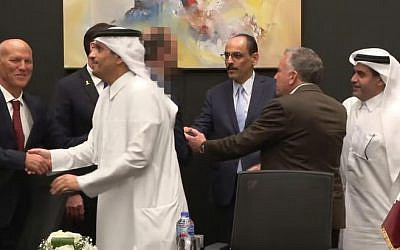
Last week, President Trump spoke about “peace in the Middle East.”
And while I remain deeply skeptical — that photo might just be the closest thing we’ve seen to real change in the region.
What Biden failed to achieve for over a year, Trump managed to deliver. The president’s extraordinary efforts, and those of his team, go beyond imagination — and Israel will be forever indebted to him
In 2009, Barack Obama won the Nobel Peace Prize for nothing but words. The committee that chose him cited his speeches in Prague and Cairo, in which he spoke of a world free of nuclear weapons and a desire to improve relations with the Muslim world.
In other words, Obama won a Nobel for talking.
It would be fitting, then, for the same committee to honor its own purpose and award the Nobel Peace Prize to the man who didn’t just speak — but also delivered.
Today was indeed an incredible day; Of hope, morality and freedom. We deserve this moment, we deserve to celebrate, and we deserve to heal as a nation.
To those being liberated. To those who fought. To those who negotiated.
And above all —
to the State of Israel.