
Brutal is not the same as genocide
Israel’s war in Gaza deserves hard criticism. But it does not meet the definition of the worst crime there is, and the region’s population history shows why the difference matters. Call the war in Gaza brutal. Call it disproportionate. Point to the Gaza Health Ministry’s count of 74,016 dead as of late September, a figure that does not separate civilians from fighters but that the ministry says is about half women and children.[1] Those are fair arguments, and Israel’s defenders should be willing to hear them. I make those points repeatedly.
But “genocide” is a different accusation. It is not a stronger word for “brutal.” It names a specific crime, and using it loosely does not sharpen the case against Israel. It blurs it. So I went on a personal search for truth, accuracy and history.
A word with a precise meaning
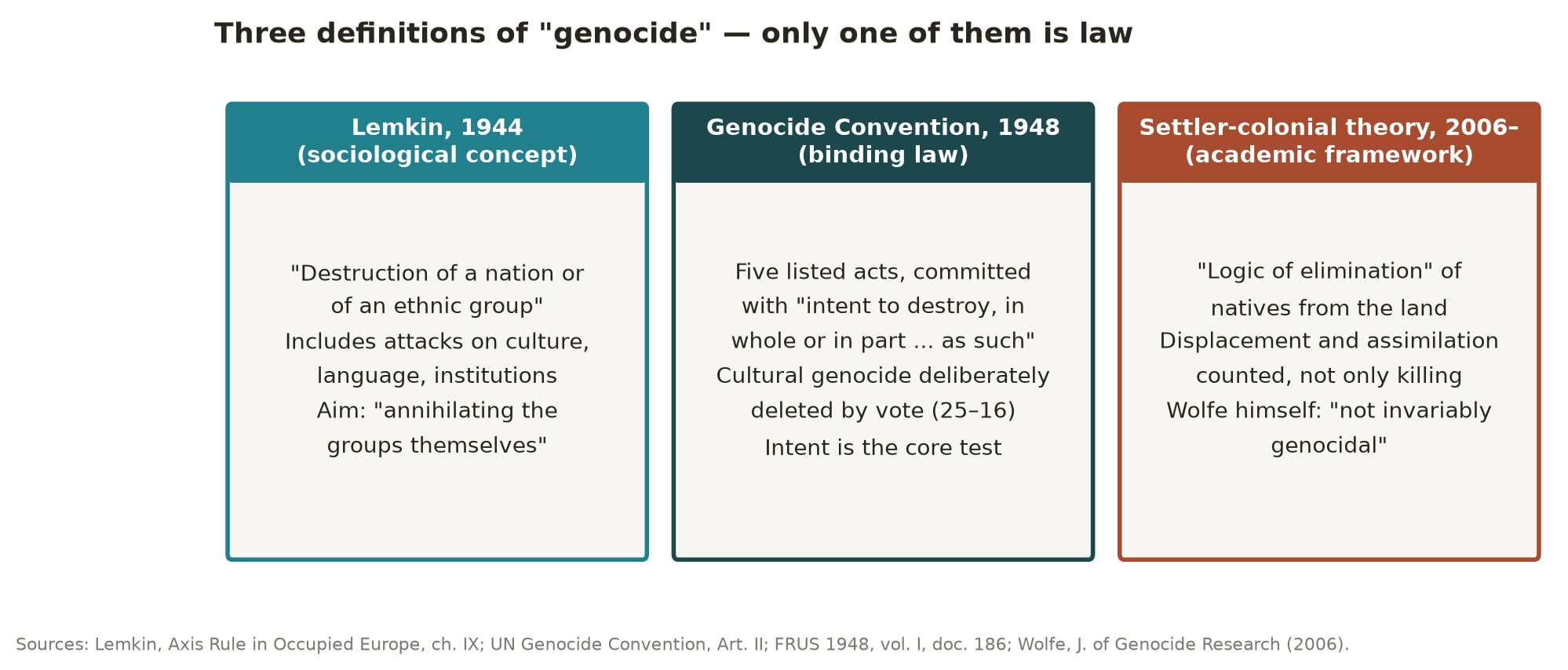
Raphael Lemkin, a Polish-Jewish lawyer, coined “genocide” during World War II and first used it in print in 1944.[2] “By ‘genocide,'” he wrote, “we mean the destruction of a nation or of an ethnic group.” The goal he described was “annihilating the groups themselves.”[3] Four years later, the United Nations wrote the crime into law. The Genocide Convention covers acts such as killing or inflicting destructive conditions of life “committed with intent to destroy, in whole or in part, a national, ethnical, racial or religious group, as such.”[4]
The key word is intent. War can be savage without being genocidal. What separates the two is purpose: whether the goal is to defeat an enemy or to erase a people. The International Court of Justice, the UN’s highest court, sets a demanding bar. When intent is inferred from conduct, it must be “the only inference that could reasonably be drawn.”[5]
That is where the Gaza charge runs into trouble. Some Israeli officials have said indefensible things; the court quoted then-defense minister Yoav Gallant saying, “We are fighting human animals.”[6] Critics are right to condemn that. But Israel’s stated aims, destroying Hamas and bringing the hostages home,[7] offer another reasonable explanation for a ferocious urban war launched after Hamas killed some 1,200 people and took 251 hostages on Oct. 7, 2023.[8] Israel also accepted a ceasefire that took effect Oct. 10, 2025,[1] releasing 1,968 Palestinian prisoners and detainees in exchange for the 20 living hostages.[9] Governments bent on wiping out a people do not usually sign ceasefires with its leaders.
Nor has any court found genocide. The ICJ’s January 2024 order is often described as calling the charge “plausible.” Joan Donoghue, the court’s president at the time, later said that “isn’t what the court decided.”[10] A ruling is years away; South Africa’s next filing is not due until November 2027.[11]
Displacement is not extermination
Some activists get around the intent problem by redefining the word. Borrowing from “settler colonialism” theory, they argue that pushing a native people off its land is itself genocide, which would make Israel guilty from its founding no matter what happens in Gaza. The ICJ has rejected that reasoning, holding that displacing a group, “even if effected by force, is not necessarily equivalent to destruction of that group.”[12] Even Patrick Wolfe, the scholar most associated with the theory, wrote that settler colonialism is “not invariably genocidal.”[13] In the Bosnian war, marked by mass expulsions, the court found genocide only at Srebrenica, where more than 7,000 Bosnian Muslim men and boys were massacred.[14]
Figure 1. Lemkin’s concept, the binding legal definition and the settler-colonial framework are not the same thing.
What the population numbers show
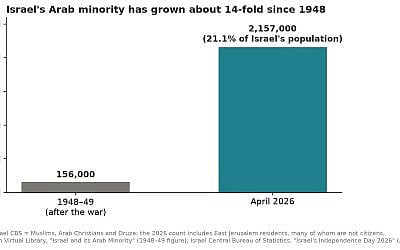
If Israel had spent 78 years trying to destroy Palestinians, the numbers would show it. They show the opposite. After the 1948 war, about 156,000 Arabs remained inside Israel.[15] Today Israel’s statistics bureau counts 2.157 million Arabs, 21.1% of the population.[16] That figure includes East Jerusalem residents who are not citizens, but the increase is more than tenfold either way.
Figure 2. Arab population of Israel, after the 1948 war and in April 2026.
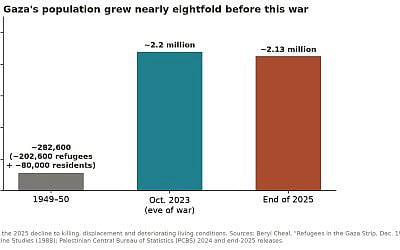
In Gaza, about 202,600 refugees joined roughly 80,000 residents after 1948.[18] By October 2023, the population was about 2.2 million.[19] The war has cut that number to an estimated 2.13 million by the end of 2025.[20] The loss is real. It is not the demographic signature of a 75-year extermination.
Figure 3. Gaza Strip population, 1949–50, October 2023 and end of 2025.
There is another set of numbers this debate usually leaves out. In 1948, about 265,000 Jews lived in Morocco, 140,000 in Algeria, 135,000 in Iraq, 105,000 in Tunisia and 75,000 in Egypt.[21] Iran had about 100,000.[22] Today Iraq has about seven Jews, Libya none, and Egypt and Syria about 100 each.[21] Lebanon, home to about 20,000 Jews in 1948, had 29 in 2020.[23] Across the region, a population of roughly 970,000 has shrunk to about 15,000.
Figure 4. Jewish population of Middle Eastern and North African countries, c. 1948 and most recent estimates.
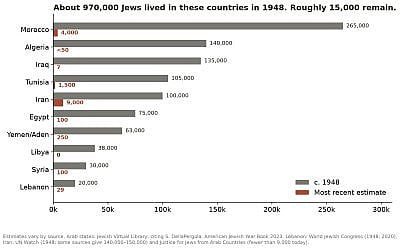
That is what the near-disappearance of a people from a region looks like. It was driven by persecution and expulsion, and it was a grave injustice.[24] Yet few serious people call it genocide, because under the law it was not. The same standard should apply to the Palestinians displaced in 1948.
Why the distinction matters
The world defined genocide narrowly after the Holocaust, in which Germany and its collaborators killed nearly two of every three European Jews.[25] If the word is applied to every brutal war, it stops meaning anything, and it loses its force for the next Rwanda or Srebrenica.
It also does not help Palestinians. Charges that fit the evidence, such as disproportionate force, failure to protect civilians and blocked aid, can be proved and prosecuted. Framing everything as genocide pins the case on the hardest question to prove and turns a debate about how Israel fights into a debate about whether Israel should exist.
Israel’s conduct in Gaza deserves hard scrutiny. It does not lead to our legal word reserved for the worst crime there is, genocide. I am a proud Zionist. We deserve the homeland where we’ve lived continuously for 6000 years. The death of innocents is always tragic: Those murdered by Hamas on October 7th., as well as those innocent Palestinians killed in Israel’s Gaza war. But the tragedy of war is not called genocide.
Footnotes:
- Associated Press, “Palestinian death toll in Gaza war rises above 74,000,” Sept. 27, 2026 (reporting Health Ministry figures and the Oct. 10, 2025 ceasefire). https://apnews.com/article/israel-gaza-iran-israel-yemen-september-27-2026-96b100178557a28f51e2ad4f74539699
- U.S. Holocaust Memorial Museum, Holocaust Encyclopedia, “What Is Genocide?” https://encyclopedia.ushmm.org/content/en/article/what-is-genocide
- Raphael Lemkin, Axis Rule in Occupied Europe (Carnegie Endowment for International Peace, 1944), ch. IX, “Genocide.” Text as reproduced by PHDN. https://phdn.org/archives/www.ess.uwe.ac.uk/genocide/Lemkina.html
- United Nations Office on Genocide Prevention, “Definitions of Genocide and Related Crimes” (Convention, Art. II). https://www.un.org/en/genocide-prevention/definition
- International Court of Justice, Croatia v. Serbia, Summary of the Judgment of Feb. 3, 2015 (paras. 143–148). https://icj-web.leman.un-icc.cloud/sites/default/files/case-related/118/18450.pdf
- International Court of Justice, South Africa v. Israel, Order on Provisional Measures, Jan. 26, 2024, paras. 52 and 54. https://icj-web.leman.un-icc.cloud/sites/default/files/case-related/192/192-20240126-ord-01-00-en.pdf
- Times of Israel, live blog, Oct. 28, 2023 (Netanyahu press conference). https://www.timesofisrael.com/liveblog-october-28-2023/
- Associated Press, “A look at the hostages left in Gaza, by the numbers,” Oct. 14, 2025. https://apnews.com/article/hostages-israel-hamas-war-released-rescued-ceasefire-517c4684c7554823c4f1257ca7e56c99
- The Irish Times, live updates, Oct. 13, 2025 (1,968 prisoners and detainees released); France 24, “Hamas frees all living Israeli hostages,” Oct. 13, 2025. https://www.irishtimes.com/world/middle-east/2025/10/13/israel-hamas-gaza-hostages-ceasefire-live-updates/ https://www.france24.com/en/live-news/20251013-hamas-and-israel-set-for-hostage-and-prisoner-exchanges
- BBC News, “Israel-Gaza: What did the ICJ ruling really say?” May 2024. https://www.bbc.com/news/articles/c3g9g63jl17o
- South African Government, “Presidency notes ICJ Order on South Africa and Israel case,” June 2, 2026. https://www.gov.za/news/media-statements/presidency-notes-icj-order-south-africa-and-israel-case-02-jun-2026
- International Court of Justice, Bosnia and Herzegovina v. Serbia and Montenegro, Judgment of Feb. 26, 2007, para. 190. https://www.worldcourts.com/icj/eng/decisions/2007.02.26_genocide_convention.htm
- Patrick Wolfe, “Settler Colonialism and the Elimination of the Native,” Journal of Genocide Research 8, no. 4 (2006): 387–409. https://rodriguez21lpol301.commons.gc.cuny.edu/files/2021/09/Settler-colonialism-and-the-elimination-of-the-native.pdf
- UN News, “UN World Court acquits Serbia of genocide in Bosnia; finds it guilty of failing to prevent massacre,” Feb. 26, 2007. https://news.un.org/en/story/2007/02/210142
- Jewish Virtual Library, “Israel Studies: An Anthology — Israel and its Arab Minority.” https://jewishvirtuallibrary.org/israel-studies-an-anthology-israel-and-its-arab-minority
- Israel Central Bureau of Statistics, “Israel’s Independence Day 2026,” press release 117/2026, Apr. 19, 2026. https://www.cbs.gov.il/he/mediarelease/DocLib/2026/117/11_26_117e.pdf
- Israel Democracy Institute, “Arab Society Statistical Report 2023.” https://en.idi.org.il/arab-society/2023/?chapter=55095
- Beryl Cheal, “Refugees in the Gaza Strip, December 1948–May 1950,” Journal of Palestine Studies (1988), via Palestinian Journeys. https://www.palquest.org/sites/default/files/Refugees_in_the_Gaza_Strip_December_1948-May_1950_-_Beryl_Cheal.pdf
- Palestinian Central Bureau of Statistics, “The Conditions of the Palestinian Population” (press release). https://www.pcbs.gov.ps/en/post-details/?postId=22046
- Palestinian Central Bureau of Statistics, “A brief on the status of the Palestinian people at the end of 2025.” https://www.pcbs.gov.ps/en/post-details/?postId=23319
- Jewish Virtual Library, “Jewish Populations in the Arab World (1948–Present),” citing Sergio DellaPergola, American Jewish Year Book 2023. Estimates vary by source. https://jewishvirtuallibrary.org/jewish-populations-in-the-arab-world
- UN Watch, “Jews from Arab and Muslim Lands” (Iran: 100,000 in 1948). Some sources estimate 140,000–150,000. https://unwatch.org/wp-content/uploads/2022/06/Jews-from-Arab-Muslim-Lands.pdf
- World Jewish Congress, “Community in Lebanon.” https://www.worldjewishcongress.org/en/about/communities/LB
- Jewish Virtual Library, “Jewish Refugees From Arab Lands.” https://jewishvirtuallibrary.org/jewish-refugees-from-arab-countries
- U.S. Holocaust Memorial Museum, “Frequently Asked Questions about the Holocaust for Educators.” https://www.ushmm.org/teach/fundamentals/holocaust-questions