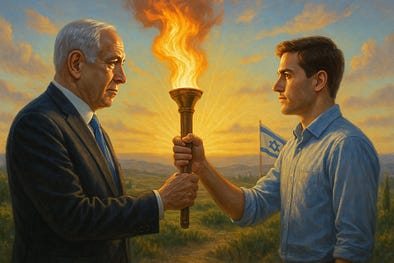
Bye Bye Bibi: It’s Time to Pass the Torch to a New Generation
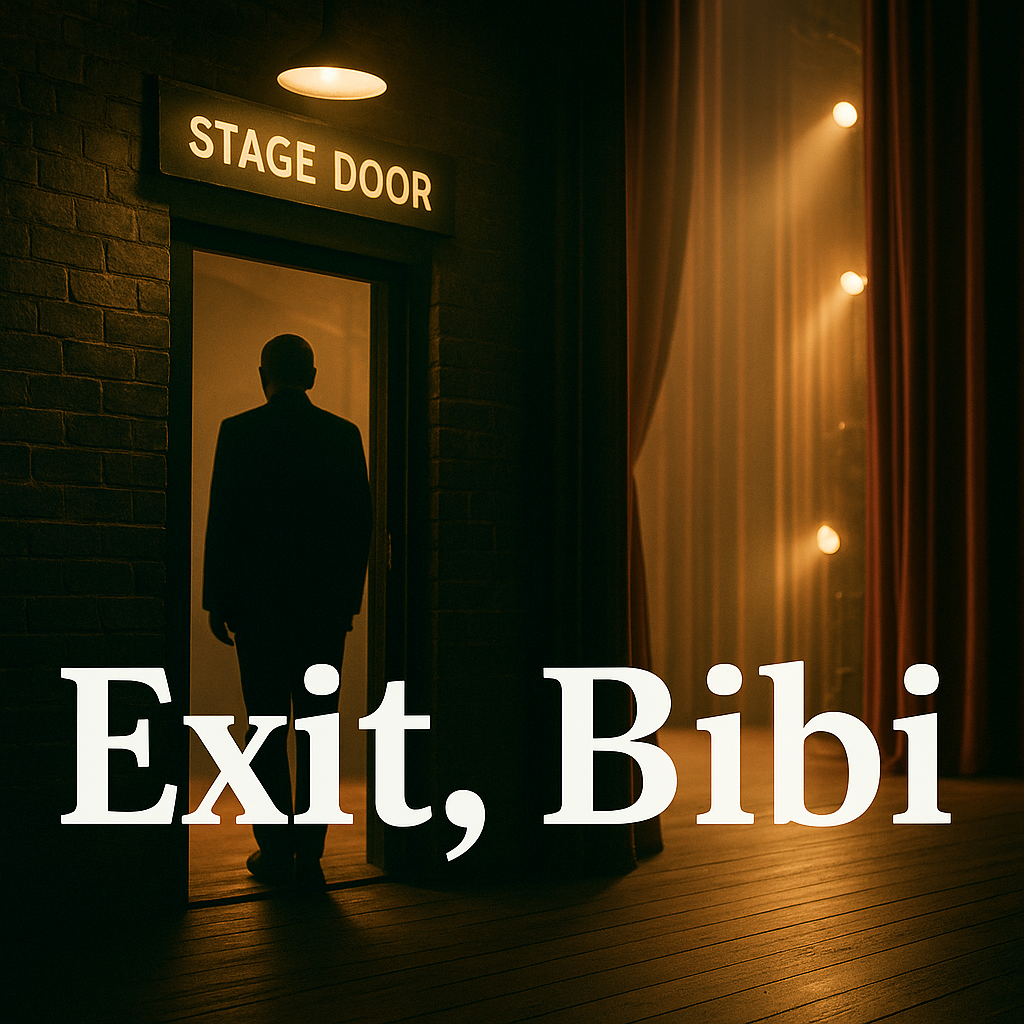
A tip of the kippah to Tom Stoppard, who passed away this week and takes with him a pen so sharp it could have cut through Israeli politics like a hot knife through hummus. Stoppard was one of my gateway drugs to the written word. Rosencrantz and Guildenstern Are Dead was the first college play I ever attended, and it convinced me that language could be playful, profound, and impactful all at once. It’s part of what nudged me toward journalism, toward trying to arrange words with even a fraction of his precision.
Today, Israel is living inside a Stoppard play of its own creation. The script is called Bebezis, and its plot centers on one man, Benjamin Netanyahu, now 76 years old, whose presence dominates every scene, every argument, every coalition, every vote. As Israeli journalist Ari Shavit recently described in conversation with Dan Senor on the Call Me Back podcast, Israel has reached a point where political identity is reduced to a single axis: Only Bibior Never Bibi. Everything else — security, democracy, religion and state, the future of Zionism — becomes supporting dialogue. If Stoppard were here, he’d remind us that no drama survives when the lead confuses himself for the playwright.
Shavit’s mapping of the political tribes is far more revealing than the usual right-left clichés. The Only Bibi faction is not ideological but emotional. It is built from Israel’s social periphery: Mizrahi families who remember being dismissed by the Ashkenazi elite; ultra-Orthodox communities accustomed to secular suspicion; national-religious voters who feel condescended to; Russian-speaking immigrants who sensed they were never fully embraced. For them, Netanyahu is not merely a politician, he is a vessel of dignity, the man who stands up to the institutions they believe never accepted them.
The Never Bibi camp is equally emotional, but in the opposite direction. It stretches from social democrats like Yair Golan to hard-right figures like Avigdor Lieberman. What unites them isn’t policy but opposition: a belief that Netanyahu’s continued presence is an existential threat to Israel’s democratic foundations. Their demographic anchor is the secular Ashkenazi cohort, “Mayflower Israel”, that built the state and now fears that Bibi’s populist turn will dismantle the country’s liberal character.
Here is Shavit’s central insight: there are two Netanyahus.
The early-era Netanyahu was a cautious conservative who triangulated toward the center, endorsed a vision of a two-state solution in the Bar-Ilan speech, froze settlement activity, and built unity governments with ideological rivals. That Netanyahu was a statesman.
The later Netanyahu, the post-2014 version, is a bunker populist. Years of investigation, resentment, and political siege transformed him. Today he thrives on grievance, leans on identity politics, and surrounds himself with extremists he never would have touched two decades ago. He has become the mirror that reflects and amplifies every fracture inside Israeli society.
This evolution explains why Israeli politics no longer revolves around ideology but around personality. Which is why, as I wrote in last week’s JNR, the time has come, morally, strategically, generationally, for Netanyahu to pass the torch.
And let’s say this plainly: Benjamin Netanyahu is 76.
Leadership today requires immense stamina. It demands war decisions at 2 a.m., coalition management before breakfast, strategic planning at lunchtime, and crisis communications at dinner. The pace is brutal even for leaders decades younger. Americans have learned, painfully, what happens when the highest office in the land is held by someone in their late seventies or beyond. Israel should not repeat that lesson.
None of this is ageism. It is realism. It is an acknowledgment that the country’s future, its security, its democracy, its social fabric, requires leaders with the bandwidth and energy to meet the demands of 2025, not 1996.
Which brings us to the pardon. Netanyahu has asked President Herzog for an unprecedented, mid-trial pardon. His supporters frame it as national healing. His opponents see it as the death of equal justice. The public is uneasy with either extreme. Israelis want closure, but not capitulation. Stability, but not monarchy.
The only path that threads this needle, the one Shavit intimates, the one Israel deserves, the one I fully endorse, is a conditional pardon: Pardon Netanyahu, yes—but only in exchange for his complete, unconditional, and permanent exit from political life.
This is not clemency. It is remedy. It allows the man to end his career with dignity rather than humiliation. It prevents a decade of martyr politics. It ends the courtroom theater. It allows Israel to detox from Bebezis by shifting the national story away from a single polarizing figure. As I wrote in my last post:
Israel has asked much of him, and he has delivered more than many expected. But even great wartime leaders must know when their chapter is over. Netanyahu has earned the right to take a bow, and Israel has earned the right to turn the page. The country does not need him to disappear; it needs him to pass the torch so the political and generational renewal Israel desperately requires can finally begin.
And in return, the judicial “revolution” is taken off the table. No more demolition of liberal institutions. Any future constitutional reforms are deferred to the next government and undertaken through broad consensus, not populist fiat.
Only then will Israel finally have the political oxygen it needs to create what must come next: a Zionist Unity Party. A broad, centrist coalition of pragmatic Zionists—religious and secular, center-left and center-right—united by a shared purpose: to modernize the country’s institutions, rebuild its social contract, and shape a forward-looking national vision. The talent exists everywhere, in the IDF reserves, in the tech sector, in civil society, in the younger leaders forged by October 7. These Israelis are ready to lead. The only thing blocking the runway is the one man who refuses to leave center stage.
Netanyahu was consequential, often brilliant, sometimes damaging, always dominant. But every drama, even the greatest, must end. And the final, most patriotic act he can perform is the one that opens the curtain for the next generation.
Bebezis has run its course.
The cure is a clean transition: a conditional pardon that ends the era, and a torch passed to those who will build the next Israeli century.
It’s time.
The words of JFK could not be more relevant to Israel today:
Let the word go forth from this time and place, to friend and foe alike, that the torch has been passed to a new generation of [Israelis] –born in this century, tempered by war, disciplined by a hard and bitter peace, proud of our ancient heritage–and unwilling to witness or permit the slow undoing of those human rights to which this nation has always been committed, and to which we are committed today at home and around the world.