
Somaliland Geostrategy: Geography, Power and Regional Influence
Introduction: When Geography Becomes Strategy
In international politics, geography is never merely about where a country is located. It is about access, influence, security, trade, and the ability to shape events beyond national borders. Some territories acquire strategic importance because of their natural resources; others because of their military capabilities, economic strength, or diplomatic networks. A few possess a geographical position that places them at the intersection of several major international interests.
Somaliland belongs in this last category.
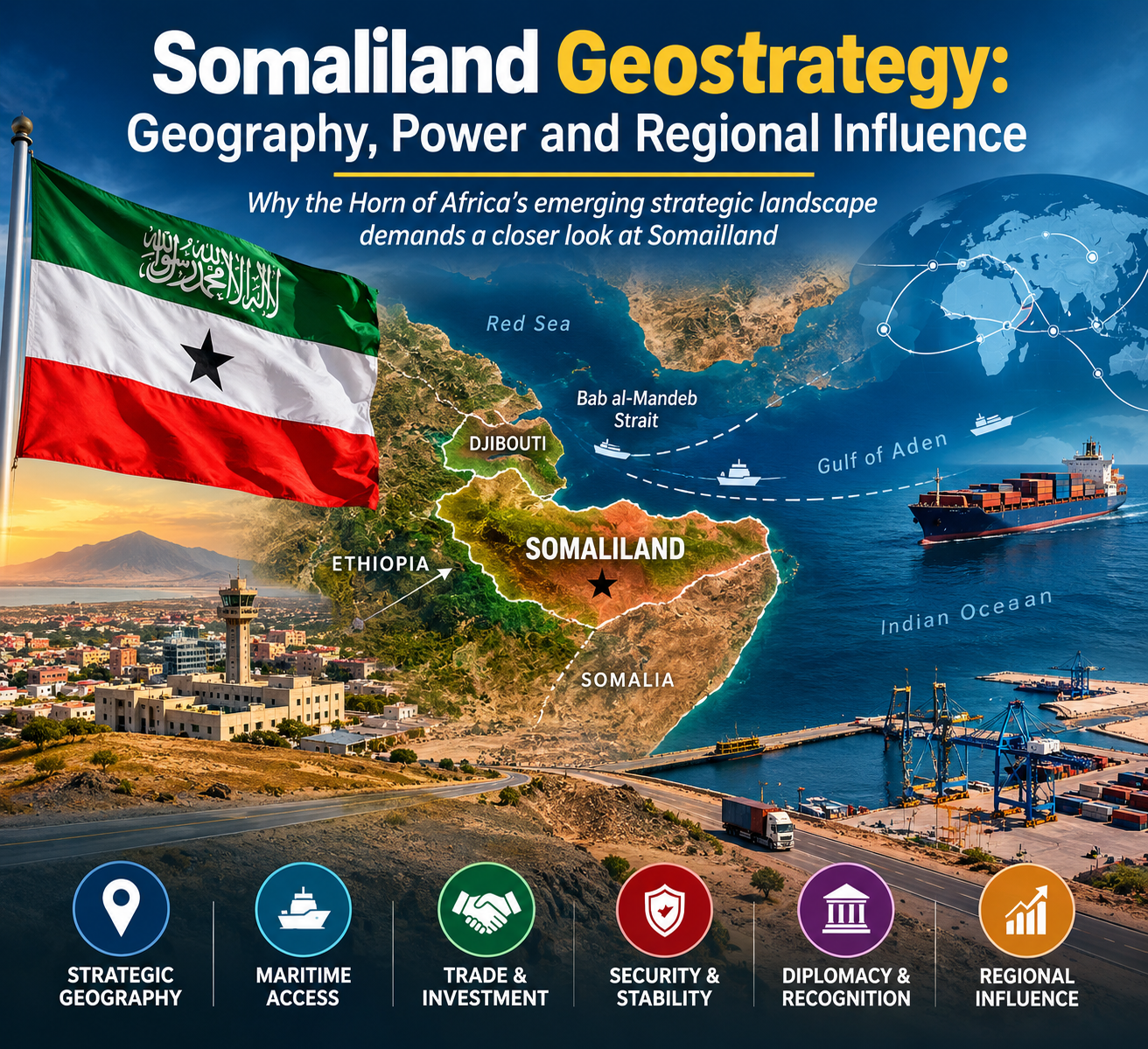
Located in the Horn of Africa, along the southern approaches to the Gulf of Aden, Somaliland occupies a position overlooking one of the world’s most important maritime corridors. Its proximity to the Red Sea, the Bab al-Mandeb Strait, the Arabian Peninsula, and the wider Indian Ocean gives it strategic relevance that extends well beyond its territorial size.
A major diplomatic development has added a new dimension to this strategic position. On 26 December 2025, Israel formally recognized the Republic of Somaliland as an independent and sovereign state, becoming the first country to do so since Somaliland restored its independence in 1991. The announcement marked an important development in Somaliland’s pursuit of international recognition and opened a new chapter in its bilateral relations. [1]
Yet geography and diplomatic recognition alone do not guarantee power. The central question is whether Somaliland can transform its location and emerging international relationships into sustainable economic opportunities, credible security partnerships, stronger diplomatic engagement, and meaningful regional influence.
Understanding Somaliland’s geostrategy therefore requires examining the relationship between geography, state capacity, maritime commerce, international recognition, regional competition, and the changing distribution of power across the Horn of Africa.
- The Geography of Strategic Opportunity
The Horn of Africa connects Africa, the Middle East, and the wider Indo-Pacific trading system. The Gulf of Aden serves as a maritime gateway between the Indian Ocean and the Red Sea, through which ships travel toward the Suez Canal and Mediterranean markets.
This corridor matters to global commerce, energy transportation, supply chains, and international security. Instability around the Bab al-Mandeb Strait can affect shipping costs, insurance premiums, delivery times, and the calculations of governments and commercial operators worldwide.
Somaliland’s northern coastline, including the area around Berbera, places it close to these strategic routes. This creates opportunities for port development, logistics, maritime services, fisheries, and international commercial partnerships.
However, proximity to a major shipping lane should not be confused with control over it. Somaliland does not control the Bab al-Mandeb Strait, and its strategic value depends on its ability to provide reliable infrastructure, effective governance, and a secure environment for legitimate commercial activity.
The distinction is important: geography creates potential, but policy determines how much of that potential can be realised.
- Berbera: From Port Infrastructure to Geo-economic Influence
Berbera is central to Somaliland’s economic and strategic outlook. Its port offers the possibility of connecting maritime trade with inland markets, particularly Ethiopia, one of Africa’s most populous countries and a major economy without direct access to the sea.
For Ethiopia, diversified access to ports is a significant economic and strategic consideration. For Somaliland, Berbera provides an opportunity to position itself as a commercial gateway serving regional trade, transport, and logistics.
The Berbera corridor could help strengthen connections between maritime infrastructure and inland economic activity. Its long-term value, however, will depend on road networks, customs efficiency, competitive costs, dependable services, and cooperation among the relevant authorities.
A successful port strategy requires more than expanding physical capacity. It requires building an integrated economic ecosystem involving warehousing, freight services, transport operators, financial institutions, insurance providers, and businesses that create jobs.
If developed effectively, Berbera could become more than a port. It could serve as an instrument of geoeconomic influence: a means through which Somaliland builds mutually beneficial relationships with neighbouring economies and international commercial partners.
The strategic objective should not be to turn trade into a weapon of political pressure. It should be to make cooperation economically attractive, commercially reliable, and beneficial to all participating parties.
- Ethiopia and the Strategic Politics of Sea Access
Ethiopia’s need for dependable maritime access is one of the defining geopolitical questions in the Horn of Africa. Its reliance on external ports exposes its economy to transportation costs, logistical bottlenecks, and political developments beyond its borders.
Somaliland’s location and the Berbera corridor create a basis for practical cooperation on these challenges. Such cooperation could encompass port services, transit arrangements, transport infrastructure, trade facilitation, and long-term investment.
Nevertheless, maritime access is a complex issue involving sovereignty, international law, regional diplomacy, and the interests of multiple states. Commercial arrangements and any proposals involving special access rights must be assessed through careful negotiations and clear legal frameworks.
For Somaliland, the most sustainable strategy is to demonstrate that cooperation can produce measurable economic benefits while respecting regional stability and the legitimate interests of all parties.
For Ethiopia, diversified and commercially viable access arrangements could support economic resilience and reduce dependence on any single route.
For the wider region, transparent agreements and practical cooperation would be preferable to escalating rivalries over ports and maritime access.
The question is not simply who gains access to the sea. It is whether regional actors can build a framework in which maritime connectivity becomes a source of shared prosperity rather than confrontation.
- The Red Sea, the Gulf of Aden, and Maritime Security
The strategic importance of Somaliland is inseparable from the wider security environment surrounding the Red Sea and the Gulf of Aden. Piracy, armed conflict, attacks on commercial shipping, illicit trafficking, and geopolitical competition have demonstrated how quickly insecurity in this region can affect global trade.
The interests of regional and international powers increasingly intersect around maritime routes, port infrastructure, military facilities, and security partnerships.
Somaliland can contribute to regional stability by strengthening maritime domain awareness, developing effective coastguard and law-enforcement capabilities, combating illicit trafficking, protecting legitimate commercial activity, and cooperating with appropriate regional and international partners.
Such efforts require investment in training, communications, surveillance, institutional accountability, and clear legal procedures.
Maritime security should also be understood in economic terms. Safer shipping routes, predictable port operations, and effective law enforcement can reduce commercial risk and make the region more attractive to investors.
Somaliland’s strategic contribution would be strongest if it were based on practical capabilities and responsible cooperation rather than geopolitical rhetoric alone.
- Israel’s Recognition of Somaliland: A New Diplomatic Chapter
On 26 December 2025, the State of Israel formally recognised the Republic of Somaliland as an independent and sovereign state. Israeli Prime Minister Benjamin Netanyahu announced the decision following a joint declaration involving Israel’s leadership and Somaliland President Abdirahman Mohamed Abdullahi, commonly known as Cirro. The announcement made Israel the first country to formally recognise Somaliland since its restoration of independence in 1991.
This development represents an important milestone in Somaliland’s diplomatic history. For more than three decades, Somaliland had pursued international recognition while developing its own governing institutions, conducting elections, and maintaining a distinct political and administrative system.
Israel’s recognition introduces a new dimension to Somaliland’s international engagement. It creates a formal basis for bilateral relations and the potential development of cooperation in areas including agriculture, healthcare, technology, economic development, and maritime security. The extent to which these opportunities produce lasting benefits will depend on the agreements, institutions, and practical initiatives developed by both governments.
The decision also has a wider geopolitical context. Israel’s interest in Somaliland intersects with the strategic significance of the Red Sea and the Gulf of Aden, where maritime security, international trade, and regional competition are increasingly interconnected.
For Somaliland, the recognition presents an opportunity to expand diplomatic engagement and demonstrate its capacity to build constructive international partnerships. It may also encourage further discussion among policymakers and analysts about Somaliland’s role in regional security, economic connectivity, and the evolving political landscape of the Horn of Africa.
However, the diplomatic implications should be assessed realistically. Recognition by Israel does not automatically mean that other countries will follow, nor does it establish universal international recognition or membership in the United Nations.
The decision also generated opposition from Somalia’s federal government and criticism from several regional actors, who raised concerns about Somalia’s territorial integrity and the potential implications for regional stability. These reactions underline the importance of continued diplomatic engagement and peaceful management of disagreements.
For Somaliland, the strategic challenge is to build on the recognition through substantive cooperation, economic development, and further diplomatic outreach. Its international engagement will be more sustainable if it combines the pursuit of recognition with transparent institutions, practical economic achievements, and constructive relations with neighbouring states.
The central question is no longer only whether Somaliland can attract international attention. It is how Somaliland can translate an important diplomatic development into lasting institutional, economic, and strategic benefits.
- Somaliland in a Multipolar World
The Horn of Africa is increasingly shaped by overlapping interests involving Gulf states, Türkiye, China, the United States, European countries, and regional powers. These actors do not necessarily share the same priorities: some focus on trade and investment, others on maritime security, political partnerships, military access, or broader competition for influence.
Israel’s recognition adds another dimension to this evolving environment, but it does not remove the need for Somaliland to maintain a broad and balanced approach to international relations.
A wider range of potential partners could support infrastructure development, investment, technological exchange, and diplomatic engagement. However, competition among external powers can also place pressure on smaller political actors to align themselves with one side against another.
Somaliland’s most effective approach would be a form of strategic pragmatism: engaging partners according to clearly defined national interests while avoiding unnecessary dependence on any single external power.
Such an approach would require transparent investment agreements, sound financial management, careful assessment of security commitments, and a consistent diplomatic message.
Partnerships should be judged by the value they deliver: employment, infrastructure, skills, trade, institutional capacity, and long-term economic resilience.
In a multipolar world, influence does not always come from military strength or economic size. It can also emerge from the ability to provide reliable services, connect markets, maintain stability, and build trust among competing interests.
- The Foundations of a Sustainable Somaliland Geostrategy
A serious geostrategy must move beyond identifying geographical advantages. It must establish priorities, allocate resources, and build institutions capable of turning long-term objectives into practical results.
Five priorities deserve particular attention.
First, develop a comprehensive maritime and port strategy. Berbera should be integrated into a broader framework covering transport, logistics, fisheries, coastal protection, environmental management, and commercial services.
Second, strengthen economic diplomacy. Somaliland should pursue partnerships that generate investment, expand export opportunities, improve infrastructure, and create measurable benefits for local communities.
Third, invest in institutional capacity. Predictable regulations, transparent public administration, effective customs systems, and reliable dispute-resolution mechanisms are essential for attracting long-term investment.
Fourth, pursue balanced regional relations. Cooperation with Ethiopia and engagement with neighbouring states should be based on dialogue, mutual benefit, peaceful dispute management, and respect for applicable international law. Somaliland should also seek to develop its bilateral relationship with Israel in ways that deliver tangible benefits while contributing to regional stability.
Fifth, develop a credible international narrative. Somaliland’s external engagement should combine its historical and political case with verifiable evidence of institutional performance, economic potential, diplomatic engagement, and contributions to regional stability. Israel’s recognition should form part of this narrative, while further diplomatic engagement remains an important objective.
These priorities are interconnected. A strategically located port cannot generate lasting influence without effective institutions. Diplomatic recognition cannot deliver its full potential without economic credibility. And geographical importance cannot substitute for a coherent, realistic, and consistently implemented national strategy.
Conclusion: Turning Location into Influence
Somaliland’s strategic importance rests on a combination of geography, maritime access, proximity to Ethiopia, the commercial potential of Berbera, and the wider international significance of the Red Sea–Gulf of Aden corridor.
Israel’s formal recognition on 26 December 2025 added a significant diplomatic dimension to this strategic position. It established a new bilateral relationship and created opportunities for further engagement, while also highlighting the continuing disagreements over Somaliland’s international status and the future political order of the Horn of Africa.
But Somaliland’s future will not be determined by geography or diplomatic recognition alone.
The decisive question is whether Somaliland can transform its location and international partnerships into productive economic relationships, resilient institutions, effective maritime security, and constructive regional diplomacy. This requires patience, strategic clarity, and an understanding that lasting influence is built through both capabilities and relationships.
For international policymakers, investors, researchers, and regional leaders, Somaliland deserves to be examined through this wider strategic lens. Its position raises important questions about maritime connectivity, diplomatic recognition, state-building, economic interdependence, and the future balance of power in the Horn of Africa.
Ultimately, the strongest geostrategy is not simply about possessing a valuable location or securing diplomatic recognition. It is about turning both into lasting benefits for society while contributing to regional stability and international cooperation.
Geography may open the door to strategic opportunity. Diplomatic recognition can widen that opening. Institutions, economic vision, and responsible diplomacy determine whether the opportunity becomes lasting influence.