
Executive Director, World Jewish Relief USA
Can a Dog Do a Mitzvah? A Rosh Hashanah LaBehemot Reflection
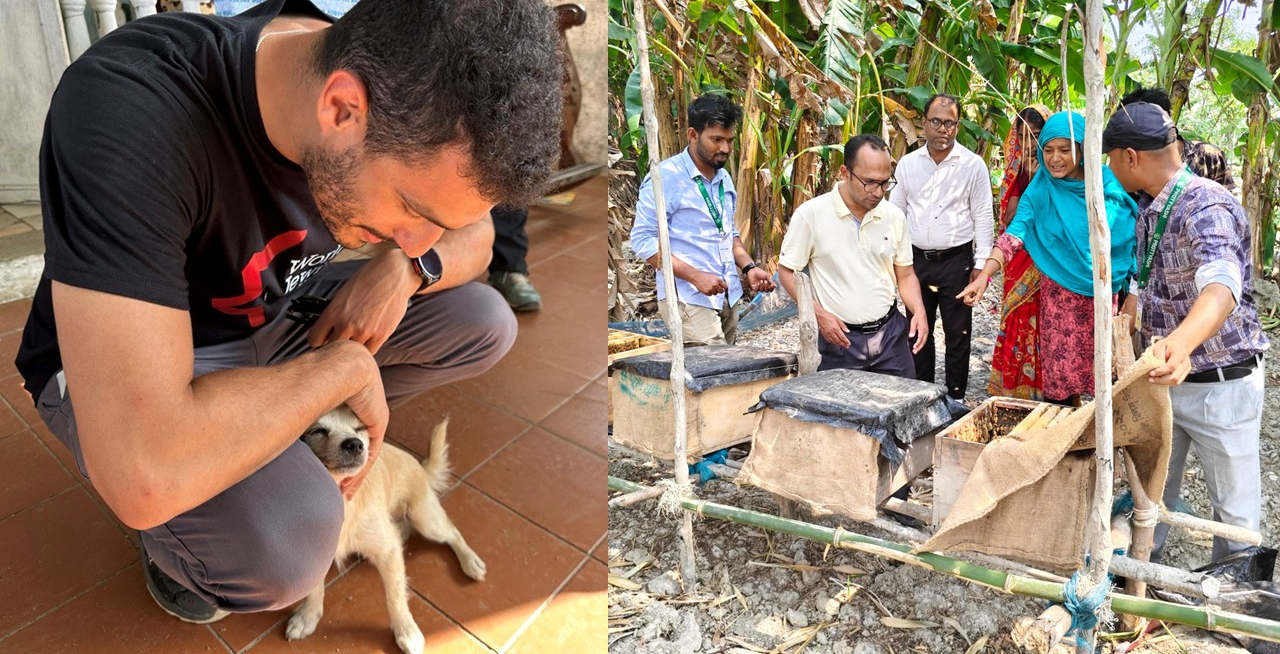
L: World Jewish Relief staff member with dog of a Venezuelan family whose home was badly damaged during earthquakes on June 24. (CREDIT World Jewish Relief) R: Community in the Sundarbans, Bangladesh, learning sustainable beekeeping with the support of World Jewish Relief. (CREDIT Prottyashi) Photos shared with permission.
Can a dog do a mitzvah?
Having spent an inordinate amount of time considering that question myself, years ago, I emailed a dozen rabbis to ask their opinions.
The answers were predictably varied. (What else would you expect from a dozen rabbis?) Some said, “Absolutely.” Others answered, “Definitely not.” A mitzvah, after all, is a commandment, and commandments are given to human beings, not dogs. Others raised the question of intention. Can an act be a mitzvah if the one performing it does not fully understand the motivation behind what they are doing?
But my favorite answer came from my childhood friend, Rabbi Neil Zuckerman of Park Avenue Synagogue in New York.
“There are questions of intent, obligation, comprehension, etc…So, in a purely technical sense, I would say dogs don’t HAVE to do mitzvoth. But they can certainly choose to. And since, in my opinion, the presence of a dog in one’s life is one of the purest things I know, I would say that the essence of a dog is to do mitzvot.”
I loved Rabbi Neil’s answer then, and I still do.
But it also led me to think about the question from the other direction.
If an animal can perform a good deed without necessarily understanding the mitzvah, what about those of us who have dreams and visions for making an impact in the world that we are unable to complete?
I have been thinking about that question as we approach one of the lesser-known holidays on the Jewish calendar, Rosh Hashanah LaBehemot, which begins at sundown this Thursday.
While many may only have heard of one Jewish New Year, one Rosh Hashanah, the Mishnah tells us there are four.
There is a New Year for kings and festivals (just before Passover), another associated with years, sabbatical and jubilee cycles and agriculture (the Rosh Hashanah we all know), and the New Year for trees that we know as Tu B’Shvat. And then there is the first of Elul — Rosh Hashanah LaBehemot, the New Year for Animals.
While I’ve observed Rosh Hashanah LaBehemot in the past by blessing my pets, its original purpose was to establish the date for determining the animal tithe. With the destruction of the Temple, Rosh Hashanah LaBehemot largely disappeared from Jewish life.
But the idea of setting aside a day to think about our relationship with the animals with whom we share this world feels anything but obsolete.
Half a world away, along the northern edge of the Bay of Bengal, lies the Sundarbans, one of the world’s largest mangrove forests. It is an extraordinary landscape of islands and waterways, home to snakes, deer, crocodiles, countless other species…and the iconic Bengal tiger. The tigers there have adapted so completely to their aquatic environment that they swim between islands in search of prey.
But the Sundarbans are also home to millions of people.
For generations, families there have depended upon the forest for their livelihoods, through fishing, farming, hunting and logging. Increasingly, climate change is disrupting that delicate relationship. Cyclones, tropical storms and floods are becoming more intense and less predictable. Saltwater is replacing freshwater. Livelihoods that were once dependable are disappearing.
And it is here that the interests of people and animals can collide.
A person who enters a mangrove forest to gather firewood isn’t thinking about biodiversity. They are thinking about cooking dinner.
A person who extracts resources from a fragile ecosystem isn’t necessarily indifferent to the animals who live there. They may simply need to feed their children.
And a Bengal tiger doesn’t know that the human being entering its habitat is simply trying to survive.
World Jewish Relief has been working with our local partner, Prottyashi, to help communities in Bangladesh adapt to this changing environment.
Part of that work is remarkably simple. Families receive new cooking stoves that require less firewood. That means fewer trips into the forest to collect wood, and fewer potentially deadly encounters between people and tigers.
And then there are the bees.
World Jewish Relief is helping 200 families, particularly women and people from marginalized groups, build sustainable livelihoods through beekeeping. They receive training, equipment, business advice, and connections to markets so that they can produce honey and earn an income.
That income does something important for people.
But it does something for animals, too.
When a family has another way to make a living, there is less need to extract resources from the mangrove forest. There is a little less pressure on the Sundarbans. A little less intrusion into wildlife habitat. A little more space in which human beings and animals can coexist.
We sometimes talk about protecting people and protecting animals as though they were competing causes.
In the Sundarbans, they are intertwined.
Helping a family earn a sustainable living can help protect a tiger. Protecting a forest can help preserve a family’s future. And even something as small as a bee can become part of an ecosystem in which people, animals, and the natural world have a better chance of surviving together.
On Rosh Hashanah LaBehemot, that feels like a mitzvah.
But I don’t live in Bangladesh. I don’t know how to teach someone to keep bees. I can’t build a climate-resilient home in the Sundarbans. I can’t provide a family with a more efficient cooking stove. And, much as I might like to, I certainly don’t know how to protect a Bengal tiger myself.
I do, however, want all of those things to happen.
Years ago, I was interested in whether an animal capable of doing something good, but, some would argue, incapable of forming the intention to do so, could perform a mitzvah.
But I also found myself wondering about the reverse.
What about those of us who possess intentions that we are personally unable to turn into realities?
There is a tangible difference between wanting to repair the world and actually repairing some small piece of it.
We encounter that difference all the time, and it can leave us feeling helpless. We want to feed someone who is hungry, shelter someone who has been displaced, help a family escape poverty, or protect a fragile corner of the natural world.
But we don’t know the person who needs us. We don’t speak their language. We don’t know how to reach them. And, perhaps most importantly, we may not know what will actually help.
That is one of the roles an organization such as World Jewish Relief plays.
We exist in the space between intention and action.
Someone thousands of miles away has the desire and resources to help. Someone closer to the problem has the knowledge, relationships, and ability to act.
One provides the blessing. Another provides the amen.
And something actually changes.
An intention becomes an action.
A mitzvah gets done.
Which brings me back to the dog.
Rabbi Neil believed that even without obligation, a dog could choose to do a mitzvah. For the rest of us, perhaps the challenge is the opposite. We have the intention. We just need help understanding how we can do the mitzvah.
On Rosh Hashanah LaBehemot, may we find the joyous and meaningful avenues that turn our dreams and visions for building a more beautiful world into tangible impact.
Bless the animals…and all of us.
Amen.
Related Posts