I thought a sukkah was fragile; the border kibbutzim proved me wrong
For the first 30-plus years of my life, I was the wandering Jew. That was my minhag, my custom. Ten cities and even more boroughs! Modiin is where the wandering stopped. We passed the four-year mark, a personal record, and kept going (with a small less-than-a-year detour in Boca Raton…).
When I visit most of those places, my memories feel like vacation memories. One memory per spot.
Now I have a home. A neighborhood. A community. I am so grateful for that. But having a home means many memories… memories of very different sentiments and nature stretching across one small physical area.
I take a walk at least twice a week. On one stretch of that walk, many memories flash as I pass. I’ve had deep conversations with walking friends there, where we’ve discussed job woes, relationships, politics, and also just laughed. I celebrated a Shavuot lunch in that same spot… with sports, games, and just chilling. That’s also the same spot I was when the first Houthi missile came in. I wasn’t used to needing to take cover when there was no cover, and I just felt helpless. I felt even more helpless walking past that same spot, lined with posters for Hersh Goldberg-Polin z”l. Then Hersh was murdered, and the helplessness turned into despair.
One area of land. All of the memories and emotions at once. That’s what a physical space can do in manifesting memory.
I love Sukkot. I always have. The adventure of building, the creativity of decorating, the juggling of where and when to eat depending on the weather, the timing, the guests. I sometimes wonder whether I love it because of those 30-plus years. This is the holiday of the wandering Jews!
The Torah tells us why we sit in the sukkah: l’maan yeidu doroteichem, so that every generation will know that God made us dwell in sukkot when we left Egypt (Leviticus 23:43). Sukkot is a mitzvah of memory. For one week a year, the whole Jewish people go back to being the wandering Jews.
A few years ago, I gave a dvar Torah in my shul that I really loved. Every Friday night we say ufros aleinu sukkat shlomeCha, spread over us the sukkah of Your peace. And I asked: why a sukkah? Why not the palace of Your peace, or the fortress of Your peace? A castle stands for centuries. A sukkah is fragile. A strong wind can blow your hut off the roof. A downpour can ruin it. It can catch fire. You have to tend to it constantly. And that, I said, is what peace is. Fragile. Something you have to keep checking on. It was an aha moment for me and a truth that I wanted to share.
I believed that. I still want to believe it.
Then came October 7th.
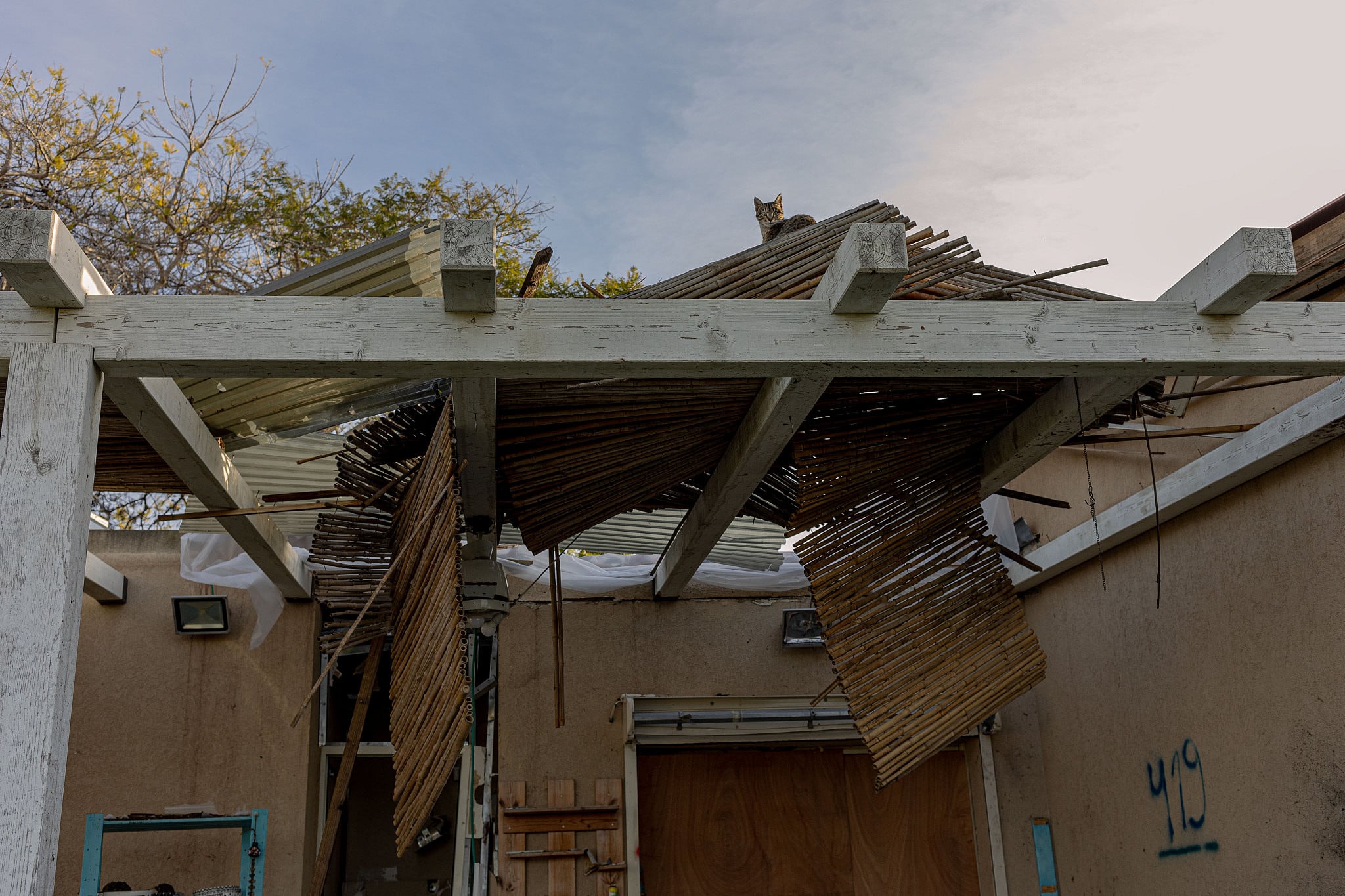
In the kibbutzim, the sukkot still stood long after the devastation. They were more durable than I ever could have imagined. Painfully durable. Dreadfully durable. They withstood hell on earth. The wind didn’t knock them over. The fire didn’t take them.
I almost wished they had burned down. Because what we were left with was a physical reminder that people who spent their lives seeking peace, committed to it, dreaming of it, had their lives cut short by those who defied and defiled that dream.
It turns out the sukkot weren’t fragile. We were.
I know time has passed. But I can’t let it go. Memory is a critical part of who we are. Our religion is built on zachor, remember. It’s our DNA. We have a seder so we don’t forget. We keep doing things in very specific ways because memory shaped our people, our practices, and it shapes each of us too. Even this holiday is built on it. We leave our homes and sit in huts precisely so we won’t forget what it was like to have no home.
Call it second-generation PTSD, but whenever I see train tracks, or the opening of a Warner Brothers movie, with that aerial shot sweeping over the buildings, I think of Auschwitz, where over three-quarters of my father’s family were murdered and incinerated. I can’t help it. Memory is just a part of me, and I think it is part of our people. It just is. Zachor isn’t only a commandment. For some of us, it happens whether we choose it or not.
Clashing with all that memory, halacha walks in and says: v’samachta b’chagecha, you shall rejoice in your festival. Be happy. We are now in zman simchateinu, the season of our joy.
I used to teach a shiur, a class, on this. Some of my shiurim, on feminism, for example, took real work to get audience buy-in. But being happy? That is a nice, pareve shiur. Who argues with being happy? Then one Simchat Torah in a suburb of Philadelphia, a woman pushed back. Her community had recently suffered a terrible loss right before a chag. The children couldn’t sit the full shiva, because the holiday cut it short. Isn’t it cruel, she asked, to require happiness?
I didn’t have a great answer then in my early 20s. I’ve been thinking about it ever since.
The Talmud (Sukkah 25b–26a) says that someone who is mitzta’er, in physical distress, is exempt from the sukkah. If it’s too cold or too wet, you can go inside. But then it says that an avel, a mourner, is still obligated. Their pain comes from within, and halakha requires them to self-comfort and settle their mind. They have to figure it out.
When I first learned this, it seemed harsh. Rain can send you inside. Grief cannot. I know Israelis seem to be more terrified of rain than any Brit or American, but come on. It is easier to withstand a drizzle than the pain of loss.
I’m choosing to read it differently now. Grief is exactly when halacha refuses to let you sit alone in your house. You have to come out, under the schach, the thatched roof, with everyone else.
The Rambam goes further when it comes to the requirement of simcha, happiness or joy. He says someone who celebrates the chag with their family but doesn’t feed the orphan, the widow, the poor, and the stranger isn’t celebrating a mitzvah at all (Mishneh Torah, Laws of Festivals 6:18). That’s simchat kreiso, the joy of the belly. Joy on chag is measured by who is sitting with you.
So maybe the question from Philadelphia was aimed at the wrong person: the mourner. The mitzvah of simcha isn’t only on the one who is grieving. It’s on all of us to build a sukkah the grieving can bear to sit in.
I think that’s what the Torah is asking of us. Not to feel happy on command, and not to forget. We couldn’t forget if we tried. It asks us to show up. Dressed for chag, at the table, in the sukkah, together. Sometimes the feeling follows. Sometimes it doesn’t. But the showing up is the resilience.
The sukkot of the kibbutzim stood. Now it’s our job to fill ours with love, understanding, and conversations that bring peace.
–
I’m planning to share the above words with my beloved kehila, Lechu Neranena in Modiin this chag.