
Can I Build A Digital Sukkah on Facebook?
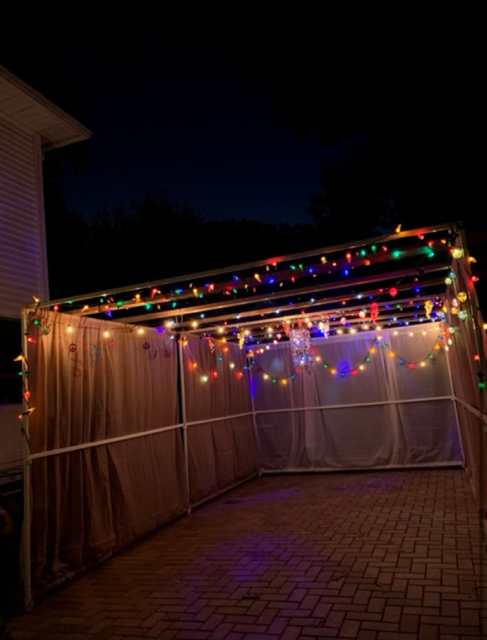
The Mishnah of Sukkah in Seder Moed offers an extensive and exhaustive list of what materials are allowed and are forbidden in the construction of a Sukkah. It provides seemingly never-ending examples of places where one might construct a Sukkah and where one cannot imagine doing so. And the Mishnah expresses incredible craftsmanship in articulating the heights, sizes, and footprints of what might entail the appropriate Sukkah. Embedded in the never-ending list of permissible and forbidden craft is the very ironic realia that this dwelling is meant to be a fragile, non-permanent space, that very much opens one up to the endless possibilities of the infinite, yet is constructed in the most meticulous and finite manner.
What is always limiting in the rabbinic imagination is that, predictably, they could not quite imagine the craft of the world we inhabit today. Yes, there are a multitude of ways in which their storytelling and legal proclamations describe guidelines that we can employ in our spiritual everyday lives as Jews in the digital era. But their boundless energy and creativity still falls short of imagining, for example, a digital world in which we are able, in short strokes, to connect across time and space simultaneously and with deep, meaningful connectivity.
In that space, what might it look like to say, I am building a Sukkah on Facebook, and inviting in as my Ushpizin, as my guests, the people in my life whom I do not get to connect with on a daily basis? Because, after all, for many of us, even those of us who “take social media breaks” or are part of “another generation” (whichever that might be), there is a fascination with, and an excitement about, the ability to stay “in touch” across time and space. And that “staying in touch,” that “connecting across time and space,” is the rabbinic model of the Ushpizin, invited into our lives for this week of Sukkot. During this holiday we encounter the dichotomy of being prescribed the celebration of the joy of life, while also being instructed to succumb to the fragility of life and to experientially and spiritually engage with both extreme feelings and expressions at one and the same time.
Into that temporal space, our Ushpizin, our invited guests into our digital Sukkah, bring us blessings and joy from across time, while also reminding us that a life well lived is one captured in memories, for our lives have not only a beginning but also an end, and we do not control when they end, just as we ultimately do not control any of the fragility of the lives we are gifted.
In this space, what Sukkah might we build on social media in this digital era? Is it not a thread connecting our Ushpizin to our life stories, and through our life story connecting them to one another? It is the ultimate imagined Sukkah as a fragile construct open to guests. It is a place to welcome Ushpizin and enable a conversation between Ushpizin, as we welcome guests to visit not only with us in our Sukkah but also with one another. It turns out the rabbis might have already imagined this, even if they never could have imagined Facebook. Each day of Sukkot, the Ushpizin liturgy calls in that day’s guest by name and then asks all six of the others, all twelve of the others, to sit not only with the host, but with that guest as well: “If you please, Abraham, if you please Sarah, my lofty guest, may all the exalted guests sit with me and with you.” The formula repeats for each of the seven days, so structurally, every guest is connected not only with the host, but with the guest who came before them, and anticipates being connected with those who come after them. It is, in its own finite and meticulous way, a Sukkah set for a conversation across space and across time, with and between one another.
A Facebook Sukkah: a post goes up, and the people who show up in the comments are not only responding to the OP (original poster), they start responding to each other. I think of a recent post of my own, where friends from across different moments of my life each joined in with comments, and those comments connected them not only to the life event itself but also to one another. It was a constructed space in which people were noticing, in asynchronous time, that they had shared friendships, that our circles had quietly overlapped for years without either of us knowing. And more than one person said some version of the same thing: that they wait for this posting every year, that it has become its own small way of communally marking time.
A Facebook Sukkah: the post could last from year to year, or it can have the intention of being posted just for the fulfillment of interconnecting to the physical and existential fragility of this holiday of Sukkot. It allows one to see the metaphysical sky twinkling in the webosphere. And most importantly it invites Ushpizin, guests and visitors, who exist in discrete communities, from across time and space, and for a few precious days. A Facebook Sukkah, where they, like the Ushpizin of yore, are in conversation with one another while visiting with me.
May we find the ongoing joy in the gift that is sitting with something that is fragile and still ours to shape. And maybe that is the truest sense in which a Facebook post can be a Sukkah after all: not a structure I build alone, but in this digital era, a community that is created through the ongoing practice of showing up with one another, not only for this joyful holiday, but across time and space. May our Facebook Sukkah be a place where the guests continue to choose to sit down with one another in conversation and dialogue, joyfully.