
Can Religious Rituals Truly Inspire Moral Action?
After completing the High Holidays, the global Jewish community is now entering Sukkot (the Festival of Booths), which is arguably the pinnacle of the biblical calendar. Sukkot is not only the last and the longest of the holidays in this holiday season, it is also the culmination of the ancient Levantine agricultural cycle — the last of the three pilgrimage harvest festivals, before the winter. While observing these holidays, I find myself wondering: Can religious rituals truly inspire moral action?
Sukkot has a vital moral message for our time, but there is a challenge with how it tries to convey that message. On Sukkot, we are to leave the comfort of our homes and “dwell” in temporary structures without solid roofs for a week, in order to remember our essential vulnerability and dependence on Divine grace, and also to remember those who are more vulnerable than we are and who are dependent on our support and protection.
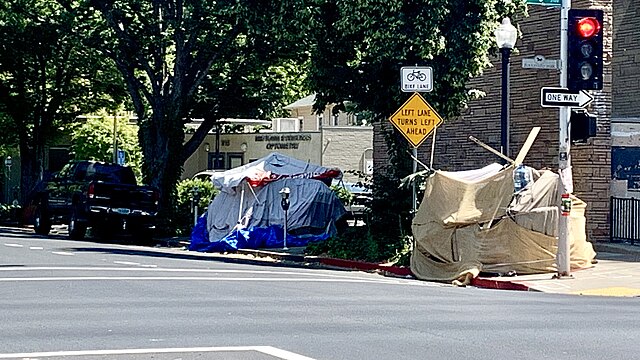
Those of us with the privilege of secure housing so urgently need this reminder right now in 2025. As the current administration is slashing resources for the social safety net including massive cuts to HUD, rolling back the AFFH, America desperately needs to remember empathy for the vulnerable. Not only is assistance being removed just as the cost of living increases, but federal, state, and local governments are actively attacking the unhoused population through criminalization of homelessness, aggressive policing and sweeping of the streets.
But I wonder: Does this ritual work? Many of us spend the week of Sukkot eating particularly delicious holiday meals, outside in pleasant fall weather, on comfortable chairs, in beautifully decorated Sukkot, in the privacy of our backyards. In our sukkot, we face none of the uncertainty unhoused people face, of our possessions being seized by authorities or ourselves being forced to leave or imprisoned. We have easy access to food, medication, and showers. Now, there are plenty of members of the Jewish community who themselves face economic insecurity or homelessness. But do the rituals of the holiday really give the rest of us an experiential reminder of those hardships?
Should we make our Sukkot less comfortable, limit our food, trying to experience the reality of life without a home? Is that truer to the spirit of the holiday? But no — another major theme of Sukkot is joy! We are commanded to eat those especially delicious holiday meals! We are supposed to leave the sukkah if it starts raining. We are forbidden from work and chores.
Watching the state of American discourse today, I have come to believe that this contradictory call to experience vulnerability and to experience joyous abundance is itself the necessary lesson to take from Sukkot.
The great 12th-century Jewish scholar Maimonides writes in his monumental code of law about the need to rejoice in the holidays not only in abstract, spiritual joy, but through material things: new clothes and jewelry, good food and wine, and sweet treats for the children. And then he goes on to say,
When a person eats and drinks, he is obligated to feed converts, orphans, widows, and others who are destitute and poor…. a person who locks the gates of his courtyard and eats and drinks with his children and his wife, without feeding the poor and the embittered, is [not indulging in] rejoicing associated with a mitzvah, but rather the rejoicing of his gut.
We are commanded to rejoice, but if we rejoice alone with our families — that does not count. That is not real rejoicing. We must rejoice by making sure the most vulnerable people in our society are also rejoicing with material abundance.
The attacks in our society on the vulnerable, on minorities, on the unhoused, on refugees and immigrants, have more than one source in our societal psyche. One is a lack of empathy for these “others” — a loss of identification with the vulnerable. But on the other hand, a strong identification with vulnerability is itself another source for the cruelty — a sense that I am under threat, that in order to ensure my own family’s material needs, material joys, I must “lock the gates of my courtyard” and look out only for myself and my “own.”
We are nearing Sukkot, in the shadow of the Days of Awe, the days of deep personal humility and repentance. Sukkot, the last harvest, with gratitude for what has grown this year and nervous anticipation to see how the rains will fall and what will grow in the coming season. And Sukkot reminds us: You must remember your human vulnerability, and you must simultaneously celebrate abundance. And the only way to celebrate is for everyone to share in the abundance, and the only way to find security is for everyone to protect each other.
Can the millennia-old Jewish ritual of dwelling in a hut for a week inspire us to act on behalf of those facing housing insecurity? I don’t know but I’m willing to keep trying.