
Russian-American-Israeli Palestinian. Palestine is Israel.
Canonical Pi Day
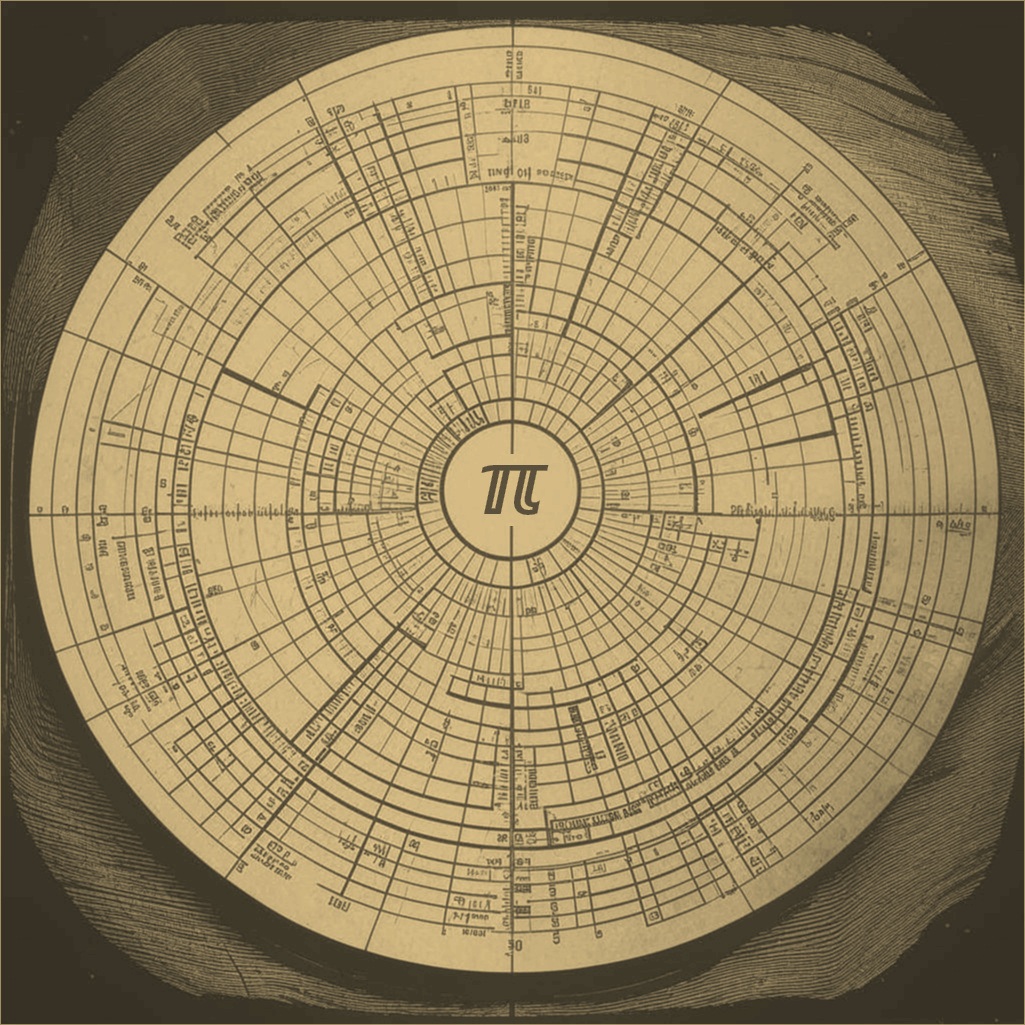
π is not just the ratio of a circle’s circumference to its diameter. It is a number pointing to the infinite within the finite, to the presence of eternity in a simple circle. Image © Ivan Bassov, 2025. Licensed under CC BY 4.0.
Loyalty to the Number, Not the Format
November 10 is approaching — the Canonical Day of the Number π.
Paradoxically, every year in mid-March, the internet explodes with festive posts, memes, and videos featuring pies: “Happy Pi Day!” — March 14, 3/14.
On this day, people around the world, primarily in the United States, celebrate π — the eternal mathematical constant connecting the circle to infinity.
But if you think about it, the choice of this date is far from obvious. Why March 14? Because Americans write dates in the month/day format, and 3/14 visually resembles the first digits of π: 3.14.
Beautiful, yes. But only within one country. For the rest of the world, it is just March 14, without any association with π.

Some mathematicians celebrate another option — July 22 (22/7), in the day/month format used elsewhere in the world. This is the famous rational approximation of π, known since Archimedes’ time (22/7 = 3.142857…). However, it too remains merely a compromise between convenience and precision. The key point here is that the date is dictated by format — just like 3/14 — rather than by the essence of the number itself.
I suppose that the date 22/7 in the “European format” arose partly in contrast to 3/14, since not everyone accepted the American format as the standard. Thus, July 22 became a convenient way to celebrate π, independent of local date-writing conventions.
And here begins the search for something more fundamental — the true, canonical day of π. A day that does not depend on habits, formats, or cultural conventions. A day in which form coincides with content, and the symbol matches the number itself.
A Holiday Losing Meaning in Its Form
Any symbolic date is a way to express an idea in time. Why shouldn’t π have its own day, based not on an arbitrary date format in one country, but on the number itself?
If π ≈ 3.14, then the 314th day of the year is its natural place in the calendar.
- In common years — November 10
- In leap years — November 9
This is the day I proposed to consider the Canonical (or Orthodox) Pi Day — not in a religious, but in a philosophical sense: a day where form and content coincide, where the symbol does not play on word games, but reflects the essence.
And we already have precedents. The same property is found in Programmer’s Day — a professional holiday in Russia, observed on the 256th day of the year. In common years it falls on September 13, in leap years — September 12.
This number — 256 = 2⁸ — is as fundamental to computing as π is to the universe. Each has its natural day in the calendar, arising from its very nature.
Why the 314th Day is Fairer than 3/14
Let’s try to set aside the habit of looking at the calendar through the eyes of a particular culture.
The date format is a convention, an agreement, a social contract. But π does not recognize conventions. It is the same in all languages, on all continents, in all numeral systems. There is no “American” or “European” version.
It is a number underlying the very structure of the world — from planetary orbits to microscopic spirals of DNA.
So why should a holiday celebrating the very idea of universality be hostage to a single local date-writing tradition?
The 314th day of the year does not depend on format. It exists on its own, regardless of how you number the months or in what order you write the digits. It is not imposed by culture — it is calculated, and that is its beauty.
The Canonical Nature of π in Different Calendars
One could argue that even starting the year on January 1 is itself a convention. Moreover, different countries and cultures use other calendars, either alongside or instead of the Gregorian calendar: the Jewish lunisolar calendar, the Muslim lunar calendar, the Ethiopian calendar, the Indian calendars, and many others.
Even in these calendars, π Day can be observed on the 314th day of the corresponding calendar, and Programmer’s Day on the 256th day. The meaning remains the same: the reference point and the symbolism of numbers matter more than the specific format of month and day.
A Circle Closing in November
I celebrate my birthday precisely on the 314th day of the year — November 10 (or November 9 in leap years). Perhaps it is this coincidence that gives me a special sense of connection to π.
For me, it is not merely a beautiful play of numbers. It is a reminder that in life and thought, there is something that strives for completeness, for a circle, where everything returns to itself.
π is not just the ratio of a circle’s circumference to its diameter. It is a number pointing to the infinite within the finite, to the presence of eternity in a simple circle.
It unites matter and idea, form and infinity — just as a calendar unites moments of time with symbols of meaning.
Mathematical Honesty as a Form of Respect
We are used to treating dates conditionally. But if we speak of π Day, let it be honest — like the number itself.
Let it be a day that is calculated, not invented. A day where the idea coincides with the form, rather than pretending for convenience.
Therefore, I believe the 314th day of the year is the true, canonical Pi Day.
Just as the 256th day is the indisputable Programmer’s Day, not June 25 (25/6) or any other arbitrary date.
A Holiday for Those Who Think Precisely
The world increasingly lives in symbols, where meaning is obscured by superficial shine.
But π remains unshakable — it does not belong to a culture, language, or country.
It is a pure constant, independent of human arbitrariness.
In this sense, November 10 (or November 9) is not just a mathematical date, but a day of inner harmony between thought and number — between idea and calendar — between humanity and the Universe.
Canonical Pi Day — the day when the circle truly closes.
Related Topics
Related Posts