
Russian-American-Israeli Palestinian. Palestine is Israel.
Us vs Them, Part I
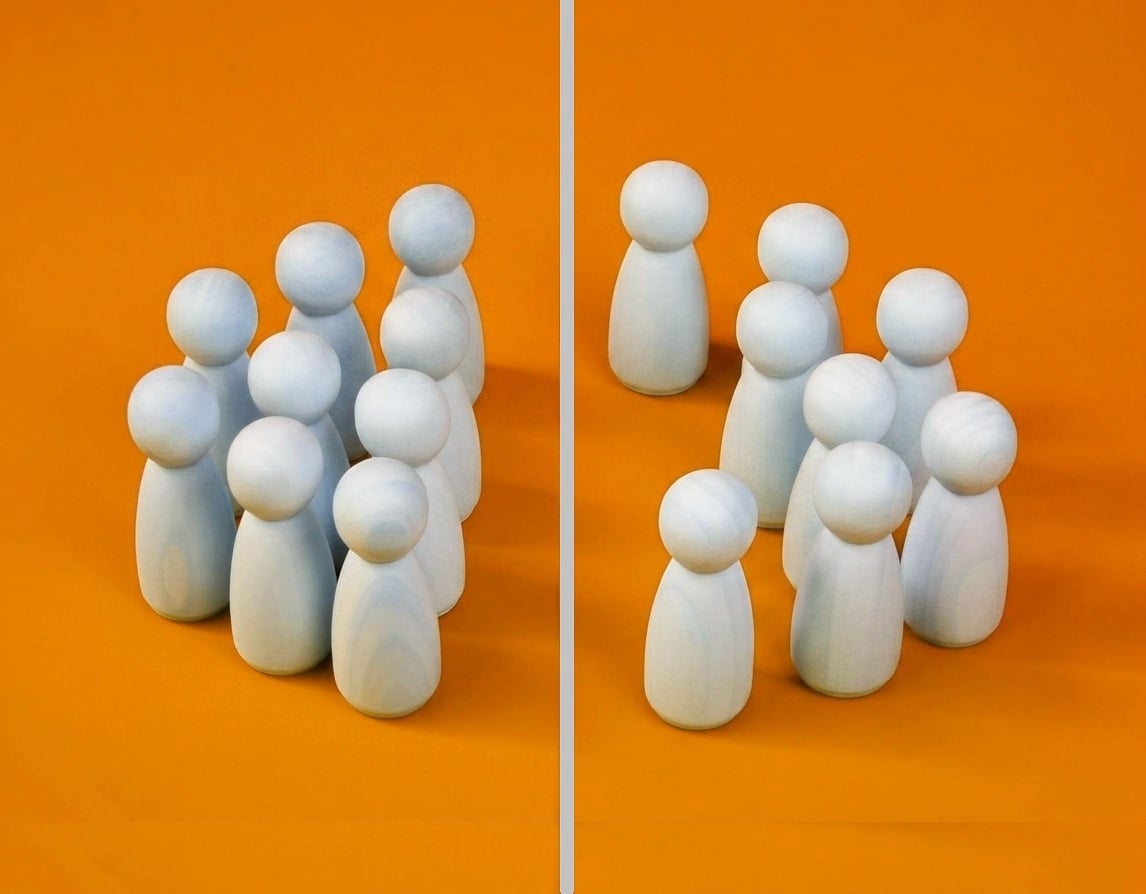
The Psychology of Belonging: How do we create “us” and “them”? Image © Ivan Bassov, 2026. Licensed under CC BY 4.0.
The Psychology of Belonging
Human beings have always divided the world into “us” and “them.” But what creates that boundary?
Is it language, religion, ancestry, appearance, nationality, culture, or something else? And do differences create group boundaries—or do we first establish boundaries of belonging and only afterward decide which differences matter?
This series explores three related questions:
How do we create “us” and “them”?
How do group boundaries become social and political institutions?
And if human beings will always form groups, how can we live together?
This first part examines the psychology of belonging: where the distinction between “us” and “them” comes from, what the minimal-group experiments reveal about it, and why the characteristics we use to distinguish groups may be less fundamental than the boundaries themselves.
Belonging Before Difference
What makes someone one of “us” and someone else one of “them”?
At first glance, the answer seems obvious. Human beings notice differences, and those differences divide us into groups. Different languages create linguistic communities; religions create religious communities; appearances can become racial boundaries; and political beliefs can create opposing camps.
But is that actually how the process works?
Perhaps the more fundamental question is not which difference separates us, but who belongs in the first place.
Do people see a difference and conclude, “They are not one of us”?
Or do they first recognize—or construct—a boundary between “us” and “them,” and then begin looking for characteristics that explain or justify it?
This possibility raises a series of deeper questions. If human beings inevitably form circles of belonging, are tensions between groups unavoidable? Does assimilation actually dissolve group boundaries? Why could highly assimilated Jews in nineteenth- and twentieth-century Western Europe still be regarded as outsiders? And what happens when political, religious, ethnic, or national identities become so important that the other side is no longer seen merely as different, but as incompatible?
These questions lead to a more unsettling possibility:
Perhaps belonging comes before difference.
People may not simply discover the boundaries between “us” and “them.” To a significant extent, they may create those boundaries first—and only afterward decide which differences matter.
Which Difference Matters?
If belonging comes before difference, an obvious question follows:
What determines which difference becomes important?
Skin color?
Language?
Accent?
Religion?
Nationality?
Political ideology?
There is no universal answer.
History provides examples for almost every possibility.
In many societies, language has been one of the most powerful markers of group membership.
The ancient Greeks distinguished themselves from foreigners partly through language. Those who did not speak Greek were barbaroi—a term associated with speech that sounded unintelligible to Greek speakers.
A similar process appears in Russian. The word немец (nemets), meaning “German,” is related to немой (nemoy), “mute” or “speechless,” reflecting an old Slavic way of referring to people whose speech was unintelligible.
In both cases, the linguistic outsider was defined, in effect, as the person who cannot speak like us.
Elsewhere, religion became the defining boundary.
In other places, ancestry became decisive.
In modern societies, political ideology can divide people who share almost everything else.
And in some societies, visible characteristics such as skin color have become powerful markers of social identity.
But there is something curious about this variety.
If one particular characteristic were inherently responsible for creating “us” and “them,” we would expect it to be remarkably consistent across societies.
It is not.
The marker changes.
The boundary remains.
Perhaps, then, the important question is not simply which characteristic separates people.
It is why a particular characteristic becomes important in the first place.
The Minimal Group Experiment
Social psychology provides a remarkable clue.
In the classic “minimal group” experiments associated with Henri Tajfel, researchers divided people into groups using trivial and essentially meaningless criteria.
The participants did not share a history.
They did not share an ancestry.
They did not speak different languages.
They did not practice different religions.
They had no centuries-old conflict with one another.
The groups were, in effect, artificial.
Yet even these minimal categorizations could produce a preference for members of one’s own group.
The finding was important because it showed how little can be required to produce an “us” and a “them.”
People do not necessarily need ancient grievances.
They do not need obvious physical differences.
They do not even need a meaningful reason for the division.
A minimal social distinction can be enough to activate group-based thinking.
Once people are categorized into different groups, they may begin treating members of the two groups differently—even when the original distinction has little or no intrinsic meaning.
This suggests an important possibility.
Perhaps the psychological sequence is not:
They are different.
Therefore, they are not one of us.
Perhaps it is often closer to:
These are my people.
Those are not my people.
What makes us different?
The difference may come afterward.
The Corollary
There is an important corollary to this idea.
If people can begin with “these are my people,” they can also begin with:
These are not my people.
The two statements are really two sides of the same boundary.
Once someone is placed outside the circle, differences can suddenly become more noticeable.
Their accent sounds foreign.
Their customs seem strange.
Their beliefs appear irrational.
Their clothes look unusual.
Their values seem incompatible.
Their history becomes different from ours.
The same characteristic may have been completely irrelevant before the boundary was drawn. Afterward, it can become evidence for the boundary.
This does not mean that people simply invent differences.
The differences may be real.
The important point is that their social significance may be assigned rather than discovered.
A language difference can exist without producing hostility.
A religious difference can exist without producing exclusion.
A racial difference can exist without producing social separation.
A political disagreement can exist without producing hatred.
The difference alone does not determine the relationship.
The meaning assigned to the difference does.
This distinction matters. It does not deny that people are genuinely different. It asks a different question: which differences become socially consequential, and why?
Circles of Belonging
Every person belongs to many circles simultaneously.
Family.
Neighborhood.
School.
Profession.
Religion.
Nation.
Political movement.
Sports club.
University.
Language.
Culture.
Some memberships are inherited. Others are chosen. Some last a lifetime; others change within a few years.
A person can belong to many circles at once, and those circles overlap.
A person may disagree with a neighbor politically but share the same profession.
Two people may belong to different religions but the same family.
Two citizens may disagree about nearly every political issue but still identify as members of the same nation.
Two strangers may have nothing else in common except that they support the same sports team.
Overlapping identities can create bridges between groups.
But they can also change.
A person can move to another country, change religions, change political beliefs, change professions, or enter an entirely different social circle.
One person can become a committed communist while another becomes a devoted capitalist.
One can become deeply religious while the other becomes secular.
One can become passionately supportive of Israel while the other becomes passionately opposed to it.
The point is not that every identity is equally flexible. Some memberships are inherited and difficult or impossible to change; others are voluntary and fluid. The point is that the relative importance of our identities can change.
We do not simply belong or not belong.
We belong to multiple circles, with different degrees of importance.
And the circle that matters most in one situation may matter much less in another.
This flexibility creates opportunities for coexistence. A political disagreement need not erase a shared nationality. A religious difference need not erase a friendship. A disagreement over one identity can be contained by another identity shared in common.
But the opposite is also possible.
When One Circle Takes Over
What happens when one identity becomes more important than all the others?
A person can be a neighbor, colleague, citizen, friend, and political opponent at the same time.
But if political identity becomes dominant, the other identities may become irrelevant.
The colleague becomes “a communist.”
The neighbor becomes “a fascist.”
The citizen becomes “an enemy of the nation.”
The person disappears behind the category.
Something similar can happen with religion, ethnicity, nationality, or any other identity.
The more completely people divide the world into two opposing camps, the fewer bridges remain between them.
And when several identities align—when the same people are perceived simultaneously as belonging to the wrong religion, the wrong ethnicity, the wrong nation, and the wrong political camp—the boundary becomes especially powerful.
At that point, “them” is no longer simply a collection of people who differ from “us.”
They can become the other side of the world we have constructed.
The Boundary Comes First
This brings us back to the question with which we began.
What creates “us” and “them”?
It is tempting to answer with a characteristic: language, religion, ancestry, appearance, nationality, culture, or ideology.
But the evidence suggests a more complicated process.
Human beings do not merely encounter differences and automatically turn them into boundaries. They are capable of forming group boundaries from remarkably little—and once a boundary exists, differences can acquire meaning within it.
The boundary can determine which differences we notice.
The boundary can determine which differences matter.
And the boundary can determine how we interpret those differences.
This does not mean that group identities are imaginary, that differences are unreal, or that every boundary is arbitrary. It means that the relationship between difference and belonging runs in both directions.
Sometimes a difference helps create a boundary.
But once the boundary exists, it can also give that difference a significance it did not previously have.
We do not simply discover who “they” are.
We participate in deciding who “they” are.
That is the psychological starting point of “us” and “them.”
But psychology is only the beginning.
A boundary inside the mind can remain informal and temporary. It can also become something much larger: a social category, a norm, an institution, a law, a political movement, or a system of power.
How does a psychological distinction become a social reality?
That is the question of Part II: When Belonging Becomes a Boundary.
Related Topics