Chicago’s Jewish History Is Hiding in Plain Sight
Frank Gehry died recently. Obituaries celebrated the architect behind the Guggenheim Museum Bilbao, the Walt Disney Concert Hall in Los Angeles, and the Pritzker Pavilion in Chicago’s Millennium Park — those sweeping stainless-steel ribbons that have become as inseparable from the city’s identity as the skyline they overlook. Most obituaries noted that Gehry was Jewish. Fewer mentioned that he was born Ephraim Owen Goldberg, the son of Jewish immigrants from Russia and Poland, and that in 1954 he legally changed his name — at his first wife’s urging, out of fear that an overtly Jewish surname would cost him clients. He expressed regret about that decision late in life.
I learned that story while developing the Jewish Builders of Chicago walking tour as a volunteer docent with the Chicago Architecture Center. I work professionally in commercial real estate and have spent my career reading buildings as economic artifacts — expressions of capital, market conditions, and structural technology. For years as a docent, I did what docents do: I recited dates, styles, and architects’ names. It took more than a year of research into this tour to realize how much I was leaving out — that behind every date and every name was a life. Researching this tour taught me to read buildings as something else entirely: biography.
Buildings tell us about the art, technology, and economics of the eras that produced them. But they also carry human stories — the architects, engineers, entrepreneurs, patrons, and communities who imagined and built them. Scholars have never identified a Jewish style of architecture. Stanley Tigerman, a generation later and the grandchild of Eastern European Jewish immigrants, broke directly into Chicago’s top firms without needing that workaround. He spent a career trying to find a Jewish style of architecture, tracing lines all the way back to Solomon’s Temple in his 1988 book Architecture of Exile — and admitted the connection was “a real stretch.” There isn’t one. What there is instead is something more interesting: Jews living across different eras who helped shape the urban landscape around them while navigating questions of identity, opportunity, community, and belonging. This column will explore those stories.
The Buildings They Built — For the City and for Themselves
What strikes me most about the first generation of Jewish architects in Chicago is how seamlessly they moved between the commercial skyline and the communal institutions of their own community — not two separate careers, but one.
Alfred Alschuler, son of German Jewish immigrants and a graduate of the Armour Institute of Technology, designed the London Guarantee and Accident Building on Wacker Drive in 1923 — now the London House Hotel, a Beaux Arts landmark overlooking the Chicago River. He also designed KAM Isaiah Israel synagogue in Hyde Park and what is now Anshe Emet in the Lakeview neighborhood. Commercial skyline and communal life, built by the same hands.
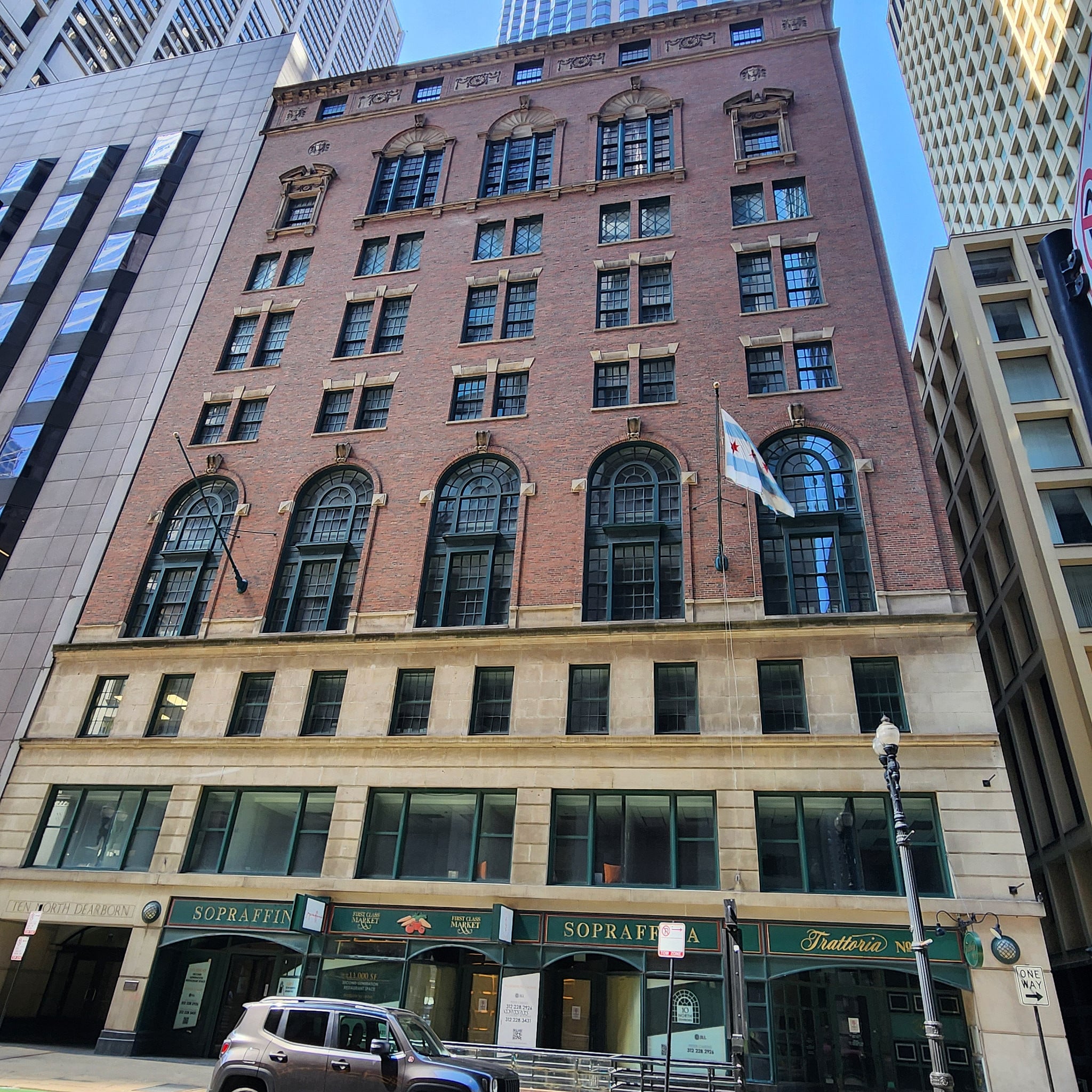
Walter Ahlschlager, also an Armour graduate and descendant of German Jewish immigrants, designed the Covenant Club at 10 North Dearborn in 1924 — an eleven-story vertical country club for Eastern European Jewish professionals, complete with a running track, bowling alley, library, and event spaces. The backstory matters: Chicago’s established Jewish community had already built the Standard Club as an alternative to mainstream institutions that excluded Jews. But the Standard Club’s membership was largely German-Jewish, and Eastern European Jews who rose into the professional class found themselves unwelcome there too. The Covenant Club was their answer — built with the same ambition and craft Ahlschlager brought to every downtown commission. When the door is closed, build a better room.
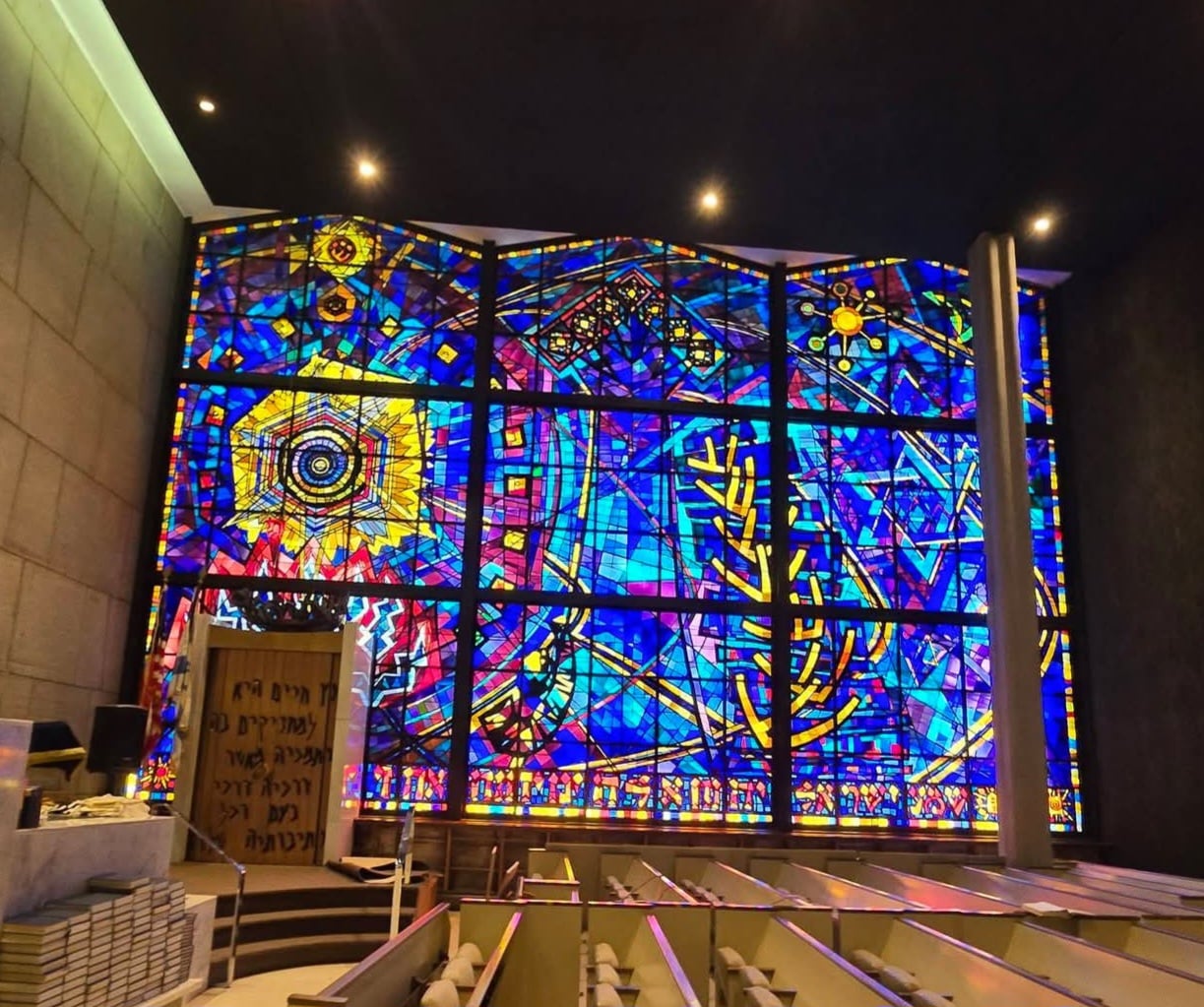
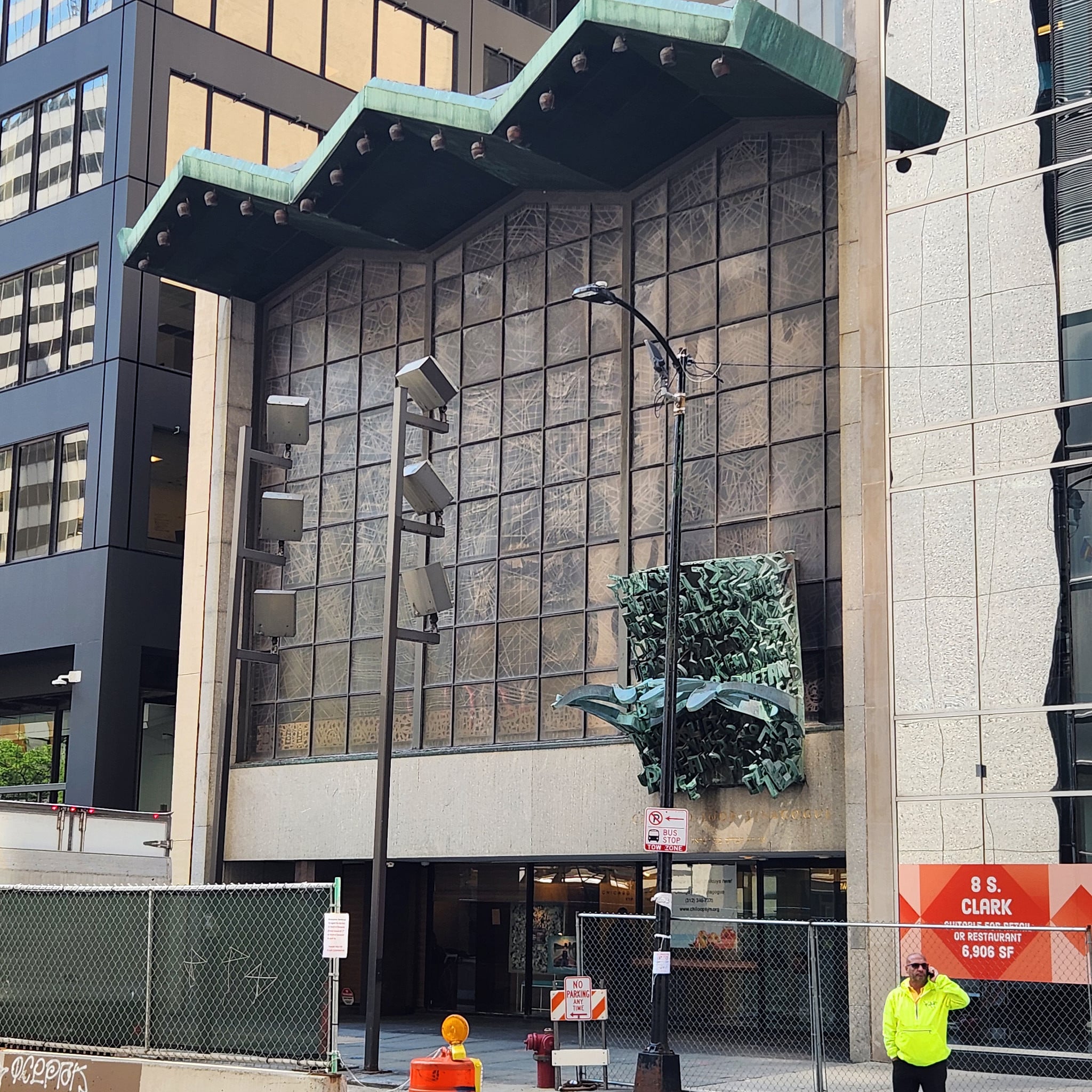
The same thread runs through the Chicago Loop Synagogue at 16 South Clark, designed in 1957 by the firm of Loebl, Schlossman and Bennett — with Richard Bennett as lead architect — for a congregation founded in 1929 to serve Jewish professionals working in the Loop. Jerrold Loebl and Norman Schlossman were both Armour graduates, sons of Hungarian and German Jewish immigrants respectively, and the commission reflects the pattern the tour traces throughout: the same architects building the commercial skyline and the communal institutions of Jewish life, often in the same career. Inside the main sanctuary, the east wall holds Let There Be Light, a stained glass composition by American artist Abraham Rattner — three years in the making in a Paris studio, its ancient Hebraic symbols, Tree of Life, Menorah, and Star of David, rendered in luminous color and installed personally by the artist before the High Holy Days of 1960. In 2026, Preservation Chicago named the Loop Synagogue one of the city’s most endangered buildings. The same people who built Chicago’s commercial skyline built this. It deserves to survive.
A Monument as Evidence
In 1936, a Polish-born Jewish attorney named Barnet Hodes looked at the rise of Nazi ideology and asked: how do you respond to hatred with something permanent? His answer stands at the corner of Wabash and Wacker — the Heald Square Monument, dedicated in 1941 and sculpted by Lorado Taft. It depicts George Washington alongside Robert Morris and Haym Salomon, the Polish-born Jewish financier whose personal funds helped keep the Continental Army solvent during the American Revolution. The inscription on the granite base comes from Washington’s 1790 letter to the Hebrew Congregation in Newport, Rhode Island: to bigotry no sanction, to persecution no assistance.
Hodes understood that the most durable response to antisemitism is not protest but evidence or proof, rendered permanent, that Jewish Americans were not guests in this country. They were here at the founding.
Two Engineers, a Century Apart
The structural story of Chicago’s skyline owes a particular debt to two Jewish engineers whose paths to mastery looked nothing like the expected route.
Dankmar Adler, whose father was the rabbi of Chicago’s first synagogue, applied to the University of Michigan and was not admitted. He learned engineering instead through service in the Army Corps of Engineers during the Civil War — experience he translated into the structural and acoustical innovations that, in partnership with Louis Sullivan, helped invent the Chicago skyscraper. The 1882 Jewelers Building on Wabash is the oldest surviving work of Adler and Sullivan — and it is home to Iwan Ries and Company, a tobacco shop founded in 1857 by a German Jewish immigrant, now run by the fourth and fifth generations of the same family. It is the oldest continuously operating tobacco business in the United States, in one of the oldest commercial buildings in the Loop. The family once owned the building. They are tenants now. They stayed.
Nearly a century later, Eli Cohen arrived in Chicago by an equally unlikely route. Born in Germany, he fled the Nazis in 1935 and fought in Israel’s War of Independence in 1948 before making his way to Chicago, where he led the engineering firm CBM. Cohen perfected composite high-rise construction — a concrete core to absorb the punishing wind loads of a city on the lake, a steel frame to carry the floors — a synthesis that made the column-free glass towers of Wacker Drive economically viable. Two engineers. Two detours. One skyline.
A Name, and What It Cost
Return, finally, to Frank Gehry — the name he chose, not the one he was born with. He set it aside because he was afraid of what it might cost him. Consider him alongside Bertrand Goldberg, who kept his name, fled the Nazi regime that shut down his school at the Bauhaus in 1933, came home to Chicago, and built Marina City — those iconic concrete towers on the river, curvilinear and organic and unlike anything else in the city. Two architects who shared a surname. One erased it. One built with it. Both left their mark on a skyline that belongs to everyone.
What the Bean Reflects
Stand near Cloud Gate on any afternoon and watch what happens. People walk up to it and immediately do something instinctive: they look for themselves. They crane their necks, shift sideways, hold up their phones, laugh when they find their own distorted face staring back. Children press their palms flat against the steel. Couples search for each other in the reflection. What draws everyone in is the same impulse — the chance to see yourself and the city at the same time, fused into a single image you could not have composed any other way.
The sculpture was created by Anish Kapoor, whose mother came from the Baghdadi Jewish community of Mumbai — Iraqi Jews who fled Ottoman persecution in the nineteenth century. Kapoor identifies as Jewish. He received the Genesis Prize in 2017 for his work with refugee causes and donated the entire million dollars to refugee relief. He set out to make great art. What it reflects is a collection of people, each with their own story, all drawn to see themselves in the same surface.
A skyline is not just a collection of buildings. It is a collection of stories — the people who imagined them, engineered them, and built them, each one a chapter in the larger story of a city and a community. Chicago’s skyline is one of the most celebrated in the world. Look closely and you will find Jewish stories hiding in plain sight, in the facades and foundations of buildings you may have passed a hundred times without knowing what was there.
I hope this column gives you a few reasons to look up. The buildings are still there. So are the stories.