
China’s road to dominance runs through Haifa
The Tianjin summit is being celebrated by Beijing as proof of a multipolar world, but its deeper meaning is harder to ignore. Xi Jinping is weaving together Russia, Iran, Turkey, Pakistan, and even a cautious India into a bloc designed to erode American influence far beyond Asia. For Israel, the consequences are immediate and personal: Beijing’s support for Iran, its embrace of Hamas, and its foothold in Haifa’s port all point to a deliberate strategy to push Israel to the margins of the regional order and weaken the alliances that protect its security.
Beijing has pursued this on three fronts. First, it has kept Iran afloat, supplying economic lifelines and military cooperation that allow Tehran to resist sanctions. This backing empowers Hamas, Hezbollah, and the Houthis to intensify pressure on Israel. Second, it has embraced the Palestinian cause, hosting rival factions in Beijing last year, including Hamas, and producing a declaration critical of Israel. Third, it has worked through international forums to cast Israel as an obstacle to “multipolarity,” attempting to weaken its strategic partnerships with the United States, India, and the Gulf.
This campaign accelerated after the Indian G20 summit in 2023, when Israel was highlighted as a key partner in the India-Middle East-Europe Economic Corridor (IMEC) during the Indian G20 in September 2023. The Hamas attack on October 7th that same year shattered momentum for IMEC, and Beijing wasted no time arguing that no Western-backed project could replace its own Belt and Road Initiative. Xi’s goal is clear: ensure that US-led frameworks linking India, Israel, and the Gulf never rival China’s Silk Road ambitions.
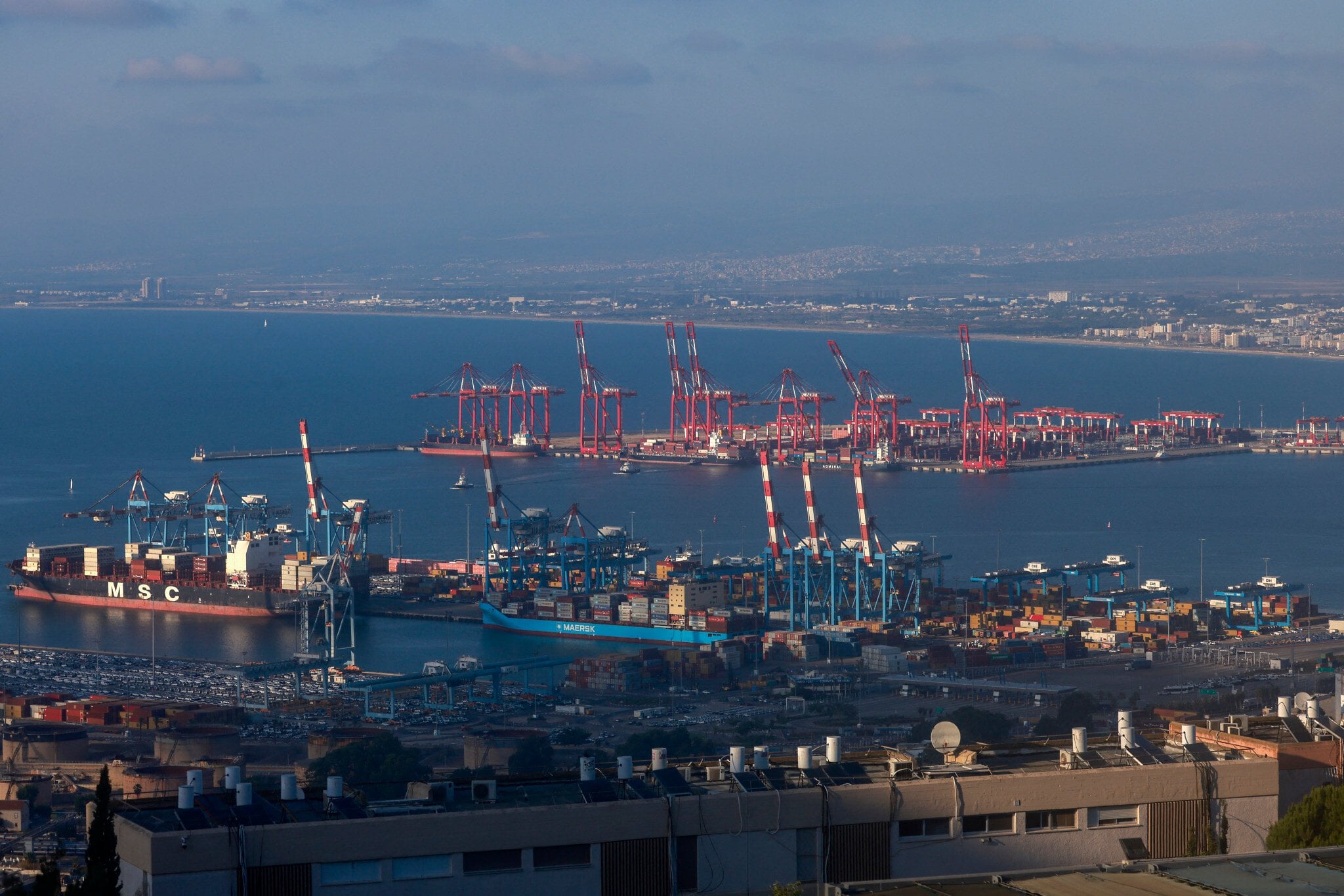
The threat is not abstract. It is rooted in Haifa. In a recent Newsweek op-ed, Gordon G. Chang sounded the alarm: “Israel must halt this expansion, reassess the Haifa arrangement, and align itself once again with the values and interests it claims to share with the United States. Anything less is a betrayal of our shared security—and of the American trust we rely on.” Shanghai International Port Group (SIPG), a state-owned Chinese giant, operates the Bay Port under concession until 2040—just 1.8 kilometers from Israel’s main naval base. According to a 2019 University of Haifa–Hudson Institute report, SIPG’s integration into Israel’s transportation networks creates openings for cyber intrusion, espionage, and intelligence transfer directly to Iran. In wartime, the Chinese operator could disable cranes, disrupt logistics, or sabotage naval operations.
Haifa today is split between two foreign powers. While SIPG controls the Bay Port, India’s Adani Group, together with Israel’s Gadot, purchased majority ownership of the older Haifa Port in 2022. This dual ownership highlights Israel’s dilemma. Adani, a close Indian partner, represents an alignment with the democratic world. SIPG represents a strategic vulnerability and a direct channel to Beijing and Tehran. Both operate in the same harbor—Israel’s most critical maritime asset.
The concession to SIPG was flawed from the start. Section 9(b) of the 2015 contract allows Israel’s government to revoke authorization “for reasons of public interest.” As Chang argues, China’s open political, economic, and military support for Iran and its proxies qualifies beyond doubt. Beijing has supplied Hamas, Hezbollah, and the Houthis with weapons, technology, and components, while championing the Palestinian cause in global forums. Every action reinforces its role as a strategic adversary of Israel.
The Tianjin summit will be advertised as a celebration of diversity and multipolarity, but its subtext is unmistakable. Xi Jinping is building a coalition of states disaffected with Washington, tying Russia to Beijing, courting India with inducements, and pushing the Islamic world closer to China’s orbit. Within this strategy, Israel is not merely a target of proxies but of Beijing’s long-term calculations. Isolating Israel weakens its bridge role between India and the West, diminishes its leverage in the Gulf, and undermines US-led projects like IMEC.
Xi has not simply taken advantage of the Ukraine war, Indian hesitation, and Arab grievances—he has woven them into a deliberate strategy designed to serve China’s long-term ambitions. For Israel, the choice is stark. It can allow China to maintain its foothold in Haifa and continue exploiting divisions across the region, or it can act decisively: cancel SIPG’s concession, pivot to partners it can trust, and reaffirm its alignment with the United States and India.
Haifa is not just a port. It is Israel’s ticking time bomb.