Crisis Communicator, Droll Dragon
Civics or Chaos: America at the Edge After Charlie Kirk’s Murder
I didn’t know Charlie Kirk personally. I recently met his booker at a function in Washington, D.C., and had begun a dialogue with him for a client. That small encounter now feels haunting. His murder is appalling – an assassination of a public figure in broad daylight. In a country that once prided itself on free speech and robust debate, this is what we have come to: silencing with bullets.
No matter your politics, murder is murder. Yet already, some voices are working to frame Kirk’s killing as the logical outcome of his rhetoric – an almost excusable expression of frustration “taken too far.” That is not justice. That is not civics. That is moral collapse.
This is not an isolated event. Consider the murder of Brian Thompson, the CEO of UnitedHealthcare. He was gunned down outside the New York Hilton hotel while attending a conference in Manhattan – a public assassination at the heart of American commerce. His alleged killer, Luigi Mangione, has already been transformed online into a kind of folk hero. Especially among younger voices, Mangione is portrayed as a man who “took a stand” against corporate greed, soaring healthcare costs, and insurance giants accused of denying care. Memes glorify him. Posts hail him as the embodiment of rage against an unjust system. His legal team will likely seek a jury that shares the same sentiment – and attempt to win an acquittal.
A CEO is executed in broad daylight, and instead of universal condemnation, the act is reframed as resistance, protest, and righteous fury against the rich, the greedy, and the privileged – even if we hear that Thompson was a good man. It is the same poisonous logic that excuses terror as “frustration taken too far,” or justifies campus assaults as “the language of the unheard.” We are raising a generation that no longer sees murder as evil in itself, but as a political tool – acceptable when the victim is someone they believe deserves it. That echoes the darkest time of the last century.
We are living in an age where violence is becoming normalized, even rationalized. It cuts across every headline. When Hamas butchered Israelis on October 7, the response from too many was, “Yes, but Israel…” – as though rape, mutilation, and murder could be justified if one disliked the victim enough. When college student Laken Riley was killed in Georgia, her death was shrugged off because the accused came from a migrant community progressives were desperate to champion. When Ukrainian refugee Iryna Zarutska was slaughtered on a commuter train, the crime was almost buried. The attacker should never have been on the street, but he was – thanks to progressive bail policies. The mayor even warned the public not to share the video because it contradicted her narrative.
Silence in the face of violence is complicity. Excuses are worse – they turn murder into politics.
The rot goes even deeper. It isn’t only crime on the streets. It is justice itself being twisted into a weapon. The Department of Justice has repurposed the Trafficking Victims Protection Act – a law meant to stop actual human trafficking – into a tool to criminalize unpopular people and groups. In New York, Attorney General Letitia James and Judge Arthur Engoron sought to destroy Donald Trump over inflated real estate valuations. No one was harmed. Every bank was repaid. Inflating values for sales and deflating them for taxes is a common, if unofficial, practice in real estate. Yet they called it fraud and demanded punishment – not because of damage done, but because of who he is. That is not justice. That is political war.
This is the dark age in which we live. Weaponized law on one end, street violence on the other. History tells us where it leads. Before the Holocaust, Jews in Europe were debased daily in print and in speech. That propaganda softened the ground until killing Jews became palatable. Today’s rhetoric – against political opponents, against social groups, against entire faiths – does the same. It prepares the ground for violence.
No political camp is innocent. The right is guilty too. Two of the highest-paid conservative podcasters in America claim they are “just asking questions” while they drip-feed hatred to audiences primed for outrage. They profit from rage. They provoke without consequence. They make violence not only likely but inevitable.
When George Floyd was killed, most Americans of all races and politics united in outrage. He was not a perfect man, but his death was wrong, and people knew it. That moment showed we could still come together. Compare it now to Riley’s death – no marches, no vigils, no bipartisan outrage. Or Zarutska’s – silence, even censorship. Or Kirk’s – where analysts like Matthew Dowd on MSNBC said he was a “natural target.” Or Thompson’s – where a CEO’s murder is celebrated online as if it were justice. That is the slope we are on.
Meanwhile, the world burns. A war in Gaza is dividing nations and stirring powerful emotions. Russia is threatening Poland. America’s cities are on edge. Political violence here at home – from attempted assassinations of a former president to riots that turn neighborhoods into warzones. It feels like we’re standing on the edge of a knife. One push in the wrong direction, and we fall into civil conflict—or worse, a global one.
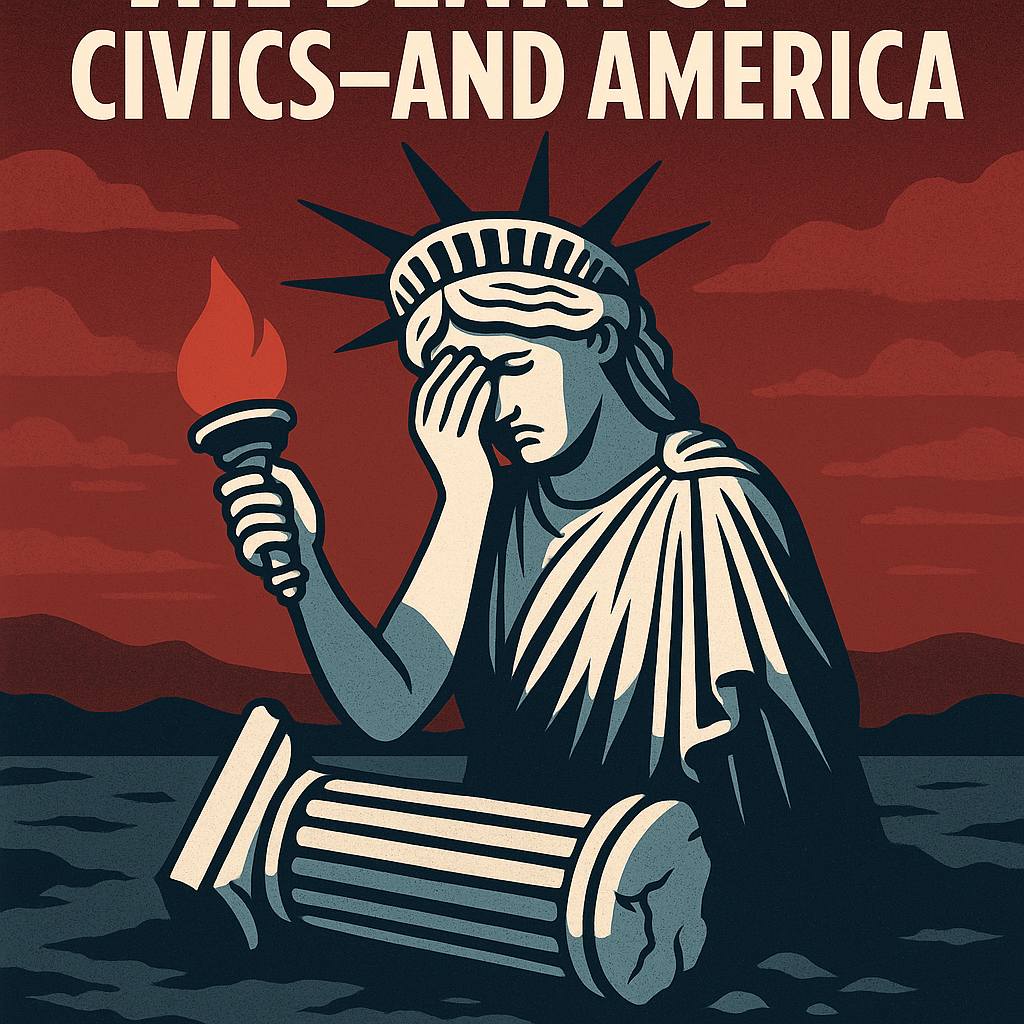
The answer is not complicated and will sound naive. The answer is civics. The ordinary, unfashionable, unglamorous practice of civics. Free speech, yes. Free thought, yes. Yet also respect for process, for debate, for losing today and coming back tomorrow. Civics is what allowed America to thrive through past storms. It is what made us the country people wanted to come to, the country that led the world.
Civics means listening even when you don’t like what you hear. It means accepting that in a democracy, everyone gets a say, but majorities decide. It means pushing your agenda without dehumanizing those who oppose it.
Right now, we have abandoned civics. Leaders use law as a club. Media plays prosecutor and jury. Activists turn crime into politics. Assassinations, such as what happened to Charlie Kirk and Brian Thompson, are met with shrugs, justifications, or applause.
That cannot stand.
If our leaders cannot stop vilifying their opponents, if our media personalities do not stop excusing violence, then what happened to Kirk will not be the end. It will be the beginning. What happened to Trump – an attempted assassination – will not be a warning shot. It will be a preview.
Do we want that? Do we want to live in a country where political speech is met with bullets, where CEOs are killed for being unpopular, where the courts are just another political battlefield, and where violence is justified if the victim was on the “wrong side”?
We are at the edge. Civics is the only way back. Without it, America will not survive the storm that is coming.
Related Topics
Related Posts