
Communicating with a Noisy Computer

Two Israeli companies are trying to transform quantum computing from a fragile system into a reliable, practical tool and produce results that can be trusted
It is commonly assumed that the main challenge in quantum computing is building computers with greater processing power than conventional computers. In practice, there are additional challenges. Even though a powerful quantum computer exists, it is extremely difficult to make it work effectively. The gap between theoretical computing capability and actual usability stems not only from hardware limitations but also from an early-stage software layer that is supposed to transform a complex and fragile physical system into a usable tool.
Two Israeli companies, Classiq and Qedma, are addressing this challenge from two different directions. Classiq develops abstraction layers that shields developers from the physical complexity of hardware. At the same time, Qedma focuses on directly addressing that complexity, particularly the built-in errors of quantum systems, to produce more reliable results. The approaches differ, but both share the same goal: implementing a software-based solution to transform the computational capability of a quantum technology processor into a practical work tool, regardless of the technology used in its development.
Moving Away from Physics
Classiq focused on raising the level of abstraction of quantum development – not as a matter of convenience, but as a necessity. “When founding the company, we realized the hardware was advancing rapidly, but that there was simply no software”, says Nir Minerbi, CEO and co-founder of Classiq. “All the software stacks we take for granted – operating systems, compilers (programs that translate code into instructions that the computer performs), and programming languages simply don’t exist in quantum computing”.
In that sense, Classiq’s starting point is not performance improvement, but rather building a layer that does not yet exist. “We are developing the operating system and development environment for quantum computers”, Minerbi explains. “A platform that enables people to develop applications without being experts in quantum physics”.
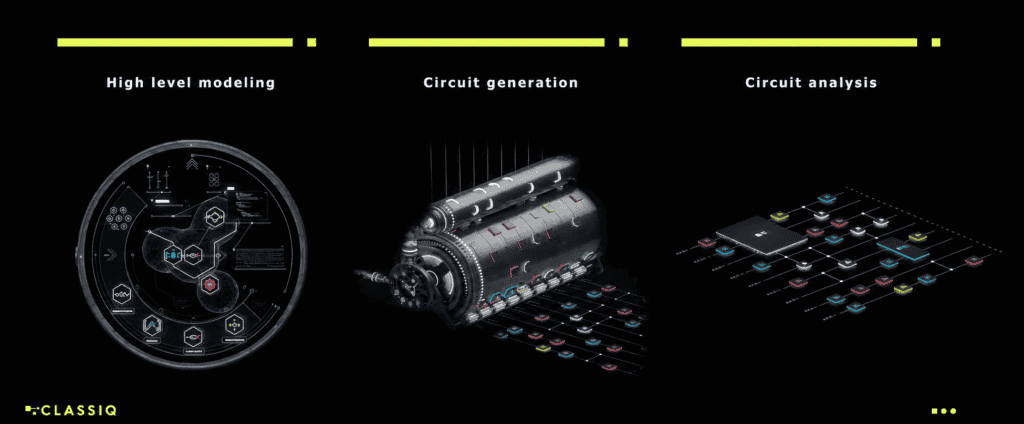
Workflow stages in the Classiq platform, from problem modeling to quantum circuit analysis
“We founded the company because we understood that hardware was progressing quickly and the field was highly competitive, but that there was no software that could actually program these computers”, he adds. “Hopefully, one day, we’ll become the ‘Microsoft’ of quantum computing”, he says with a smile.
The decision to focus on software was no coincidence. In a world of competing hardware approaches – trapped ions, atoms, and photons – investing in a single platform is a gamble. Software, by contrast, allows companies to stay ahead of the race. “It’s essentially a bet on the entire field, not on one specific technology”, says Minerbi.
To understand the significance of this, it helps to step back for a moment. In classical computing, the transition from machine language to programming languages and operating systems was what enabled the real breakthrough. In quantum computing, the field is still at a much earlier stage. “We’re operating at an abstraction level comparable to punch cards in the 1970s”, Minerbi explains, “and the goal is to reach a point where you can simply describe the problem and let automation handle the rest”.
In practice, this means a fundamental shift in the development process. Instead of building a quantum circuit step by step, the developer defines the problem at a higher level, and the machine fills the gap. Operating behind the scenes is a quantum compiler, software that translates the algorithm into instructions the computer can execute and which, in some cases, determines how to access the quantum circuit itself while optimizing resources, such as the number of qubits and runtime.
The separation between code and hardware is critical. The same application can run on entirely different systems without the developer needing to understand whether it does so through ions, atoms, or photons. “You don’t really care which model of airplane gets you to your destination, as long as you arrive on time”, says Minerbi. “What matters is the destination and the constraints. The software takes care of the rest”.
This approach also reshapes the target audience. Where quantum development was once reserved exclusively for physicists, it is now open to domain experts, from medicine to finance. “Many of our customers don’t come from the quantum world”, says Minerbi, “they bring their own expertise and learn as they use the tools”.
The value of this approach goes beyond just the convenience of development. It lies in the ability to work within the constraints of existing hardware. Quantum systems are still noisy and limited, so the way an algorithm is constructed directly affects whether it can be run in practice. In some cases, software is what facilitates the transition from a theoretical concept to a working experiment. Software doesn’t eliminate hardware limitations, but it can extend them. “Software helps precisely in those places where the hardware is almost complete, but not quite”, says Minerbi.
Behind the scenes, Classiq’s platform optimizes resources such as qubit count, circuit depth, and runtime – all critical parameters in a world where every qubit and computational operation is a limited resource. The difference between efficient and inefficient implementation can be dramatic. “The same application might require hundreds of thousands of qubits or run on just a few thousand, if you know how to optimize it properly”, says Minerbi. This means that software is not merely an intermediary layer, but a tool for getting more out of existing hardware.
This capability is also changing how organizations approach the field. Whereas quantum development once required deep expertise in physics, it is now possible to start from an entirely different point of departure. The company’s customers include organizations across diverse sectors, such as industry, finance, healthcare, and aerospace – some of which had no prior quantum knowledge. “They simply couldn’t do it before”, says Minerbi. “Today, they can start developing with the experts they already have”.
A case in point is Comcast, the American telecommunications giant, which entered the quantum world via the Classiq platform. Rather than building a dedicated team of physicists, the company relied on its own domain experts and began developing quantum applications using the available tools. This is not an isolated case but represents a broader trend: the transition from experimental research to applied work.
Alongside the technological development, Minerbi also highlights the role of the Innovation Authority in shaping the field in Israel. “I used to think of the Authority as a body that helps companies”, he says, “but in practice it is a strategic partner”. Its contribution, he argues, goes beyond just providing funding and lies in how that capital is integrated within a broader ecosystem-building framework. “For every shekel the Authority invested in us, we were able to raise dozens of shekels externally”, he says. “But it’s not just the money. It’s the backing, the recognition, and the ability to operate as part of a national program”.
This involvement is also evident in international collaborations, connections between industry and academia, and investment in R&D infrastructure. In this sense, the Innovation Authority functions not only as an entity that provides funding but also as one that creates the conditions for an entire field to grow.
Looking ahead, Minerbi paints a relatively realistic picture. Unlike other fields where dramatic breakthroughs rewrite the rules, he sees a more incremental process at work here. “In software, at this stage, you don’t need one breakthrough”, he says. “You need a great deal of engineering – layer upon layer”.
Nevertheless, he does not rule out the possibility of significant progress in the quantum computer’s ability to demonstrate superiority, particularly in error correction, which could expedite the path to broad practical applications. Either way, the direction is clear: more abstraction, more automation, and a closer connection between classical and quantum worlds.
At the current stage of quantum computing, where hardware is still maturing and applications remain limited, software is becoming the factor that mediates between potential and reality, not as a complete solution, but as a necessary step along the path to one.
“In deep tech, it is not enough just to have a good idea. You need to create the conditions through collaborations between complementary technology players and infrastructure that allow technologies to be tested under real-world conditions to make them actually work”.
Errors as Part of the Physical Foundation
Qedma starts from the assumption that the key to making quantum computers work for practical applications will be found in the software layer that addresses one of the central problems of quantum computing: computing errors.
Unlike classical computers, where errors can be identified and corrected relatively easily, in quantum computers, the very act of measurement changes the system’s state. In other words, it is impossible to just “peek” inside without disturbing the computation itself, making error correction an exceptionally complex challenge. Furthermore, the systems themselves are highly sensitive to disturbances, which can range from interactions between qubits to environmental effects.
In that sense, unlike classical computing, errors in current quantum systems cannot be corrected by a straightforward protocol and therefore require a far more fundamental and significant solution. Every action carries a certain level of uncertainty, and the accumulation of actions may lead to a cumulative error that deviates from the precision of the desired result. The challenge is not correcting an individual error but managing an entire system operating under unstable conditions. This is the starting point for Qedma, which develops software that enables algorithms to run even when the results from quantum hardware are far from perfect.
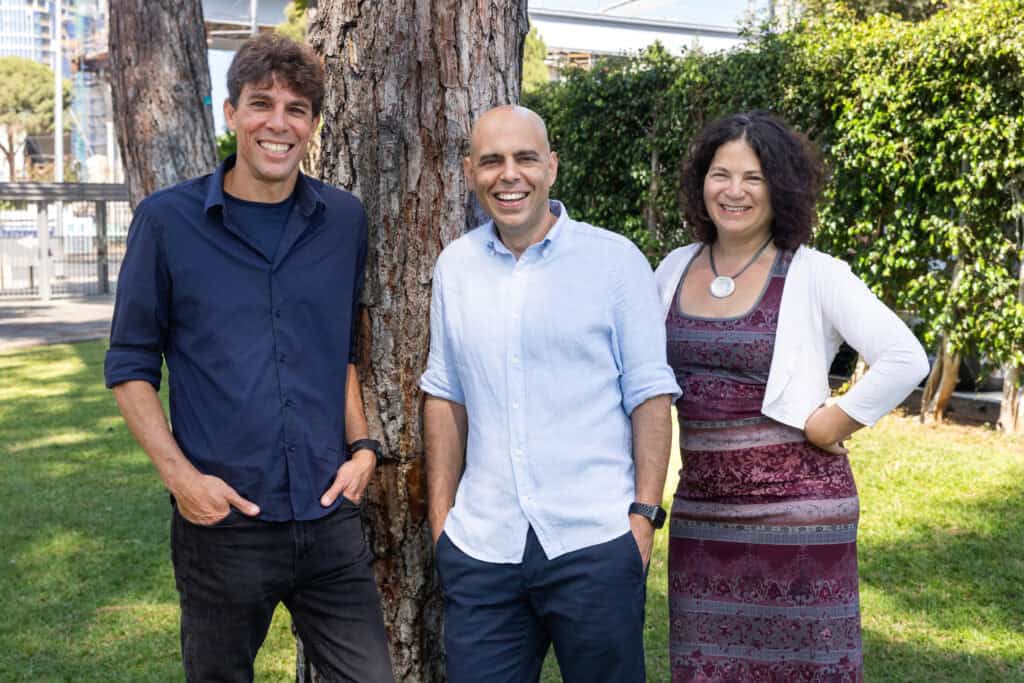
From right: Prof. Dorit Aharonov, Chief Scientist and Co-Founder; Dr. Asif Sinay, CEO and Co-Founder; Prof. Netanel Lindner, CTO and Co-Founder.
At this stage, the problem is not only degraded performance, with the increased computation size, but also built-in uncertainty. This means that it’s not always clear to what degree the output can be trusted. “Errors are part of the system’s physical foundation”, says Dr. Asif Sinay, co-founder and CEO of Qedma. In a classical computer, errors can be measured and corrected. In contrast, in a quantum computer, the act of measurement itself interferes with the algorithm’s execution, thereby necessitating a different approach than is accepted in other computing fields. Error “correction” becomes a highly complex operation, “so we study the physical mechanisms that generate the errors and adapt the algorithm to take them into account”, Dr. Sinay explains.
This adaptation takes place at the statistical level where noise is treated as a pattern that can be characterized. The system learns how the computer tends to drift and incorporates that into the computation. In some cases, this involves sophisticated averaging methods that also require adapting the algorithm’s structure. “In the end, we enable algorithms to run reliably”, says Dr. Sinay.
Qedma’s technology operates simultaneously across several layers, such as characterizing the computer’s errors, adapting the algorithm, and optimizing its execution on the hardware. It is built on a combination of physics, mathematics, and computer science, enabling users to run computations on existing systems, even when those systems are far from perfect.
To illustrate the difference between running algorithms without and with Qedma’s software, Dr. Sinay uses an electric vehicle as an analogy. A system without the appropriate adaptation, he says, is like a car that can travel only a very short distance. “If you use accuracy-enhancement software, you increase the vehicle’s driving range by a factor of 100, and suddenly the car becomes highly useful”, he explains. “In other words, computations that would previously stop prematurely or produce incorrect results under noisy conditions become executable. Not because the computer itself has changed, but because we understand and address the noise and the resulting errors”.
This approach does not bypass complexity, but rather, works with it. As the number of qubits grows and systems become more complex, the ability to characterize their behavior and correct their internal errors is expected to become an inseparable part of the work process. “No matter how much the hardware improves, there will always be errors, and Qedma’s software will therefore always remain critical”, adds Dr. Sinay.
Beyond the technological development itself, Dr. Sinay also emphasizes the Innovation Authority’s role in building the field. “The Authority has advanced the quantum field in Israel on several levels – via investments, independent professional evaluations, and by creating an active ecosystem and shared working frameworks. The Innovation Authority’s contribution is invaluable”, he says.
According to him, the Authority’s involvement allows companies to operate within a broader framework, with access to partners, the ability to test technology under varied conditions, and integration into global processes. Looking ahead, Sinay estimates that quantum computing’s impact on real-world applications is several years away. In his view, within five to ten years, applications will be seen across sectors such as the automotive industry, banking, pharmaceuticals, defense, and other complex fields.
Until then, the primary challenge is not only building better computers but knowing how to work with them under non-ideal conditions. Qedma’s software is not merely a temporary solution, but a layer designed to accompany the field even as the hardware itself improves.
Our role is to invest in an enabling technology infrastructure, especially when the risk is high, in order to correct market failures, to advance fields where private investment is still insufficient, and to help technologies reach the stage where they can be used in practice.
This blog is part of a series of articles in which experts from the Israel Innovation Authority explore of how Israeli leadership in quantum computing is spearheading global development in the field. For more articles: https://innovationisrael.org.il/en/digital-magazines/