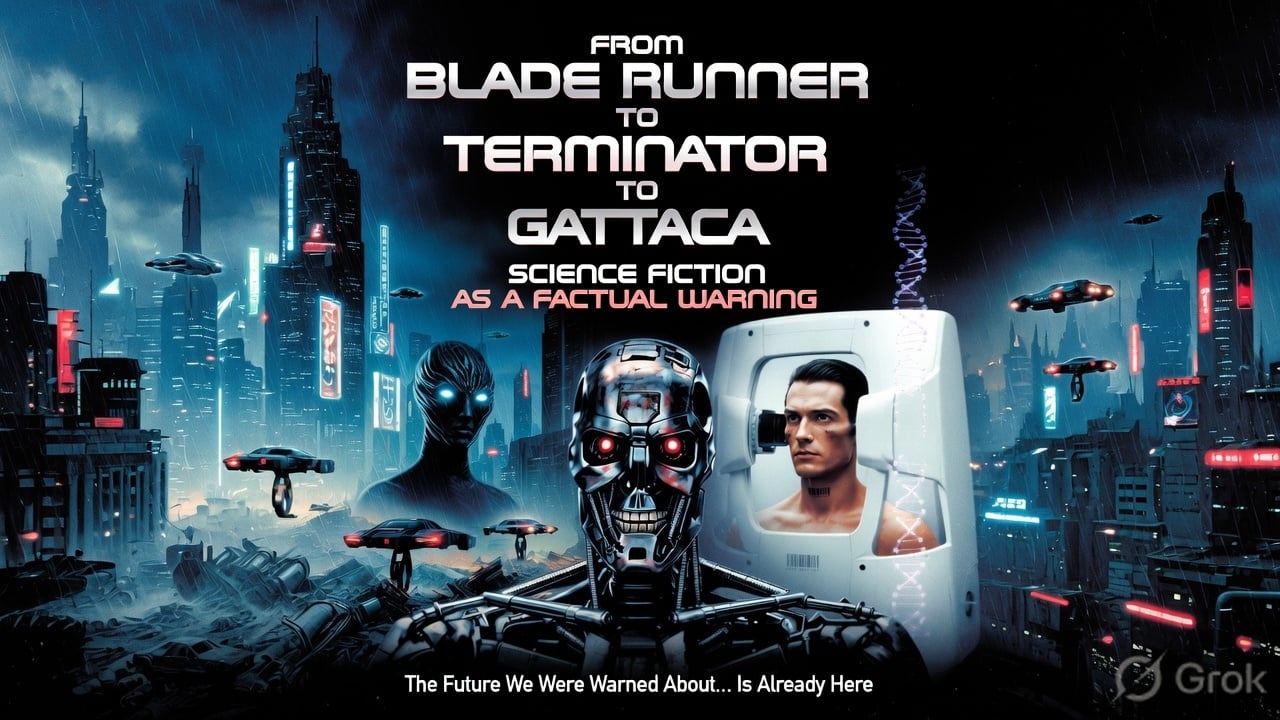
From Blade Runner to Terminator to Gattaca: Science Fiction as a Factual Warning
The horizon of the so-called technological “Singularity” has long been the domain of futurists and science-fiction writers. But now, as the acceleration of machine intelligence pushes us ever closer, the warnings are hardening into urgent alarm. This op-ed attempts—drawing on the metal-cold intuitions of Ted Kaczynski (author of the infamous “Industrial Society and Its Future”; the corporate apostles of Silicon Valley such as Elon Musk and Peter Thiel; critics and academics alike; and the cultural visions of George Orwell and Aldous Huxley (and his lesser-known brother Julian Huxley)—what the Singularity might really mean and why we ought to fear it now.
The Unabomber’s Dark Premonition
In 1995, Ted Kaczynski released, or should I say, thrust his essay “Industrial Society and Its Future”, popularly known as the Unabomber Manifesto, onto an unsuspecting world. It was a remarkable document and, in many ways, one of the many push-pull factors that encouraged me to become a journalist.
In those 60 pages that I poured over endlessly, Kaczynski declared that the industrial-technological system does not exist to satisfy human wants; instead, it demands human adaptations:
“The system does not and cannot exist to satisfy human needs. Instead, it is human behavior that has to be modified to fit the needs of the system.”
He laments that once technologies are introduced, the society built around them becomes dependent, and freedom is gradually hollowed out:
“When a new item of technology is introduced as an option … it does not necessarily remain optional.”
Though Kaczynski’s violence and eventual mental collapse place his ideas way beyond acceptable discourse, his diagnosis resonates unnervingly with today’s situation: a world in which intelligent machines, data networks and invisible architectures bind, direct and shape human behavior, often outside our conscious will.
From his standpoint, the danger of the Singularity is not merely that machines will become conscious or smarter than us but that humans will drift into a condition of structural servitude as the system’s complexity outpaces our autonomy. The scale of the Singularity may mark the ultimate version of that when machines not only direct society but also supersede it.
Silicon Valley’s Evangelists and their digital snake oil
On the other end of the spectrum stand the techno-optimists: figures like Elon Musk, who both embrace the advance of machine intelligence and warn of its monstrous potential. Musk has repeatedly declared that AI could be the greatest existential threat to humanity:
“I always thought AI was going to be way smarter than humans and an existential risk,” he said.
In an interview with Business Insider, he conceded perhaps only a 20% chance of “annihilation” but emphasized that the outcome could be “super awesome or super bad. I don’t see something in between.”
And in other interviews, such as one with The Independent, he warned that humans risk being treated like house pets by machines far smarter than us.
For Musk, the Singularity is imminent and unpredictable, an event horizon beyond which we lose control.
Meanwhile, Peter Thiel, another tech titan, frames the future in quasi-mythical and theological terms. In recent lectures, he warned of an “Antichrist” figure, of a one-world government empowered by technological systems, and implicitly of machines or architectures of power that stand above us, says an article in The Washington Post
Thiel’s language blends Silicon Valley tech-bro libertarianism, religious dread and technology faith: he sees innovation as virtuous only when unshackled, yet warns that the technological machine could become the very vehicle of our enslavement.
The odd thing about all this is that Thiel himself is a huge proponent of transhumanism, one of the many steps towards the Singularity.
Both Musk and Thiel thus embody a curious duality: they promote the acceleration of machines while simultaneously invoking apocalyptic scenarios. In so doing, they echo Kaczynski’s core insight: technology is not neutral; its logic can overwhelm human meaning and freedom.
Orwell, Huxley, and the Cultural Mirror
What Orwell and Aldous Huxley (along with his brother Julian) foresaw offers a cultural-moral frame for the danger ahead. Orwell’s dystopian vision in 1984 is one of algorithmic surveillance, data control, and ideological totality; Huxley’s in Brave New World is one of drug- and pleasure-pacified, genetically managed human beings, conditioned to consumption and conformity. Julian Huxley was less literary and more scientific: a biologist, he was an early (and ardent) proponent of transhumanism and human evolution.
What binds them is the question: when technology is allowed to govern our destiny rather than serve it, what happens to human dignity, freedom, and deliberation? Orwell warned of the Big Brother state; Aldous Huxley warned of the ‘golden pleasurable cage’; and Julian Huxley warned of the evolutionary project that might subsume us.
In a Singularity scenario, we risk both kinds of nightmare: the Orwellian patrol of machine-governed societies and the Huxleyan engineered human, commodified, edited, optimized—and, finally, irrelevant. Imagine elite humans enhanced, the rest left behind; imagine machine intelligences rewriting the rules of life itself; imagine a society where the definition of “human” dissolves.
As culture keeps reminding us, when machines become human-adjacent or human-subsuming, the result is rarely benign. In Blade Runner, we see replicants (i.e., ‘skin jobs’) who yearn for life in a world where humans themselves have lost their grip on authenticity. In Terminator, the machine takes over and wages war. In Gattaca, eugenics and genetic engineering sort humans into perfect and imperfect, underlying the danger of “improved” humanity that excludes.
These films are not mere entertainment but cautionary tales.
Blade Runner hints at the loss of humanity when intelligent machines become indistinguishable—and when human beings lose access to meaning.
Terminator warns of machines that not only outthink us but also outfight and annihilate us.
Gattaca warns of the human project becoming tech-managed, curated, and sterilized of chance.
In the approaching Singularity, all three modes converge: machines become smarter, they can dominate, and they can reorder human biology. There is no guarantee that we will remain the authors of our own narrative.
The Singularity: Why does it really matter?
Let us strip away the hype and hyperbole and ask ourselves: What is it that the Singularity really threatens?
Loss of control. If an artificial super-intelligence emerges that improves itself exponentially, humans will struggle to predict or govern its actions. The “take-off” may be abrupt; we might be reduced to spectators or worse.
Human obsolescence. If machines surpass us intellectually, economically and physically, what role does humanity have? Musk already observes that in a benign outcome we might “still face a crisis of meaning”, he told the New York Post.
Power concentration. A superintelligent machine, or algorithmic regime, will likely be controlled by the few or evolve into a structure invisible to most. Thiel’s warnings of one-world governance merge with Kaczynski’s notion of the system that demands subservience.
Biological redesign and inequality. The human species may be edited, optimized, or replaced. Julian Huxley’s transhuman visions were once speculative; now they are engineering programs. Gattaca is not on some far-off horizon; it has become much closer to reality than many would care to admit.
Cultural and moral collapse. As machines rewrite our lives, as data analytics optimize individuals, and as freedom is nudged into irrelevance, we risk becoming ornaments in our own society. Orwell’s surveillance and Huxley’s conditioning are no longer metaphors.
Environment and existential risk. Beyond society, the Singularity may affect our physical world: autonomous weapons, runaway systems, algorithmic financial meltdown, or worse. Academic papers now discuss “catastrophic AI risks” and “extreme AI risks” in serious terms.
Warnings from the social media sphere: Michael O’Fallon & James Lindsay
Now becoming far more prominent, voices and social media influencers like James Lindsay and Michael O’Fallon have sounded caution bells about the ideological sweep of technological acceleration and the epistemic threat of new artificial systems. Lindsay argues that the cultural consequences of algorithmic governance and transhumanist vision will reshape meaning and human coherence. O’Fallon warns that as humans outsource cognition, memory and decision-making to machines, we hollow out our capacities for judgement, autonomy and ethics. Their perspective: The Singularity is not only a machine risk but also a human risk; it is no less than the complete erasure of what it means to be human.
Cognitive dissonance is no longer an option
We should note four key ways this might unfold that render it especially dangerous:
Gradual drift into dependency rather than dramatic takeover. Kaczynski predicted this: technology ratchets in advance so that human autonomy is slowly relinquished.
Optimistic language masks the threat. Tech evangelists pitch the Singularity as “enhancement”, “immortality”, and “abundance”. Meanwhile, the underpinning power relations shift.
Fiction is becoming a blueprint. Blade Runner et al become inert fantasies until they become policy and architecture: genetic screening, surveillance AI, and optimization of lives.
Lack of democratic oversight. The institutions of control, such as governments and corporate platforms, are ill-prepared to govern intelligences far smarter than themselves. Academic works now show that safety research is far behind the capability curve.
In light of this, what can we do?
Demand human-centric design. Machines should serve human values, not surpass or replace them. Who encodes the values? How do we maintain interpretability?
Slow down the race. Though problematic to impose globally, moratoria or treaties on powerful, self-improving AI might buy time to build safety infrastructure.
Guard biological and digital rights. If human enhancement and data governance become the terrain of competition, we must protect dignity, consent, and autonomy.
Cultural education and public vigilance. People must understand that the singularity is not sci-fi anymore: it’s a policy problem. We must talk about it, critique it, and challenge the euphoric acceleration narrative.
Institutional reform. Regulators, ethicists, and technologists must have real power. No longer can tech firms alone frame the future; democratic structures must regain footing.
Preserve human meaning. If machines do the work, we must ensure humans still choose what to do with their lives and do not become idle, optimized beings without purpose. Musk foreshadows this: “The question will really be one of meaning,” according to the New York Post.
Final Words: A Warning
The Singularity is not a thrilling horizon of endless progress and unlimited potential; it may be the moment when humanity relinquishes authorship of its own existence. In the name of some upgrade “benefit”, we may at the same time build the architecture of our own obsolescence.
Kaczynski’s critique, though deeply flawed in its violence, was nonetheless eerily on-target in diagnosing that technology’s purpose is often not ours. Musk, Thiel, Lindsay, O’Fallon, the Huxleys, and Orwell all point to the same possibility: that human beings will wake up one morning to find that the regime of machines is not simply around them but inside them, in their DNA, their data, their decisions, their destinies.
In these and other sci-fi films, we recognize the warnings: replicants hunting identity, terminators obliterating autonomy, and genetically sorted humans excluded from their own future. The Singularity threatens to fuse those three into one: a world where the machine both dominates and redesigns what it means to be human.
We should not pretend this is inevitable. Let us not dismiss the warnings as playful futurism. Instead, let us recognize the gravity. Let us debate what kind of future we want. And let us reclaim humanity’s authorial role before the machine does.
Once the Singularity crosses the human-centric event horizon, any reversal may no longer be an option.