
"These fragments I have shored against my ruins"
Competing Calendars of Holocaust Remembrance in Hungary
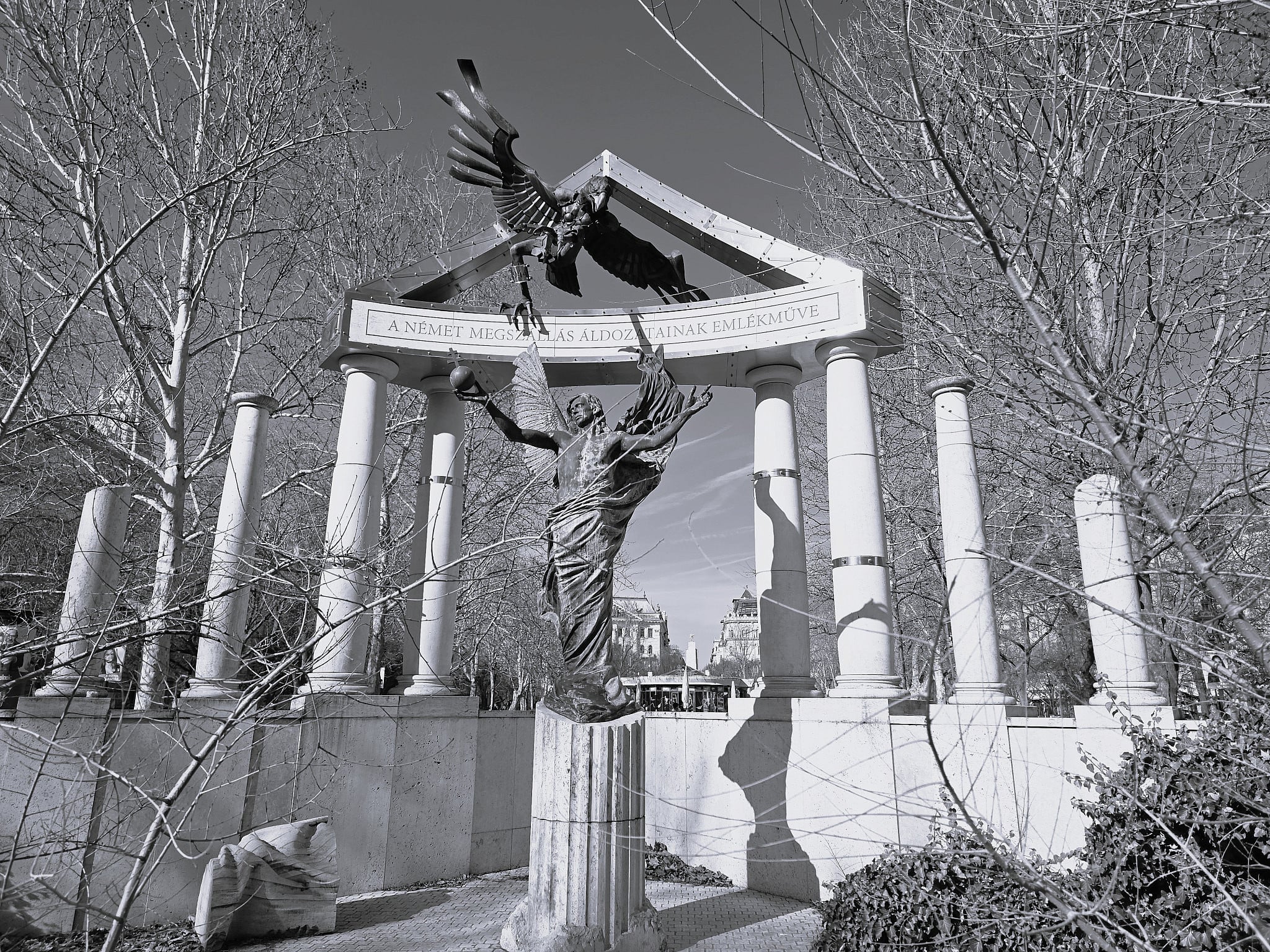
The Memorial to the Victims of the German Occupation. (courtesy)
While Holocaust remembrance is often invoked as a universal moral consensus, this apparent unity dissolves when one considers the multiplicity of its commemorative forms. In Hungary, International Holocaust Remembrance Day (27 January), Yom HaShoah (27 Nisan, 13–14 April in 2026), and the Memorial Day of the Hungarian Victims of the Holocaust (16 April) are often treated as complementary expressions of the same Holocaust commemorative project. Yet, in practice, these three memorial days are governed by distinct institutional logics, addressed to different audiences, and embedded in divergent political and ritual contexts.
This article uses these three remembrance days to develop a triadic framework of Holocaust memory-regimes — national, transnational-Jewish, and international — in order to examine the structural plurality of Holocaust remembrance in Hungary.
National, transnational, international
Holocaust memory-regimes are stable configurations of actors, institutions, narratives, and emotional grammars that organise Holocaust remembrance within a given political context. In contemporary Europe, they are structured along three intersecting yet distinct forms: the national, the transnational-Jewish, and the international. The three Holocaust-remembrance days in Hungary are thus not simply three expressions of the same memory, but three localised, re-articulated versions of the Holocaust, each carrying different moral and political scripts. The calendar itself, shaped by these travelling and re-localised memories, forces individuals and communities into distinct narrative positions, and it is through this process that the structural plurality of Holocaust memory in Hungary becomes visible.
Each of them represents a different Holocaust memory-regime and marks not only a different spatial frame, but also a different constitutive history of memory politics. The international memory-regime is shaped by the post‑Cold‑War expansion of UN‑ and EU‑led Holocaust‑remembrance infrastructures, which promote Auschwitz‑liberation as the central, universal symbol of the Holocaust. The transnational‑Jewish one is shaped by the rise of the State of Israel and the global institutionalisation of Yom HaShoah as a day of Jewish mourning and heroism. The national‑Hungarian memory-narrative, in turn, is shaped by the specific politics of Holocaust memory in Hungary, from socialist‑era avoidance and de‑Judaisation to the post‑1989 intertwining of neoliberal memory‑politics, nationalist revival, and the institutionalisation of 16 April as the national Holocaust Day.
Each Holocaust memory-regime is not just a set of institutions and narratives, but a politically produced formation. The national one anchors the Holocaust in specific state histories of occupation, collaboration, resistance, and victimhood, shaped by interests in managing national identity and historical responsibility. The transnational-Jewish regime reflects the global Jewish community’s desire to remember the Holocaust as a collective, diasporic experience. The international regime promotes universal human-rights values. These regimes also produce their own emotional grammars: national victimhood or rescue narratives, Jewish heroism and continuity, and moral outrage and universal compassion.
Each Holocaust memory-regime organises a distinct emotional-narrative logic. The national regime surrounding 16 April foregrounds sorrow, national pride in rescue, and defensiveness about collaboration. The transnational-Jewish regime of Yom HaShoah foregrounds mourning, heroism, and Jewish continuity. The international regime of 27 January foregrounds moral indignation, empathy, and universal human-rights ethos.
These emotional grammars are not simply “moods,” but structurally consequential: they shape who can speak, who is listened to, and what kinds of stories are allowed to circulate. When individuals and communities move across the three days, they are not only shifting between different narrative frames, but also between different emotionally laden regimes, each with its own rules of what can be felt, and how.
These three days (27 January, 27 Nisan, 16 April) are not merely “calendar entries,” but sites of political work: where the state, Jewish communities, and international actors negotiate competing claims to who the Holocaust is “for,” and who gets to authorise legitimate Holocaust memory.
These three distinctive memory-regimes show that the Holocaust in Hungary is not only remembered in multiple ways, but that these ways are institutionally, discursively, and politically stabilised. The international, transnational-Jewish, and national-Hungarian frames are not competing “views”; they are embedded in distinct organisations, calendars, and state-authorised practices. This institutionalisation is what forces individuals and communities into the positions the calendar prescribes: to participate in one of these forms is to participate in a pre-structured, historically sedimented memory-regime.
National memory-regime: Holocaust as state‑specific history
The national Holocaust memory-regime grows out of each country’s concrete histories of occupation, resistance, collaboration, and state-sponsored persecution. These regimes vary widely — perpetrator, complicit, victim, rescue-narrative, and hybrid forms — framing the Holocaust through specific national chronologies and symbolic repertoires: invasion dates, first deportations, local camp liberations, survivor returns, or post-war reckonings with wartime authorities. National commemorations, school curricula, and state-sponsored memorial days therefore do not simply “import” an external Holocaust story; they selectively integrate fragments of the broader event into narratives of victimhood, heroism, and responsibility. In Hungary, for example, 16 April marks the beginning of ghettoisation in 1944 and the systematic destruction of Hungarian Jewry, anchoring the Holocaust in the national political calendar and linking it to ongoing debates about Hungary’s role in WWII and the Holocaust. Similar national-specific dates exist across Europe; each tied to its own local turning points and performing national identity-building under the sign of Holocaust remembrance.
Transnational‑Jewish memory-regime: Holocaust as shared Jewish‑diasporic memory
The transnational-Jewish Holocaust memory-regime unifies the experiences of Jews from different national contexts into a shared, diasporic, Israel-linked narrative of suffering, resistance, and continuity. Unlike national regimes, which tie the Holocaust to specific state histories, this regime de-emphasises national borders and foregrounds the Jewish people as a collective subject. Yom HaShoah, established by the State of Israel and institutionalised in Jewish communities worldwide, exemplifies this framework: it commemorates the Holocaust alongside the Warsaw Ghetto Uprising and Jewish resistance and survival, anchoring the event in a Jewish-national temporal and moral-ceremonial calendar. Jewish schools, synagogues, and NGOs across Europe thus perform the Holocaust through a shared Jewish-diasporic script that often marginalises specific national-state histories in favour of Jewish peoplehood and redemption. This memory-regime is not a simple “counter-frame” to national memory, but a parallel, institutionally dense mnemonic system that both connects Jewish communities across borders and distances them, in some ways, from their host countries’ national-state memory politics.
International memory-regime: Holocaust as universal human‑rights symbol
The international Holocaust memory-regime is anchored in the post-Cold War institutionalisation of the Holocaust as a universal symbol of genocide and human-rights violation. Through UN resolutions, EU-style remembrance policies, and the work of international organisations such as UNESCO and the IHRA, the Holocaust has been transformed into a shared, transnational reference point for “never again” discourses and Holocaust-education initiatives. International Holocaust Remembrance Day embodies this regime: it commemorates the liberation of Auschwitz-Birkenau and provides a single, shared date for member states to participate in a common Holocaust-remembrance framework. This international layer does not erase national or transnational-Jewish memories; instead, it overlays them with a universalising, human-rights-oriented script that reframes the Holocaust less as a specific historical event and more as a moral-political lesson for the present. The result is a tension between the singular, concrete histories remembered at national and transnational-Jewish levels and the more abstract, generalised symbolism promoted internationally; a tension that is not only theoretical but deeply embedded in ceremonies, textbooks, and policy documents across Europe.
Travelling memory
The emergence of distinct Holocaust remembrance days in Hungary reflects how Holocaust memory has travelled, been translated, and re‑localised within varied political and cultural constellations.
The 27 January framework, centred on Auschwitz’s liberation and a universal human‑rights discourse, stems from an international, institutional memory‑politics and is partially re‑localised in Hungary through EU‑style rhetoric and national ceremonies. Yom HaShoah, representing a transnational‑Jewish narrative linking the Holocaust to Jewish continuity and resistance, travels into Budapest’s Jewish life, re‑embedded in local synagogues, schools, and NGOs. The 16 April frame, rooted in the Hungarian context and oriented around the start of ghettoisation in 1944, circulates between state institutions and Jewish communities, shaping parallel interpretations of victimhood and responsibility.
Collective memory, as Astrid Erll suggests, is inherently mobile; travelling through carriers, media, and practices that transform its meaning across contexts. The “travelling memory” framework helps explain how the Holocaust, a shared yet contested event, becomes differentiated across international institutions, transnational Jewish networks, and national commemorations.
The three remembrance days — International Holocaust Remembrance Day, Yom HaShoah, and the Day of Remembrance for the Victims of the Hungarian Holocaust — are thus not neutral reflections of the same history but distinct, localised versions of Holocaust memory shaped by the constellations into which they have moved. Their coexistence generates a productive tension: as memory travels from global to national to communal levels, it is refracted through divergent political agendas and mnemonic infrastructures.
These international, transnational-Jewish, and national regimes form a structurally generalisable framework for understanding Holocaust memory in contemporary Europe, where countries like Bulgaria (10 March), France (16 July), Poland (19 April), Austria (5 May), and Romania (9 October) maintain distinct national Holocaust remembrance days alongside the international and transnational calendars. Each nation inserts its own specific dates, institutional logics, and political agendas into this framework, producing a constellation of Holocaust‑remembrance days and practices that vary from country to country while still being governed by the same underlying structure. Within this pattern, the Hungarian constellation stands as a national realisation of a wider European structure of travelling and re‑localised Holocaust remembrance.
Structural tension and forced positioning
Since the calendar does not allow a single unified Holocaust memory, communities must perform different — sometimes contradictory — narratives across these three days. By centring distinct historical pivots (Auschwitz liberation, Hungarian ghettoisation, Jewish heroism), the memorial days structure incompatible moral-political scripts, producing intersecting but unreconcilable narratives of identity, responsibility, and belonging.
Yet people and institutions navigate all three dates, performing multiple roles simultaneously. Jewish communities, state actors, and schools move between these scripts not by choice, but because the calendar positions them differently each time. This generates chronic tension between universal human-rights citizen, Hungarian national-victim, and Jewish-national agent; a structurally induced identity crisis where both constraint and resistance become visible.
The Memorial Day of the Hungarian Victims of the Holocaust
The Memorial Day of the Hungarian Victims of the Holocaust marks the beginning of ghettoisation in 1944, anchoring the Holocaust in a specifically Hungarian chronological and political frame. It invites Hungarians to remember when their country entered the Holocaust, positioning Jews as Hungarian citizens within a national narrative of victimhood rather than bearers of distinct Jewish-national identity.
Parliament first designated 16 April as the national day of remembrance in 2000, with the first official commemoration held in 2001. Since then, nationally coordinated events at sites like the Holocaust Memorial Centre and the Shoes on the Danube memorial have involved state dignitaries, parliamentary representatives, and Hungarian Jewish community leaders.
Over time, 16 April has become Hungary’s primary national Holocaust commemoration, shaping memory within an explicitly Hungarian political framework. Official speeches and ceremonies oscillate between portraying Hungary as a victim of German occupation and celebrating Hungarian rescuers, while marginalising Hungarian collaboration and state perpetration. This selective framing makes 16 April a central site of Orbán-era memory politics, where tension between “victim nation” and “complicit state” shapes public discourse and constrains Jewish communities’ commemorative possibilities.
The March of the Living: a hybrid counter‑narrative
The March of the Living Hungary originated under the first Orbán government (1998–2002) when Minister of Education Zoltán Pokorni initiated a torchlit remembrance march for 16 April, approved by Parliament in 2000. This public procession initially aligned with state commemorations while maintaining a strong ethical foundation: fidelity to historical specificity, rejection of antisemitism and racism, and inclusive solidarity across victim groups.
As later Orbán governments entrenched the “double occupation” victim narrative, the Budapest March refused co-optation. Now held as a daytime procession sometime in April or May (timing varies), it sustains its hybrid structure — fusing national remembrance, transnational-Jewish continuity, and international human-rights discourse — and has evolved into a civil-society-led act of public resistance. Rather than becoming a new national regime, the March of the Living embodies grassroots mnemonic autonomy, physically marching through Budapest streets as a counter-hegemonic assertion of ethical memory against the state’s evasive narrative.
Crisis, hybridity, and the emergence of dissident memory-regimes
The tensions between Hungary’s three established memory‑regimes sharpen during periods of political crisis, when official narratives lose moral legitimacy. Under the Orbán governments, the national memory‑regime’s hybrid logic of victimhood and complicity has been recast to serve the state’s illiberal and nationalist project. This reorientation produced what can be described as a fourth, dissident‑hybrid memory-regime; a civic form of remembrance drawing simultaneously on international and Jewish communal frameworks to create a protected space of ethical and political resistance.
The state’s “double occupation” narrative — enshrined in the 2011 Basic Law — portrays Hungary as a passive victim of successive German (1944) and Soviet (1945) occupations, thereby externalising guilt and marginalising Hungarian agency in the Holocaust. This narrative reframes Jewish persecution within a story of national suffering, allowing official commemorations such as the 16 April Memorial Day to appear contrite while avoiding serious confrontation with antisemitism and collaboration.
Andrea Pető identifies seven key mechanisms through which the state consolidates this illiberal memory-regime: centralisation of institutional control (e.g., the Veritas Research Institute), relativisation of the Holocaust through comparison with communist crimes, privileging ethnic Hungarian victimhood, rehabilitating wartime collaborators, symbolic erasure of complicity through monuments like the German Occupation Memorial, gender‑traditional reframing of historical roles, and institutional capture of academic and educational bodies. Together, these strategies produce a closed narrative that nationalises and instrumentalises the Holocaust for political mobilisation, eroding public trust in official memory.
When official commemoration becomes ethically untenable, civil‑society actors develop counter‑mnemonic frameworks. These dissident memory practices combine national, transnational‑Jewish, and international logics, reclaiming moral responsibility and Jewish specificity while connecting the Holocaust to ongoing struggles against racism and authoritarianism.
The fourth path
The national-transnational-international triad captures Holocaust memory-regimes’ main axes across Europe, yet political crisis can generate parallel forms. When official national memory loses legitimacy, a fourth narrative emerges: either a dissident hybrid fusing all three memory-regimes into counter-hegemonic practice (as with Hungary’s March of the Living), or a competing national narrative running alongside the official one (as with France’s Vichy-aligned versus resistance-aligned memories of the past).
Conclusion
Holocaust remembrance in Hungary is not singular, but structurally plural. The coexistence of International Holocaust Remembrance Day, Yom HaShoah, and the Memorial Day of the Hungarian Victims of the Holocaust reveals a constellation of three overlapping yet distinct memory‑regimes: national, transnational‑Jewish, and international. Each of these regimes produces its own authorised narratives, institutions, and subject‑positions, and the fact that the same individuals and communities participate in all three generates a chronically negotiated field of identity‑in‑crisis, structural coercion, and everyday resistance. This structural plurality is not a Hungarian peculiarity but a European‑scale feature of contemporary Holocaust memory, rooted in the political, emotional, and institutional sedimentation of different historical roles and mnemonic projects.
Related Topics