
Welcome to the Ongoing Situation
Congratulations, you survived the war. Your reward is an election
For three years, Israel asked its citizens to be resilient. On October 27, they get to ask what for
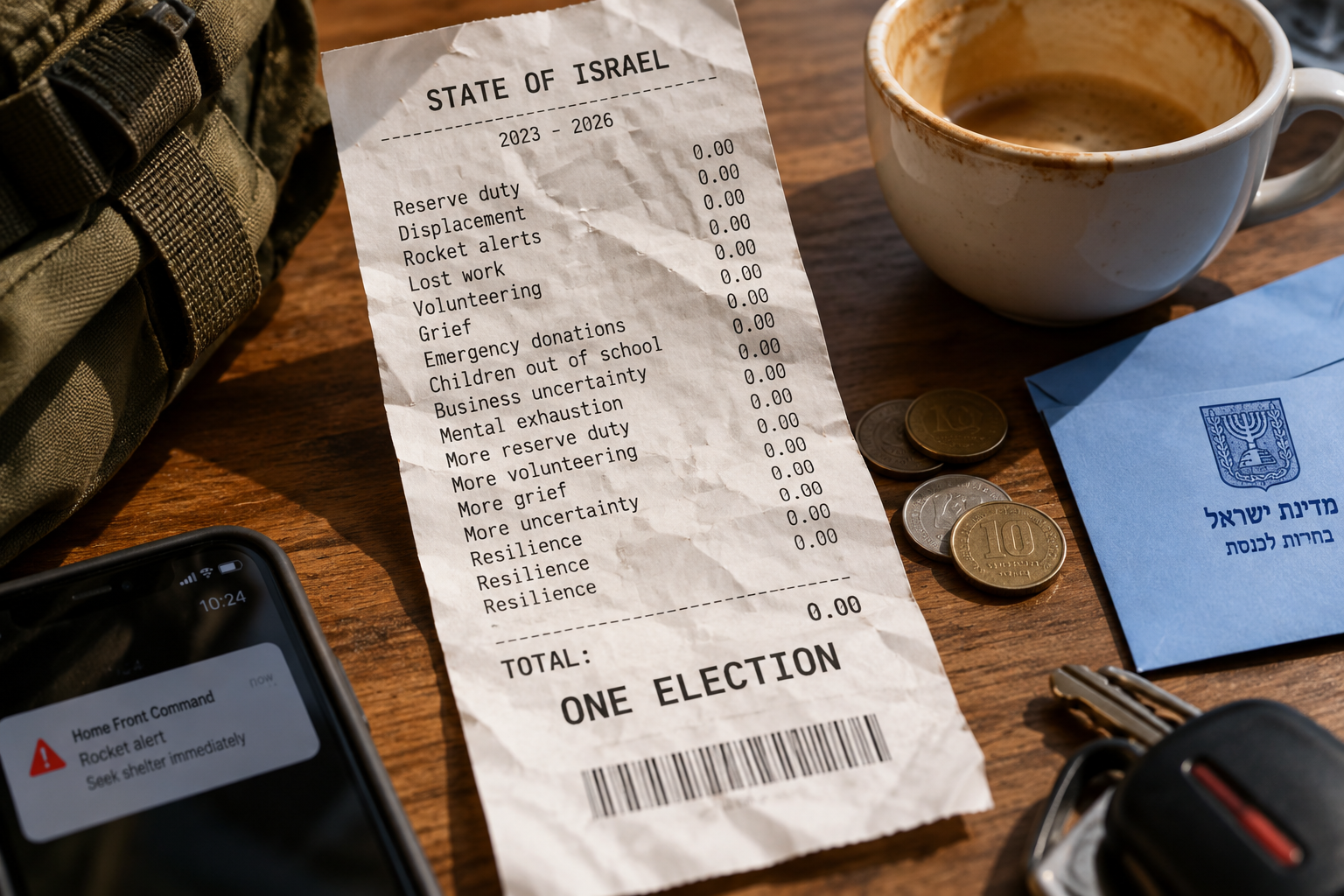
An imagined Israeli receipt tallies three years of reserve duty, displacement, rocket alerts, grief, volunteering and resilience (ChatGPT, 7-10-26).
Congratulations, Israel. You made it.
Some of you, anyway.
Three years of war, funerals, reserve duty, hostage posters, rocket alerts, evacuated towns, international condemnation and domestic fury. Three years of emergency WhatsApp groups, emergency fundraisers, emergency governments, and the uniquely Israeli ritual of hearing a boom and calculating whether it requires shoes. And now, at last, the prize.
An election. Please collect your ballot on the way out.
It’s hard to describe these three years without the word “resilience,” mostly because we’ve worn out every other word. The hostage families were resilient. The Gaza border communities were resilient. Reservists, their spouses, their kids, their employers, the farmers who lost their workers and the café owners who lost their customers: all resilient. By now the word lands less like a compliment than a recurring charge on my credit card.
Resilience has become Israel’s most abundant natural resource. Unlike natural gas, nobody is drawing up plans for what happens when it runs out.
Consider what was actually asked. People left jobs and families for months at a time. Spouses became single parents overnight. Businesses folded. Families were evacuated from homes with no return date. And into every gap the state left open, civilians poured themselves: cooking for soldiers, finding hotel rooms for the displaced, driving strangers across the country, donating blood, money, gear and time. They organized because nobody else was going to, at least not fast enough.
Eventually, we sort of started holding all this up as proof that the country works.
Look at us, we said. Look how we pull together.
And we do. It’s one of the things I love most about this place. Israel is a dysfunctional family at the national scale: we spend eleven months a year screaming at each other, and the moment something goes wrong, everyone has a spare room, a pot of soup and a cousin who knows someone in the IDF.
It is beautiful. It is also not a system of government.
There’s a point where praising citizens for covering institutional failure becomes a very efficient way of not discussing the institutional failure. When volunteers run transport because the state can’t, that’s generosity. When they feed people because the state hasn’t figured out how, that’s generosity. When they have to build an entire shadow state, over and over, to do what the real one won’t, “resilience” starts to sound a lot like “you’re on your own.”
We are spectacularly good at being on our own. Possibly too good.
Because resilience has a political upside for the people in charge in that it makes failure survivable. Ministries stall, citizens compensate. Institutions buckle, volunteers materialize. The cabinet spends a month arguing, and somebody’s mother in Ramat Gan has already launched a spreadsheet, a WhatsApp group and a Bit link. The country keeps going, and because it keeps going, it’s easy to mistake survival for success.
Politics never left, not even when we begged it to. October 7 was political before all the bodies had been identified. The hostage deals were political. The war was political. The question of responsibility was political, and so was the question of when we’d be allowed to ask it. Even grief picked up party affiliations.
Now we’re being asked to vote. Not just on taxes, judicial reform, settlements, religion and state or the price of cottage cheese, though Hashem knows we’ll make time to fight about all of it later on. We’re being asked, more or less, to decide what the last three years meant. That’s a lot to put on a ballot.
For some, the lesson of October 7 is that Israel needs to be harder, warier, quicker to use force. For others, it’s that the assumptions that ran this country for a generation collapsed in a single morning. People will vote on security, on accountability, on Gaza, on the hostages, for Bibi, against Bibi. And a healthy share will vote for whichever politician they hate slightly less than the rest.
Underneath all of it sits a simpler question: what does a government owe people after asking this much of them? Not in speeches. In practice.
If a reservist hands the state hundreds of days of his life, what does it owe his family? If a family spends a year displaced, what does it owe them after the camera crews go home? If hostage families had to become lobbyists, diplomats, protest organizers and PR firms just to keep their relatives’ names in the news, what does that say about who was working for whom?
And after three years of being told how extraordinary our resilience is, are we finally allowed to ask why we needed so much of it?
There’s a trap in building a national identity around endurance. Eventually you start admiring how much people can take instead of asking why they keep having to take it.
And we are very good at taking it. We carry on after wars, after terror attacks, after coalitions implode and elections repeat and flights get canceled.. We make jokes. We go to work. We send the kids back to school. We complain about the price of everything. Life comes back, it always does.
But a democracy is supposed to ask for more than survival. An election isn’t a participation medal for enduring your government. It’s the one moment you get to grade it.
So maybe the question to bring into the booth isn’t who kept us safe; that one has gotten complicated. It isn’t who loves Israel most, since every party will claim the title. It isn’t even who got us through the last three years. Israelis got Israelis through most of the last three years.
The question is what kind of country we want, now that we’ve seen so clearly the one we have.
The solidarity is real. The instinct to drop everything for a stranger is still one of the most remarkable things about this place. But citizens shouldn’t have to be extraordinary every day to make up for a state that isn’t.
We’ve proven we can survive almost anything. On October 27, maybe we stop treating that as the bar.
Congratulations, Israel. You survived. Now vote for a country that asks something more ambitious of you than doing it again.
Related Topics