
It’s not Mamdani’s criticism of Israel that we find so troubling
In a recent New York Times article, “Many Jewish Voters Back Mamdani,” Liam Stack correctly identifies that many New York Jews are energized by Zohran Mamdani’s economic agenda, and that many are deeply troubled by his views on Israel. But the analysis stops there, missing the fundamental reason so many of us are not just concerned, but alarmed. The issue is not merely Mamdani’s criticism of Israel; it is that he is a prominent voice in a political movement that has demonstrated a dangerously low regard for the safety of Jews, whether they be in Tel Aviv or here in Brooklyn.
This disregard for our safety is enabled by a crucial first step: a fundamental redefinition of who we are. By reducing the complex identity of the Jewish people to a single, political label, this movement creates a caricature that is easier to dismiss and, ultimately, to threaten. The New York Times article, while presumably seeking to understand Jewish concerns, evinces the precise type of blindspot to which we have become wearily accustomed.
Judaism includes, at its heart, a deep and unbreakable connection to the Jewish people. This is not a political position; it is a foundational principle of our identity. Folks like Mamdani, and the political milieu they represent, seem determined to redefine this connection as a conditional alliance, or worse, a moral failing. We must reject this redefinition.
We acknowledge that our connection to the Jewish people, and to Israel as a refuge for millions, can put us into difficult and painful moral situations. It does not mean we must blindly support the actions of every fellow Jew or every Israeli government policy. We can even question the founding story of Israel or not believe in the nation-state at all. But no serious Jew will disregard the safety of our friends and family in Israel. In light of the world’s persistent willingness to dismiss Jewish safety, we must be steadfast in this solidarity, even as it makes our moral struggles exceedingly difficult.
Somehow, the willingness to ignore Jewish safety in Israel — “Why not disband the Israeli state and let them mix freely with Hamas?” — and the willingness to downplay the Jewish right to safety in the United States — “Just stop whining about people on campus yelling at you to ‘go back to Poland’” — are often evinced by the same people. Why is that?
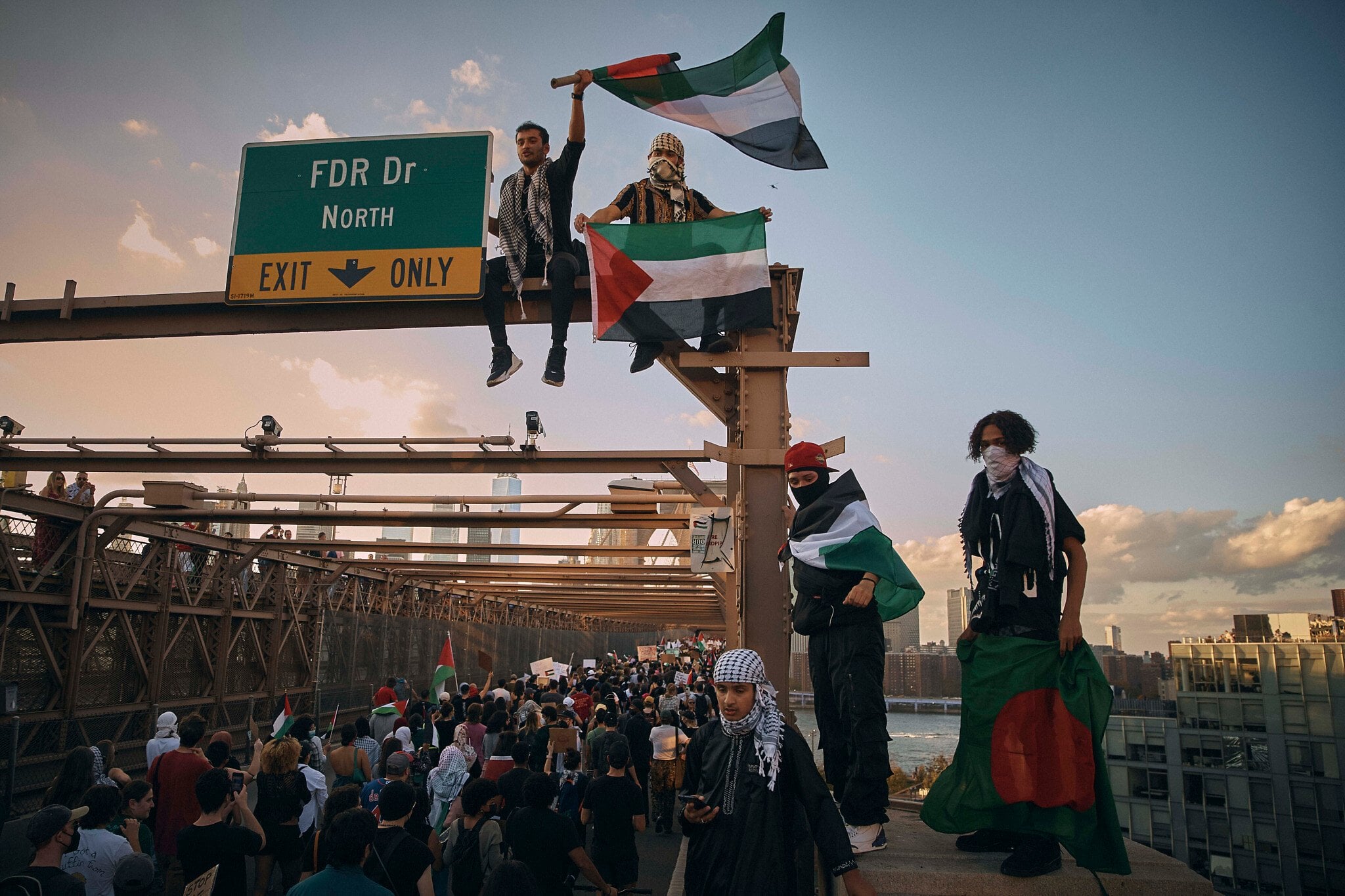
The New York Times article presumes to parse the views of Jewish voters in detail but fails to address our spectrum of concerns about cultural and political dismissiveness, exclusion, and threat, as well as the intersection between dismissiveness towards the safety and concerns of Israeli Jews and American Jews. When we see protests in our city titled “Flood Brooklyn for Gaza“—a chilling echo of Hamas’s name for the October 7th massacre—we don’t believe it’s a coincidence. When the home of the Jewish chair of the Brooklyn Museum’s board is vandalized with red paint and a sign identifying her as a “Zionist” shortly after a protest in which the museum itself was overtaken and vandalized, we see a strong connection between an incited political frenzy and threatening action. When we see book fairs cancel Jewish writers, citing concerns about support for Israel, we see a double standard that we have warned would lead to violence. As it has; including, tellingly, at a solidarity event supporting Israeli hostages and at a relatively generic networking event for young Jewish professionals.
We don’t just want to hear a candidate promise to increase funding for fighting hate crimes; we want to hear them unequivocally condemn the specific, antisemitic poison infecting our city’s political and cultural spheres.
Instead, the standard line from this political movement has become that claims of antisemitism are being “weaponized.” This is a cleverly violent phrase that serves to silence and dismiss real Jewish fear. If some have abused this claim, is that a reason to abandon all Jews to the violence of the mob? Apply this logic to any other minority group, and the deprioritization of Jewish safety becomes starkly clear.
This is why a candidate’s stance on Israel is not, as the article suggests, a simple “litmus test” about a foreign country. Rather, an obsession with Israel is just one part of a stew of behavior that Jews have witnessed in New York over the past several years. I, for one, don’t just want to be ‘protected’ by an indulgent mayor; I want my public officials to acknowledge the broader pattern of uncivil behavior that I and many others have noted for years, and which has only grown more fetid—even if acknowledging that pattern would break many current leftist orthodoxies.
I do not object to Zohran Mamdani because he opposes a particular Israeli policy. I object to him because I have every reason to believe that he is part of a political milieu that consistently and strategically dismisses our pain, delegitimizes core connections of the Jewish people, and enables threats against us. To ask a community to overlook such a pattern–in the absence of a full reckoning–is to ask it to sacrifice its own safety and integrity on the altar of political convenience.