
The Enemy of My Enemy Is My Enemy
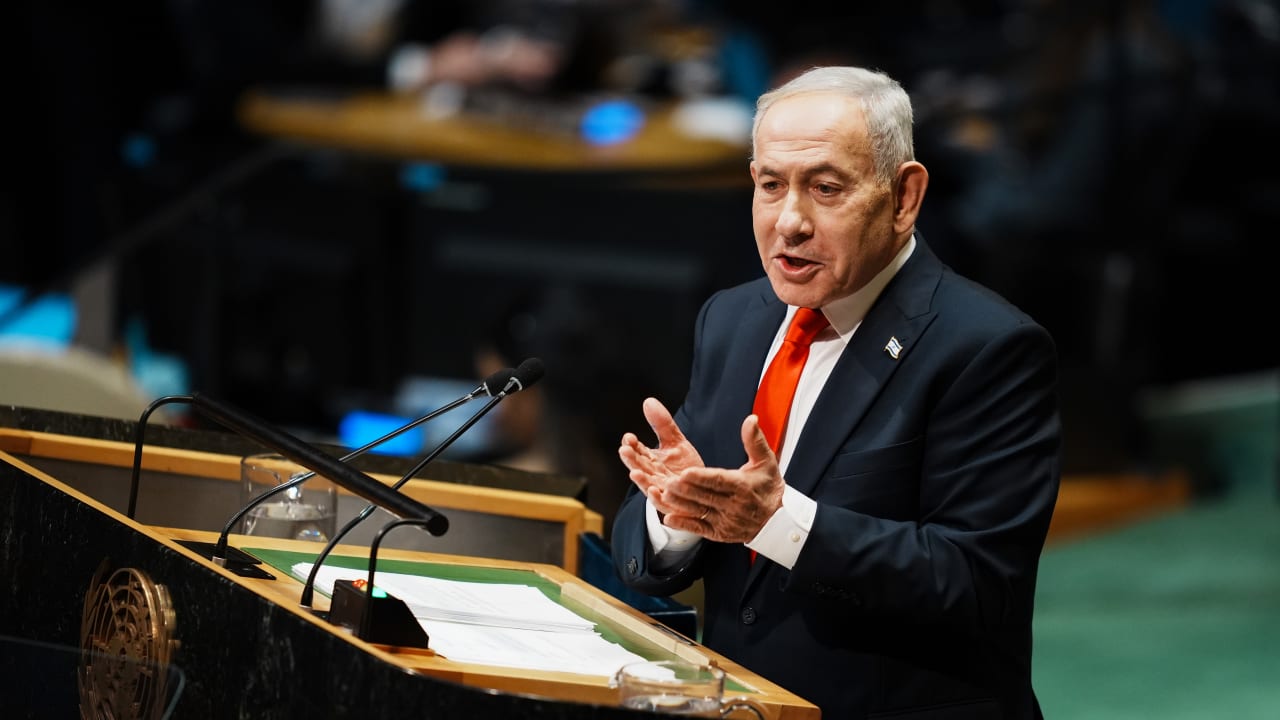
When Benjamin Netanyahu walked toward the podium of the United Nations General Assembly, dozens of diplomats began walking in the opposite direction. Most delegations from Arab and Muslim countries left the hall, while the United Arab Emirates remained. Netanyahu watched them go and called them “moral cowards.”
It was an unusually harsh accusation, even by the standards of a speech delivered in the middle of a war. But what exactly was Netanyahu accusing them of? Walking out of a speech is hardly an act of cowardice. Governments protest other governments at the United Nations all the time, and many of those leaving had profound disagreements with Israel. The more interesting question is why Netanyahu chose that particular word.
There is an old simplicity to the way states behave when confronted by a common threat. They do not have to like one another or share values, religion or political systems. History is filled with governments cooperating with countries they distrusted because, for that moment, something more dangerous stood on the other side. The old formula reduces all that complexity to a single sentence: The enemy of my enemy is my friend.
Look at the scene in New York through that old rule, however, and something does not quite fit. Iran is not merely Israel’s problem.
Europe does not need Israeli intelligence to tell it that Iran presents a security threat. Its own governments and security services have been saying so. In June, 24 governments — including France, Germany, Spain, Italy, the Netherlands and the United Kingdom — issued a joint statement condemning what they described as “lethal plotting and other malign actions” by Iranian intelligence services in Europe, North America and Australia. They specifically identified Iran’s Islamic Revolutionary Guard Corps Intelligence Organization, the Quds Force and the Ministry of Intelligence and Security. The alleged targets included Iranian dissidents, journalists, and Jewish and Israeli communities and interests.
The European Union went further. In February, it formally added the Islamic Revolutionary Guard Corps to the EU terrorist list, freezing its funds and other economic resources in member states and prohibiting European operators from making funds available to it. This was no longer a distant confrontation Europeans were merely observing. Their own governments were accusing organs of the Iranian state of plotting lethal operations on their soil.
Nor does Iran’s confrontation with Israel exist in isolation. Tehran has spent decades building relationships with armed organizations across the Middle East, including Hezbollah, Hamas and the Houthis. The precise legal designation of those organizations varies between jurisdictions, but Iranian financial, material and military support for regional armed groups is extensively documented. The European Union itself maintains a sanctions framework addressing Iranian military support to armed groups and entities in the Middle East and Red Sea region.
Then there are the missiles. In March, NATO identified, tracked and successfully intercepted an Iranian ballistic missile targeting Turkey, a NATO member. The North Atlantic Council subsequently condemned Iran’s targeting of Türkiye and emphasized that the interception demonstrated the alliance’s ability to defend its populations against ballistic threats.
There is an uncomfortable historical echo here. Fourteen years earlier, standing behind the same United Nations podium, Netanyahu held up his now-famous drawing of a bomb and warned that Iran must not be allowed to acquire nuclear weapons. The cartoon was widely mocked afterward; contemporary examples of the ridicule can still be found in The New Yorker and The Guardian. But behind the cartoon was a warning explicitly larger than Israel. If Iran acquired nuclear weapons, Netanyahu asked, who would feel safe in the Middle East, in Europe, in America or anywhere else? By then, he said, he had already been sounding that alarm for fifteen years.
Netanyahu’s predictions about the timing and trajectory of Iran’s nuclear program have been intensely disputed, but the nuclear concern itself is hardly an Israeli invention. The International Atomic Energy Agency concluded in its comprehensive 2025 assessment that Iran had maintained an undeclared structured nuclear program until the early 2000s involving undeclared nuclear material. It has also described Iran’s accumulation of uranium enriched to 60 percent — unique among non-nuclear-weapon states — as a serious proliferation concern. The Agency has not concluded that Iran currently operates an undeclared structured nuclear weapons program.
Put the pieces beside one another. Iran supports armed organizations operating across several countries. Its intelligence services are accused of lethal plotting abroad. It possesses an extensive ballistic-missile program while its nuclear activities remain under extraordinary international scrutiny. In 2012, Netanyahu warned from the General Assembly that this combination could eventually threaten countries far beyond Israel.
Fourteen years later, NATO intercepted an Iranian ballistic missile targeting one of its own members.
Iran’s collision with European security also runs through Russia. In January, the Council of the European Union imposed additional sanctions related to Iran’s continued military support for Russia’s war against Ukraine, describing that support as a “direct threat to EU security.” The measures included entities involved in Iran’s state-sponsored UAV program and ballistic-missile industry.
Then there is the Strait of Hormuz, one of those narrow pieces of geography upon which an astonishing portion of the global economy depends. Its de facto closure following the outbreak of the Middle East war disrupted liquefied natural gas (LNG) flows representing almost 20 percent of global supply. The International Energy Agency reported that European and Asian natural-gas prices subsequently rose to their highest levels since the 2022–2023 energy crisis. The consequences spread through Europe and Asia and back into the Arab Gulf itself.
Hormuz does not distinguish between Iran’s enemies and everyone else.
Only after assembling this picture does another part of Netanyahu’s speech become particularly interesting. He told the General Assembly that Israel had defended many of the countries whose representatives had just walked out and claimed that many of their leaders had privately thanked him for Israel’s actions against Iran.
Those private conversations cannot be independently verified, but they do not need to be for the strategic contradiction to exist. Arab governments have their own populations, political pressures and profound disagreements with Israel, just as European governments can regard Iranian activities as threats while condemning Israeli policies. Sharing an adversary has never required sharing a foreign policy.
Yet the picture remains peculiar. Governments whose security services accuse Iran of plotting lethal operations on their territory, whose military alliance has intercepted an Iranian ballistic missile, whose economies have absorbed the effects of instability around Hormuz and whose institutions have spent years confronting Iran’s nuclear activities can hardly regard Iran as merely Israel’s enemy.
Perhaps this is simply what modern diplomacy looks like. States compartmentalize. A government can oppose Iran, condemn Israel, negotiate with Tehran and cooperate with Jerusalem on different questions, sometimes simultaneously. Foreign policy has never required emotional consistency.
History, however, provides some extraordinary examples of what happens when a sufficiently dangerous common enemy appears. Winston Churchill spent much of his political life opposing communism and had few illusions about Stalin or the Soviet system. Then, on June 22, 1941, Hitler invaded the Soviet Union. Britain sided with Stalin, and eventually the United States did as well. The ideological gulf had not disappeared; Nazi Germany had simply become the overriding threat.
Britain did not need Stalin to become a liberal democrat before recognizing that Soviet armies fighting Hitler served an immediate British strategic interest. Some alliances are born from shared values. Others are born because two governments look across the chessboard and discover the same piece threatening both of them.
Israel’s history with the West makes the present inversion particularly curious. The United States recognized the new State of Israel on May 14, 1948, the same day Israel declared independence. A little more than a decade later, American intelligence assessments contained what US officials described as “extensive evidence” that France had supplied Israel with plans, materials, equipment and technical assistance for its nuclear complex at Dimona, while also training Israeli personnel.
The relationship changed over subsequent decades and included serious disagreements, but Israel eventually became deeply embedded in the Western strategic architecture of the Middle East. Iran followed almost the opposite trajectory.
Which brings us back to those two words at the beginning: “moral cowards.”
Perhaps Netanyahu was simply insulting diplomats who refused to listen to him. Perhaps Gaza, and the political transformation it has produced around Israel, explains the scene completely. Governments can certainly believe simultaneously that Iran threatens their interests and that Israeli policies deserve condemnation.
But is that enough to explain everything we are watching?
Netanyahu began warning from the UN podium about Iran’s nuclear ambitions long before some of the diplomats who walked out this week held public office. In 2012 he explicitly warned that the danger would not stop at Israel. Fourteen years later, an Iranian ballistic missile was intercepted while targeting NATO territory.
And still, when he approached that same podium, diplomats walked in the opposite direction.
Perhaps Gaza explains all of it.
But are we sure?
If it does not, then something else has entered the equation. What that something is may be a more uncomfortable question than anything said from the podium that day.
Churchill understood the old arithmetic: The enemy of my enemy is my friend.
Eighty-five years later, the equation still holds. Except for Israel:
The enemy of my enemy is my enemy.