
Educator, Mother, Learner, Wife — Guided by Torah
‘Context’ Is the New Excuse
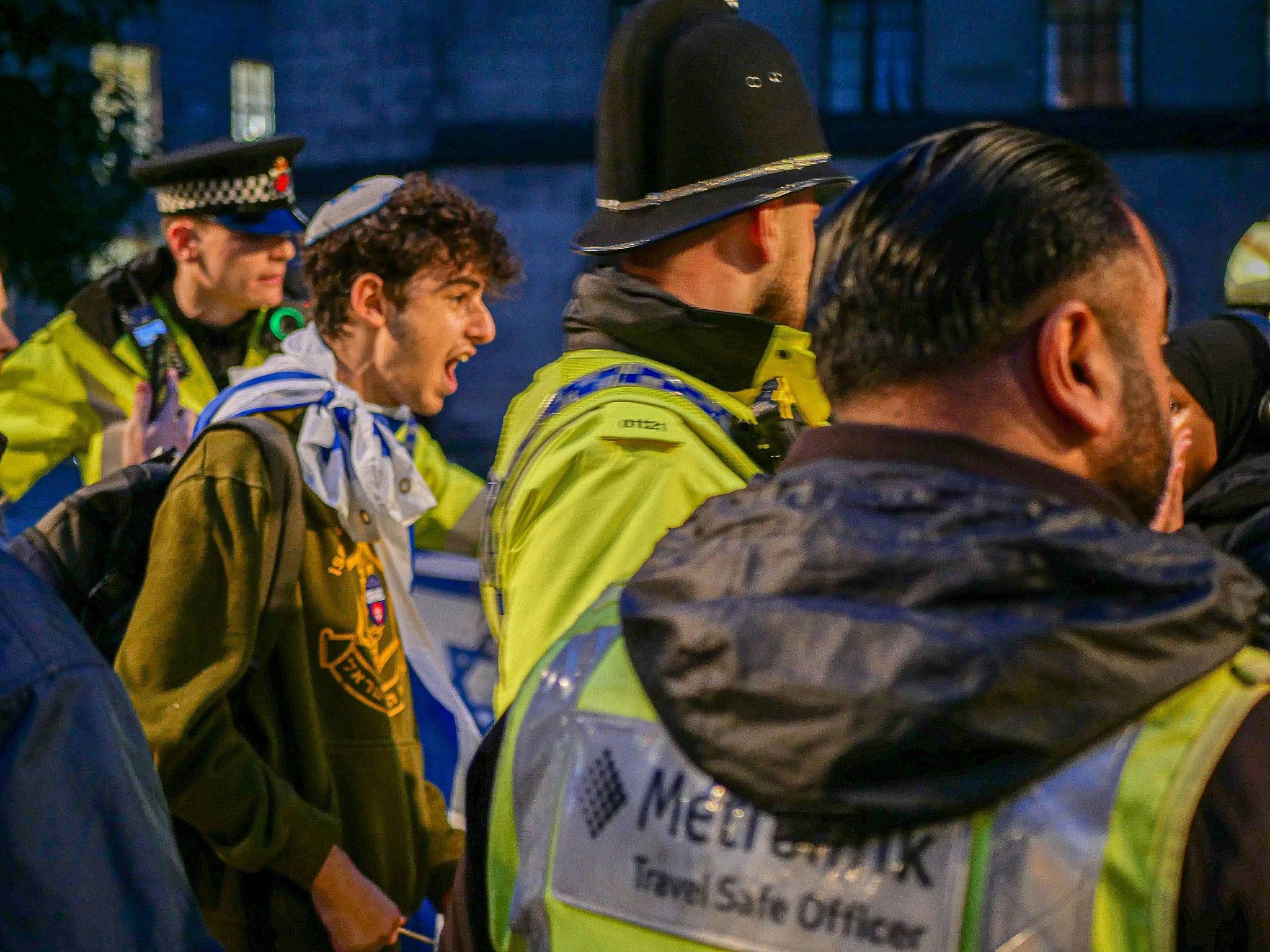
Jews around the world have to protest just for the right to live without fear (Dylan4photography, Unsplash).
In a culture obsessed with policing “harm,” ordinary speech is treated as bigotry — while explicit threats against Jews are endlessly explained away.
The Double Standard
In today’s public discourse, the problem is not simply disagreement — it is asymmetry. Certain statements, even when they involve no threat and no call for harm, are treated as moral offences the moment they are voiced. At the same time, language that is genuinely threatening, even explicitly violent, is increasingly met with hesitation, reinterpretation, and demands for “context.” This imbalance has become so normalised that many no longer notice it — except those who consistently fall on the wrong side of it.
I am a mother and a morah. My days are filled with school drop-offs, classrooms, buses, pavements, and the constant low-grade vigilance that comes with caring for children in a city that no longer pretends it can keep women safe by default. I notice where my daughter walks on the pavement. I notice which men slow down. I notice which streets empty out at dusk. This is not ideology; it is attention.
Say you believe women should be given financial resources, housing assistance, and material support so they can keep their babies if they want to, and you are accused of sexism or coercion. Helping a woman avoid an abortion she does not actually want is framed as controlling her body, while economic pressure that pushes her towards abortion is rarely described as coercive at all. Even expanding options becomes suspect if it challenges an approved ideological script. This is what abdication looks like when it wears the language of care.
Say you oppose unrestricted immigration from war-torn regions without serious screening, and you are branded Islamophobic. Say you believe violent criminals who entered illegally — including those who push women onto subway tracks, assault passengers, or rape women on public transport — should be deported, and you are labelled racist. In these cases, the existence of victims, police reports, and repeat offences does not seem to matter. Behaviour is eclipsed by identity, and naming violence is treated as the greater moral sin.
Across these debates, the pattern is consistent. Ordinary, non-violent positions are treated as hate. Context does not matter. Intent does not matter. The moral verdict is immediate. Yet, when Jews are threatened, everything changes.
When Intent Suddenly Matters
When shuls are vandalised, when Jewish institutions are threatened, or when Jews are attacked at visibly Jewish events, the response is often strikingly cautious. We are told to slow down and ask questions that would never be asked if any other group were targeted. Did the attacker really mean Jews as such? Were they merely angry about Israel? Were they confused?
After threats against synagogues or violence at public Jewish gatherings — including Chanukah festivals — we are repeatedly invited to consider whether the perpetrator might have thought the building or event was actually an Israeli embassy or consulate. As though mistaking a synagogue for a diplomatic mission somehow mitigates a threat to Jewish civilians. As though targeting Jews is less serious if the hatred can be rebranded as “political.”
Sometimes the burden shifts even further. Jews are subtly encouraged to ask whether our visibility is the problem — whether fewer Jewish symbols, fewer public celebrations, fewer markers of Jewish identity might make people “less angry.” I am not confused about what a threat looks like. I am not persuaded by word games when safety is at stake. And I do not need a seminar to tell me otherwise.
Could you imagine a progressive advising a Hindu woman or South Asian family to stop cooking curry or chicken tikka masala because the smell might “provoke” racist neighbours? Could you imagine suggesting they tone down their food, their dress, or their festivals so bigots feel more comfortable — and presenting that as compassion? Of course not. We all recognise that logic immediately for what it is: blaming the target for the hatred directed at them.
Yet when Jews are told to be less visible, less Jewish, less present in public space, this logic is treated as reasonable, even enlightened. Here, intent — dismissed entirely in debates about abortion, immigration, or crime — suddenly becomes decisive. Context, irrelevant when ordinary citizens voice non-violent objections, becomes paramount when Jews are threatened. The rules are not merely flexible; they are selectively applied.
When I was thought to be part of the “right” minority, my critiques were praised as courageous. The moment I was seen differently, the same words became suspect. The ideas had not changed. The audience had.
For years, when many on the left believed I was a “transgender woman,” my views were welcomed — even celebrated. I could speak about boundaries, safety, motherhood, and Jewish continuity, and be heard as complex, even courageous. Those same views were treated as evidence of depth rather than danger — because they were assumed to come from the “right” kind of minority.
But after extensive halachic and medical consultation, it became clear that I was intersex — not transgender — and that using the language of “transition” had never truly applied. I had not abandoned an identity — I had corrected a miscategorisation that others forced upon me because just “being a female” was seen as outdated and obsolete by the fads of our time.
The words I speak did not change. The ideas I hold did not change. What changed was how others perceived my right to speak them. Once it became clear I was not part of the LGBTQIAP+ alphabet soup community and they wanted nothing to do with me, the permission structure shifted. Positions once seen as layered were now suspect. The same moral gatekeepers who once praised my views as nuanced began framing them as dangerous.
This is not a personal grievance. It is a warning sign. Our culture increasingly treats nuance not as a virtue but as a privilege — granted only to those who serve ideological needs. Once my minority “card” was revoked, so was my right to be heard without suspicion. That is not progress. It is ideological gatekeeping, and it explains far more about our current moral climate than most are willing to admit. We pretend to value lived experience — until that experience is inconvenient. Then it is ignored, or rebranded, or denied altogether.
When “Context” Means Looking Away
What makes this gatekeeping so corrosive is that it does not remain confined to academic discourse or social media etiquette. It filters downward, shaping how real danger is discussed — and dismissed — in everyday life. The same moral culture that treats speech as violence becomes strangely hesitant when confronted with actual violence, especially when Jews are the target. The result is a profound inversion of moral priorities: words are policed aggressively, while threats are endlessly contextualised.
This inversion has concrete consequences, particularly for women. I walk my daughter to school. I ride public transport. I wait at crossings. I move through public space with constant calculation — the kind most women recognise instinctively and most theorists prefer to ignore. I have been catcalled, followed, and shouted at by men who entered this country illegally, and then told — calmly, confidently — that even noticing this pattern is xenophobic. That naming it is hateful. That my discomfort, and my child’s safety, must be sacrificed for the sake of ideological neatness.
I am warned not to generalise, not to connect dots, not to describe trends. “You cannot generalise,” I am told, as though recognising patterns were a moral failure. And yet the very same voices generalise freely — about men, about Jews, about settlers, about religious women, about entire nations and cultures — whenever it serves a political purpose.
This is not humility. It is gatekeeping disguised as principle — a system designed to punish clarity and reward fashionable blindness. A society that teaches women not to notice danger does not become more compassionate. It becomes dishonest. And dishonesty about risk does not make anyone safer; it simply transfers the cost onto women and children. I will not teach my children that refusing harm is cruelty, or that identifying danger is oppression. That lesson ends with me.
The Moral Bar Cannot Be Two-Tiered
This same inversion appears starkly when Jews are threatened. When antisemitic violence occurs, the instinct is rarely to condemn first and analyse later. Instead, the order is reversed. We are asked to consider intent, to interrogate context, to distinguish between “real” antisemitism and something more understandable — political anger, misplaced protest, confusion. Symbols that would be recognised instantly as threatening if directed at any other group are treated as ambiguous when directed at Jews.
And yet when Jews speak — calmly, non‑violently — about abortion, immigration, gender, terrorism, crime, or public safety, no such generosity is extended. There is no pause for context, no weighing of intent, no curiosity about lived experience. The moral verdict is immediate and absolute. Speech is treated as violence, while violence is treated as speech.
This leaves us with an unavoidable question. Should the bar for condemning hate be low for everyone, or high for everyone? Either position can be defended honestly. What cannot be defended is maintaining two systems at once: one in which ordinary, non‑violent speech is treated as hateful when it challenges fashionable orthodoxies, and another in which explicit threats are softened, reframed, or excused when Jews are the target.
The hypocrisy becomes obvious the moment we apply the simplest test. Imagine violence against a Muslim school being explained away as geopolitical grievance against Saudi Arabia. Imagine threats against a Black church dismissed as confusion because of riots in Haiti. Imagine slurs hurled at a gay couple prompting universities to convene panels to explore the attacker’s trauma. These scenarios are immediately recognisable as obscene. No one would tolerate them.
Yet when Jews are targeted, this is precisely the logic we are offered. Delay. Deconstruct. Discuss. Dilute. Deflect. “Context” becomes a moral solvent. It does not clarify threats; it dissolves them. It transforms danger into discourse and places the burden on Jews to empathise with those who hate them.
Clarity Is Not Cruelty
What sustains this moral incoherence is not ignorance, but ideology. White‑guilt frameworks struggle to categorise Jews, who are too ancient, too persistent, too particular to fit neatly into the approved hierarchy of Western victimhood. Postmodern thinking, meanwhile, treats moral boundaries themselves as suspect, training an entire generation to distrust clarity and recoil from judgement. Together, they produce a culture that is paralysed when protection is required and hyper‑active when condemnation is fashionable.
Jews do not fit the script. We are the “successful minority.” Thus, antisemitism is rarely denied outright; it is reframed. We are told it is really about something else. That condemning it too firmly would lack nuance. That asking for protection is embarrassing. I hoped for more from a moral culture that claims to care about the vulnerable. I am no longer surprised — but I am still not willing to play along.
I am not interested in shouting. I am interested in protection — of children, of women, of Jews, of ordinary people who are exhausted by being told that clarity is cruelty. Jews are not asking for special treatment. We are asking for equal standards. That is not extremism. It is moral adulthood.
If you need layers of “context” to condemn open hatred of Jews — whether it be October 7th or Bondi Beach — you have not misunderstood the moment. You have failed it. As a mother, a teacher, and a Jewish woman who has lived through both miscategorisation and clarity, I no longer apologise for recognising danger, drawing boundaries, or naming truth. Clarity is not cruelty. It is the first step toward safety — and toward justice.
Related Topics