
Coordinated Defense, Not Cost-Sharing: What the Interceptor Numbers Truly Mean
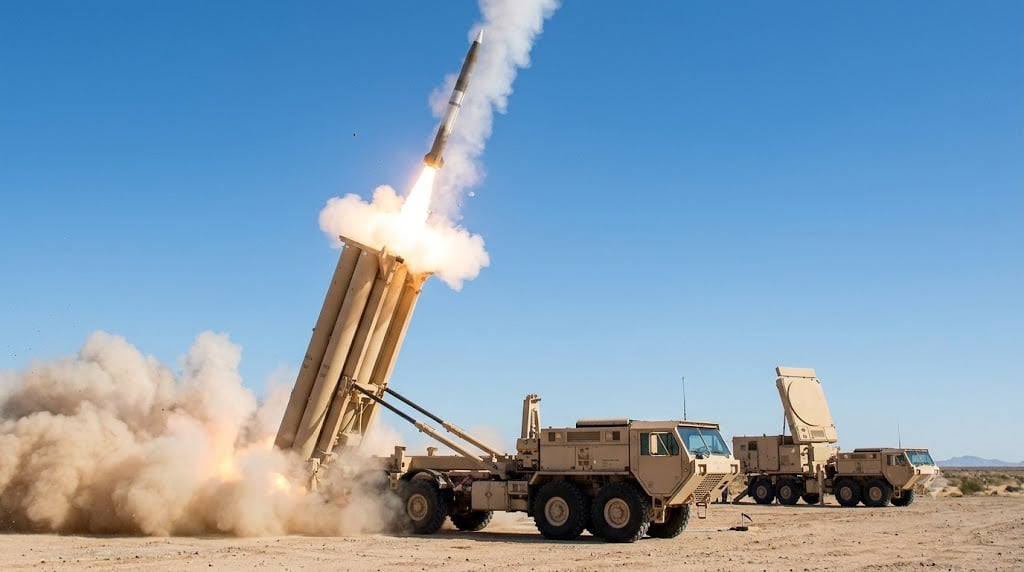
A recent Washington Post report reveals striking figures from Operation Epic Fury: the United States expended over 200 Terminal High Altitude Area Defense (THAAD) interceptors — roughly half the Pentagon’s total inventory — along with more than 100 Standard Missile-3 (SM-3) and Standard Missile-6 (SM-6 ) interceptors defending Israel, while Israeli forces fired fewer than 190 of their own. The Post frames this primarily as a story about burden: the U.S. military expended far more advanced interceptors to protect Israel than Israeli forces did.
That framing, while factually accurate, risks obscuring the more important point. The objective of integrated missile defense is not cost parity between allies — it is stopping missiles from landing on American allies and American forces stationed in the region. Judged against that standard, the operation worked. Every interceptor fired by either country contributed to the same outcome: protecting civilian populations and military personnel from an Iranian ballistic missile threat. A ledger that simply totals interceptors by national flag tells you very little about whether the mission succeeded.
This Was Never Two Separate Defenses
The U.S.-Israel missile defense relationship is not new, and it was never designed to operate as two parallel systems keeping their own scorecards. As I noted in a recent article, it dates back more than thirty years, to the first Gulf War, when Patriot batteries were first deployed to defend Israel against Iraqi Scud missiles. In the decades since, the relationship has been deliberately deepened through joint exercises — Juniper Cobra chief among them — specifically so that American and Israeli forces could fight as a single integrated system rather than as separate actors dividing up the sky over the same battlespace.
This is not a minor technical point. Integration means shared early warning, shared sensor data, and a combined fire-control picture in which interceptors are allocated based on which system is best positioned and best suited to a given threat — not based on whose military happens to own the launcher. Seen that way, the interceptor disparity documented in the Post’s reporting is not evidence of burden-shifting. It is evidence of sound operational logic working exactly as designed.
Against Iranian medium-range ballistic missiles, THAAD and SM-3 are simply the correct fire-control solution, and the system that owns those assets in the greatest depth is the U.S. military. Allocating the right interceptor to the right threat, regardless of national origin, is what an integrated architecture is supposed to do. Treating the expenditure gap as a grievance — as though Israel under-contributed — gets the strategic logic backwards, and risks undermining a partnership that has functioned exactly as intended for three decades.
Where the Real Story Is: A Problem Nearly Twenty Years in the Making
What the reporting gets right — and what deserves far more attention than the cost-sharing framing — is that the U.S. interceptor inventory problem is real, serious, and entirely predictable.
I saw this coming firsthand. As I noted, in 2007, while serving on the House Armed Services Committee with responsibility for the missile defense account, a Pentagon-sponsored Joint Capabilities Mix study had already concluded that the United States needed roughly twice as many SM-3 and THAAD interceptors as it had to meet minimum combatant commander requirements. That was nearly two decades ago. Congress raised concerns about the gap at the time. The Department of Defense largely set those concerns aside in favor of other budget priorities, and successive administrations did not meaningfully change course.
The consequences of that choice were entirely foreseeable, and they are now playing out in real time. Production lines for THAAD and SM-3 interceptors were never sized for sustained high-intensity conflict; they were sized for a peacetime assumption that advanced interceptors would be expended sparingly, against isolated threats, rather than at the volume a sustained regional conflict actually demands. Budget tradeoffs across multiple administrations consistently prioritized other systems and other modernization programs over rebuilding interceptor magazine depth. The result is an inventory architecture that performed admirably under stress but was never built with that level of stress in mind.
I’ve returned to the underlying problem — and to specific proposals for fixing it — repeatedly over the past year in publications like Breaking Defense, Defense One, and Real Clear Defense. My key recommendations in the articles include expanding interceptor production capability, investing in new technologies like directed energy, and increasing co-production with allies and partners. None of what we are seeing now should surprise anyone who has been paying attention to this issue over the past two decades.
What Comes Next
The right response to the Post’s reporting is not a debate over which ally “paid” more for interceptors. It is a serious, sustained push to rebuild interceptor production capacity — expanding THAAD, SM-3, and other missile defense production lines, diversifying the industrial base supporting them, and treating magazine depth as a first-order strategic priority rather than a line item that loses out to other procurement decisions year after year. Allies should also be having a frank conversation about co-production and co-investment in interceptor manufacturing, not as a matter of burden-sharing optics, but because a wider industrial base benefits everyone operating inside the same integrated architecture.
For years, the United States optimized its defense industrial base for efficiency: lean production lines, just-in-time manufacturing, and inventories sized for the threats of a quieter era. We are now living in an era that demands resilience instead — deep magazines, diversified production, and the industrial capacity to sustain an ally through a prolonged campaign without depleting half a national stockpile in the process. Operation Epic Fury did not expose a flaw in U.S.-Israel burden-sharing. It exposed the cost of choosing efficiency over resilience for two decades running. That is the conversation worth having now, before the next crisis arrives and finds the magazines empty again.