
U.S.–Israel Missile Defense Cooperation Is a Strategic Imperative
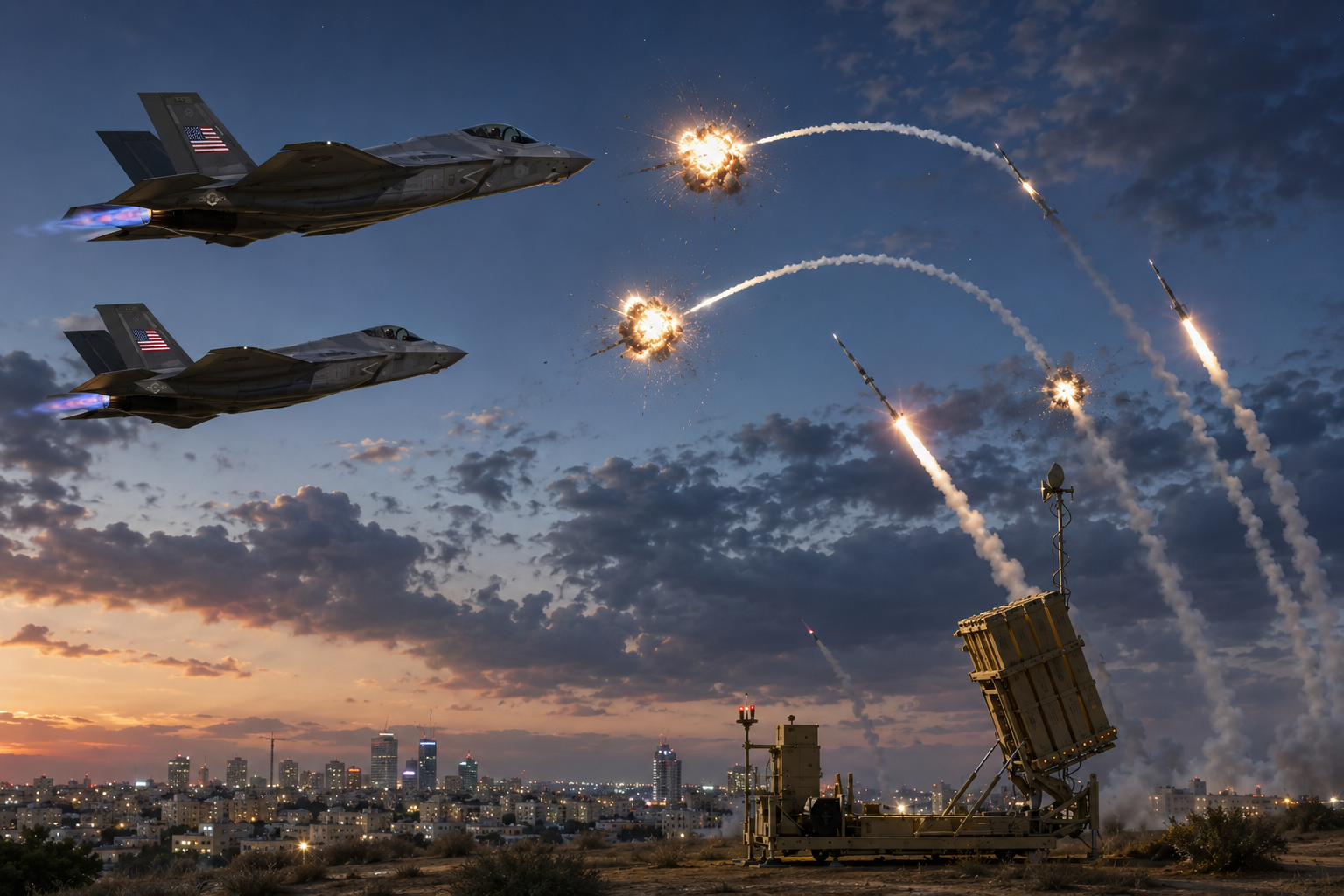
The recent conflict with Iran proved what decades of investment and cooperation had long promised: missile defense works. Israel’s layered architecture—Iron Dome, David’s Sling, Arrow, supported by U.S. capabilities including SM-3, and THAAD—intercepted most Iranian ballistic missiles, cruise missiles, and drones. U.S. forces played a direct operational role, reinforcing Israel’s defenses during critical phases of the conflict. The lesson is not simply that the technology performed. It is that the partnership behind the technology performed—and that the model it represents deserves to be extended across the region and beyond.
I had the privilege throughout my career of helping advance this cooperation, working to strengthen integration between U.S. and allied systems, expand sensor architectures, and reinforce the political and technical foundations that make such collaboration possible. I have watched this partnership mature from a bilateral arrangement into something approaching a genuine operational alliance. What follows is my assessment of where it stands, where it falls short, and what it should become.
A Foundation Built Over Decades
The U.S.–Israel defense relationship has always been a two-way enterprise. Israeli forces gained knowledge from the U.S. military’s experience in World War II, Korea, and Vietnam—adapting American tactics to the specific demands of fighting Soviet-equipped Arab militaries. In return, Israel’s hard-won experience in the wars of 1948 through 1982 informed American thinking about combined arms warfare and attrition against a sophisticated adversary. When both militaries later confronted insurgency and terrorism—Israel in Lebanon, Gaza, and the West Bank; the United States in Iraq and Afghanistan—that mutual learning continued.
Missile defense became the defining chapter of this cooperation. As I have written elsewhere, the catalyst was the 1991 Gulf War, when Iraqi Scud attacks exposed the catastrophic vulnerability of civilian populations to ballistic missile threats. In the decades that followed, the United States and Israel worked together to build a layered defense architecture specifically designed to counter Iran’s expanding missile and drone arsenal. The result—tested under fire in recent years—is the most operationally validated missile defense system in history.
The Sustainability Challenge
Success has revealed a new problem. Iran and its proxies have adapted. Having absorbed repeated setbacks, they have embraced a strategy of mass—launching large salvos of low-cost drones and rockets designed to exploit the fundamental cost asymmetry between offense and defense. An interceptor costs orders of magnitude more than the threat it defeats. Sustaining that exchange rate across a prolonged conflict is strategically and industrially unsustainable.
This is not a hypothetical concern. Israel’s Arrow inventory was significantly depleted during the recent conflict. Replenishment takes time and competes with other urgent production priorities. The Arrow 3 sale to Germany—valued at more than six billion dollars—reflects both the system’s proven capability and the scale of industrial investment required to field it at meaningful numbers. Iron Dome batteries face similar pressures.
The answer lies partly in directed energy. Israel’s Iron Beam system offers the potential to dramatically reduce the cost-per-intercept against mass drone and rocket threats—essentially making the cost asymmetry work in the defender’s favor. Combined with continued co-production arrangements, supply chain resilience, and shared interceptor stockpiling between the United States and Israel, directed energy represents the next frontier of the partnership. Missile defense must evolve from a high-end capability into a system designed for sustained, high-intensity conflict. Without that evolution, even the most advanced architectures risk being overwhelmed.
The strategic context has also shifted in ways that reinforce the urgency of this investment. Iran’s conventional military power — its air force, air defense network, and naval capacity — was severely degraded in the recent conflict. That degradation is not a reason for complacency. It is a reason to expect Iran to lean harder and faster into the one domain where it retains meaningful capacity: missiles and drones. An adversary that can no longer contest the air conventionally has every incentive to compensate through mass ballistic and cruise missile salvos, one-way attack drones, and proxy delivery systems that complicate attribution and response. The pattern is already visible. Missile defense is not simply one element of the response to Iran — increasingly, it is the response.
The Missing Piece: Regional Integration
While U.S.–Israel missile defense cooperation has succeeded as a bilateral model, the broader regional architecture remains dangerously fragmented.
Over the past two decades, Gulf Arab states have invested heavily in advanced missile defense systems—Patriot, THAAD, and others. Yet despite over a decade of efforts to increase regional integration, these capabilities still largely operate in isolation, segmented across national lines with limited sensor integration, minimal command-and-control coordination, and no shared operational doctrine. The technology exists. The investment has been made. But without integration, the collective system is substantially less effective than the sum of its parts—a strategic inefficiency that Iran understands and actively exploits.
The U.S.–Israel model points toward a different approach: shared architecture, real-time data exchange, and coordinated operations built and tested over time rather than improvised in crisis. Israel’s reported deployment of air defense capabilities to the UAE—to help counter the growing drone threat—illustrates what the next phase of regional cooperation might look like. The political sensitivity of deploying Israeli systems on Arab soil is real. But the Middle East has changed. The Abraham Accords and the security imperatives exposed by Iran’s regional aggression have created space for forms of cooperation that would have been unthinkable a decade ago.
The next step is building a genuinely integrated regional missile defense architecture—linking Gulf Arab systems with Israeli and American capabilities through shared sensors, interoperable command networks, and coordinated operational concepts. This is not simply a technical challenge. It is a political one that requires sustained U.S. leadership and diplomatic investment.
Training for Reality, Not Theory
Integration cannot be improvised in a crisis. It must be built, tested, and refined over years of sustained exercise. That is why joint exercises like the U.S.-Israeli Juniper Cobra exercise are operationally essential rather than merely symbolic. These exercises function as stress tests—simulating large-scale coordinated attacks and forcing U.S. and Israeli forces to operate as a single integrated network. They validate interoperability, expose weaknesses in command-and-control, and build the operational trust that cannot be manufactured under fire.
Juniper Cobra is not a diplomatic gesture. It is a command-and-control stress test — designed to simulate the exact scenario that materialized in recent operations: simultaneous, multi-vector attacks across multiple threat layers requiring real-time coordination between U.S. and Israeli forces. When Iranian ballistic missiles, cruise missiles, and drones arrived in combined salvos, the integration required to defeat them had already been rehearsed. Crews knew the procedures. Networks had been validated. Commanders had already worked through the decision points. That is not a coincidence — it is the return on years of deliberate investment in joint training.
Extending this exercise regimen to Gulf partners—and ultimately building a regional equivalent of Juniper Cobra that includes Arab states alongside U.S. and Israeli forces—should be a near-term policy priority. A regional missile defense architecture that exists only on paper provides deterrence value far below its potential. One option to consider might be establishing a missile defense cooperation annex under the Abraham Accords that would task U.S. Central Command to work with regional partners to expand missile defense cooperation across the region. The political obstacles are real — but so is the strategic cost of leaving the architecture on paper.
From Bilateral Success to Strategic Model
The U.S.–Israel missile defense partnership has proven something important: effective missile defense is not primarily a technology problem. It is an integration problem. The systems that performed in recent operations succeeded not because individual interceptors are perfect—they are not—but because layered architectures, shared sensors, coordinated command-and-control, and years of joint training created a system that is resilient where any single component would be vulnerable.
That lesson extends well beyond Israel. It applies to NATO’s evolving missile defense architecture in Europe, where the war in Ukraine has demonstrated the operational urgency of integrated air and missile defense at scale. It applies to the Indo-Pacific, where Chinese and North Korean ballistic missile capabilities are advancing faster than allied defensive architectures are integrating. And it applies to U.S. homeland defense, where the layered, integrated model that has succeeded in the Middle East should inform how we think about defending the American homeland against an increasingly capable adversary threat.
The United States and Israel have built something that works. The strategic imperative now is to extend that model—regionally, globally, and at home—before the next conflict demands it under less favorable conditions.