
Could Bangladesh Joining the Makkah Pact Deepen Its Crisis With India?
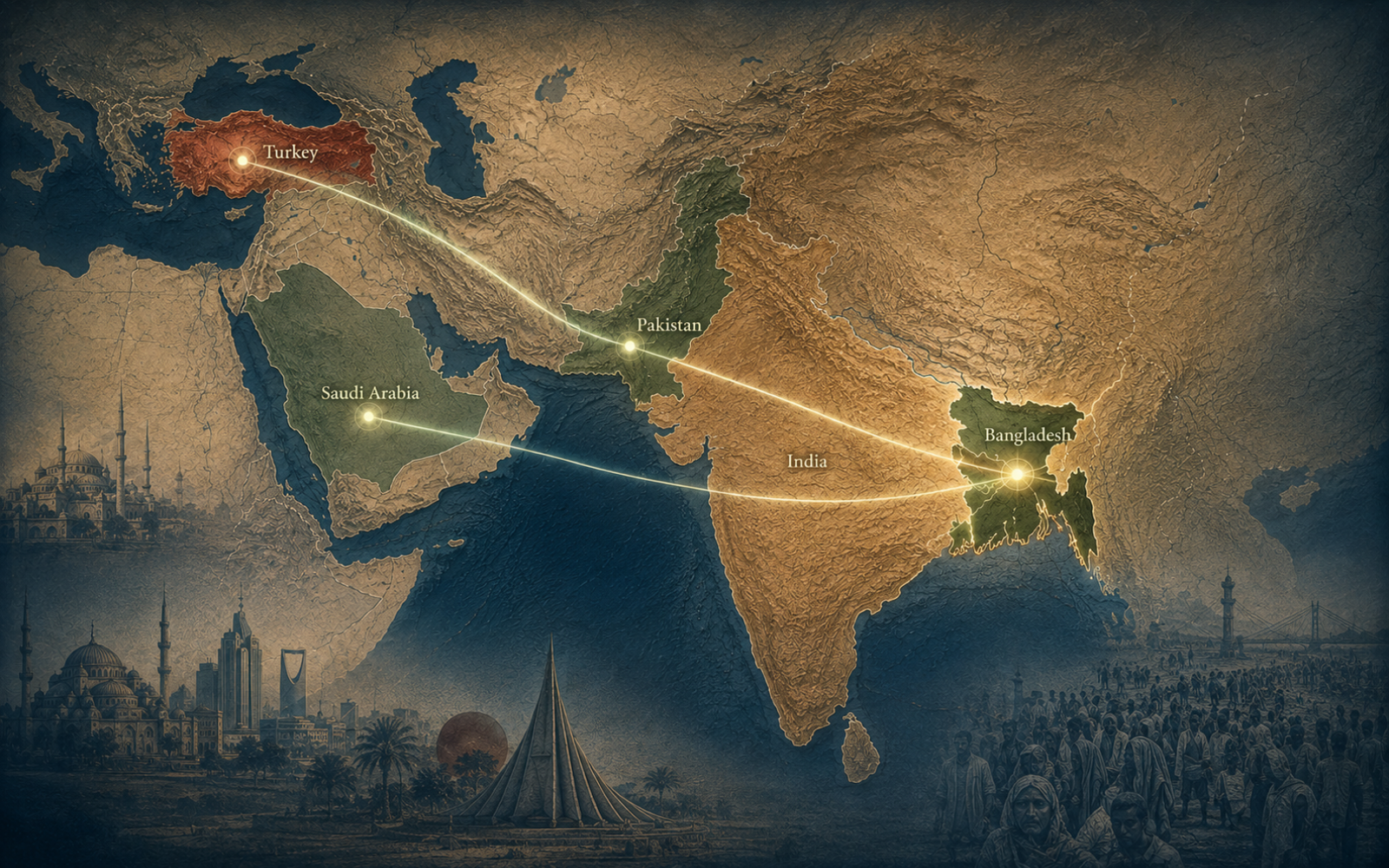
The Bangladesh Makkah Pact debate is becoming much more than a story about a new defence agreement. Bangladesh has not joined the Makkah Joint Defence Agreement between Saudi Arabia, Pakistan and Turkey, but senior officials in Dhaka have publicly left the door open if membership serves Bangladesh’s national interest.
The timing is unusually sensitive. India-Bangladesh relations are already under strain, Pakistan is rebuilding military ties with Dhaka, and tension over migration and the shared border has increased. The pact did not create these problems, but it could bring them together in a much more serious strategic picture.
For Israeli readers, there is a familiar element. Turkey makes the Makkah Pact relevant to Israeli security calculations, while Pakistan gives the same agreement a very different meaning for India.
Bangladesh Has Opened the Door
Saudi Arabia, Pakistan and Turkey signed the Makkah Joint Defence Agreement on August 7. Its central principle is collective defence: an armed attack against one member will be treated as an attack against all three, although many practical details remain unclear.
Bangladesh has not signed the pact. But State Minister for Foreign Affairs Humayun Kobir has said Dhaka has a “positive approach” toward possibly joining an economic or defence framework involving the three countries if it serves Bangladesh’s interests.
Another State Minister for Foreign Affairs, Shama Obaed Islam, has said any decision would depend on whether the agreement protects Bangladesh and its people. These statements do not mean Bangladesh has decided to join, but they make membership a real foreign-policy question rather than simple speculation.
Bangladesh can see clear benefits. Saudi Arabia is an important economic and political partner, Turkey has a growing defence industry, and Pakistan can offer weapons, training and military cooperation. For India, however, Pakistan changes the calculation.
Why Pakistan Matters So Much to India
India and Pakistan have fought wars in 1947–48, 1965 and 1971, followed by the Kargil conflict in 1999. Both possess nuclear weapons, and Pakistan remains one of the central concerns of Indian military planning.
Bangladesh has a special place in that history. Until 1971, Pakistan existed on both sides of India: West Pakistan to the west and East Pakistan, today’s Bangladesh, to the east.
Pakistan’s military thinking once included the idea that the “defence of East Pakistan lies in the West.” Geography was its great weakness because East Pakistan was separated from West Pakistan by Indian territory and was extremely difficult to reinforce during war.
The 1971 war changed India’s strategic map. Bangladesh became independent, Pakistan lost its eastern wing, and India no longer faced Pakistani territory on both sides.
This does not mean Pakistan is trying to recreate East Pakistan. There is no evidence for that. But the history explains why renewed Pakistani military or intelligence influence in Bangladesh would have a special meaning for Indian planners.
Pakistan also does not need a military base in Bangladesh to build influence. Weapons sales create training and maintenance relationships, officer exchanges create personal networks, and intelligence cooperation can develop institutional links that last for years.
Those links are already growing. In January 2026, Pakistan and Bangladesh discussed possible Bangladeshi purchases of JF-17 fighter aircraft and wider defence cooperation, while senior military contacts between the two countries have also increased.
For Pakistan, Bangladesh could therefore become more than another weapons customer. Defence sales, training and regular military exchanges could gradually build a network of influence on India’s eastern side.
Geography still limits Pakistan. India lies between Pakistan and Bangladesh, and 1971 showed how difficult it is for Islamabad to move large conventional forces into this region during a war. India’s more realistic concerns would involve intelligence access, military advisers, weapons systems, training, drones, radar and long-term strategic influence.
India-Bangladesh Trust Is Already Weakening
The Makkah Pact is not entering a calm relationship. Bangladesh continues to seek Sheikh Hasina’s extradition from India, while Prime Minister Tarique Rahman’s proposed visit to New Delhi remains uncertain.
Indian External Affairs Minister S. Jaishankar said on August 22 that relations with Bangladesh must pass the test of “mutual interest.” Bangladesh, meanwhile, is increasingly framing its foreign policy around a “Bangladesh First” approach.
Neither position is unusual. Every country has the right to protect its national interests. The problem begins when Bangladesh’s idea of national interest looks like a security risk to India, while Indian security concerns look to Bangladesh like an attempt to control its choices.
The border adds another source of tension. India has intensified efforts to identify and remove undocumented migrants, while Bangladesh has accused Indian authorities of pushing people across the frontier without following normal procedures.
Yet the two countries still cooperate. Their border forces have agreed to coordinate patrols and improve intelligence sharing, showing that practical security cooperation continues even as political trust weakens.
Recent surveys also suggest that Bangladeshi attitudes toward India have become more critical. A 2026 Pew survey found that 51 percent of Bangladeshis viewed India unfavourably and 42 percent favourably, while another survey after the 2024 political upheaval found younger respondents more favourable toward Pakistan than India.
This does not mean an entire generation is anti-India. But many younger Bangladeshis now judge India through recent issues such as border disputes, domestic politics and New Delhi’s long relationship with Sheikh Hasina rather than mainly through the memory of 1971. That gives Pakistan more political space to rebuild ties with Bangladesh.
There is also a wider security concern. A recent UN Security Council monitoring report raised concern that Al-Qaeda in the Indian Subcontinent, or AQIS, may be trying to establish cells in Bangladesh, although Bangladesh Police said they had no specific information confirming that such cells already existed.
Bangladesh should therefore not be described as an Al-Qaeda base. But India has faced jihadist terrorism for decades, so even the possibility of AQIS networks developing near its eastern border will attract attention in New Delhi.
Reports of attacks on Hindu, Buddhist, Christian and Indigenous communities have also added to concerns about Bangladesh’s internal stability. Such incidents should not automatically be blamed on Islamist organisations without evidence, but minority insecurity remains an important domestic and regional issue.
The result is an unusual strategic environment: India and Bangladesh still cooperate, but trust is weakening at the same time that Pakistan is rebuilding military relations with Dhaka.
From Israel-Turkey to India-Bangladesh
The Makkah Pact is important because one defence structure can interact with very different rivalries. Turkey’s relations with Israel have deteriorated sharply, particularly over Syria and wider regional competition.
The pact did not create Israel-Turkey tension, and it is officially presented as defensive rather than as an anti-Israel alliance. But Turkey’s membership means Israel must consider what the collective-defence promise could mean if a direct confrontation ever became serious.
South Asia has a similar problem. For Israel, Turkey is the sensitive member of the pact. For India, Pakistan is. India and Israel also maintain close defence and strategic ties, which adds another connection between the two regional security theatres.
Pakistan, however, remains the much more direct concern for India. The important point is that the Makkah Pact did not create Israel-Turkey tension, India-Pakistan hostility or India-Bangladesh distrust, but it can add a new military layer to all of them.
What Would Bangladesh Joining Actually Change?
Bangladesh is a sovereign country. India has no legal veto over which defence agreements Bangladesh joins, which weapons it buys or which countries it chooses as partners. Dhaka can reasonably argue that strategic independence requires several partners and that closer relations with Pakistan, Turkey or Saudi Arabia do not automatically make Bangladesh anti-India.
For New Delhi, however, the treaty itself may matter less than what develops underneath it. India would watch whether membership produces regular exercises with Pakistan and Turkey, deeper intelligence sharing, military advisers, integrated weapons systems or long-term defence planning.
India would also pay attention to drones, radar, air-defence cooperation and maritime coordination in the Bay of Bengal. Bangladesh lies beside West Bengal and India’s Northeast, while the wider region includes the strategically sensitive Siliguri Corridor connecting northeastern India with the rest of the country.
The central Indian question would therefore be whether Pakistan is simply rebuilding normal relations with Bangladesh or gaining a usable strategic position on India’s eastern side. Bangladesh must ask the opposite question: whether the additional security it expects from the pact is worth the distrust it could create with the country surrounding most of its land border.
A security dilemma could develop even without hostile intentions. Bangladesh could move closer to the pact because it wants more security, India could increase military readiness because it feels less secure, and Dhaka could then interpret India’s response as pressure and move even closer to Pakistan.
India also has responsibilities. If New Delhi treats every independent Bangladeshi foreign-policy decision as an anti-India move, it could strengthen the very political forces that favour closer relations with Pakistan and China.
Could a Political Crisis Become a Strategic One?
There are three broad possibilities. Bangladesh may consider the pact but never join, or it could join while limiting cooperation to training, weapons purchases and political coordination without allowing permanent foreign military access. Either outcome would probably remain manageable.
The more serious scenario would be deeper military integration. If membership produced Pakistani intelligence links, regular exercises, military advisers, weapons integration or long-term operational planning, India could begin to see the pact as a security structure reaching its eastern frontier.
Bangladesh must also ask what the alliance could realistically provide during a crisis with India. Pakistan is separated from Bangladesh by Indian territory, while Saudi Arabia and Turkey are thousands of kilometres away. Weapons, intelligence and diplomatic support can travel over distance, but large military forces are much harder to move.
That is one of the central lessons of 1971. Geography does not decide every war, but it places hard limits on what distant allies can realistically do.
The Makkah Pact would not automatically make Bangladesh safer, and joining it would not automatically turn India and Bangladesh into enemies. Much would depend on how far military cooperation developed after membership.
The danger is the combination of trends. Political trust between India and Bangladesh is weakening, Pakistan is rebuilding defence ties with Dhaka, border tensions remain sensitive, public attitudes toward India have become more critical, and new extremist-security concerns are appearing at the same time.
What Bangladesh sees as strategic freedom could eventually be viewed in New Delhi as Pakistan rebuilding influence on an eastern frontier from which it disappeared in 1971.
Bangladesh has every sovereign right to choose its partners, while India has the right to assess changes around its borders and protect its security. The real question is not whether Bangladesh has the right to join the Makkah Pact. It does. The question is whether joining it would give Bangladesh greater security—or turn an existing political crisis with India into a strategic one.
August 23, 2026
Tokyo, Japan