
Could an Israel-Turkey War Trigger NATO’s Article 5?
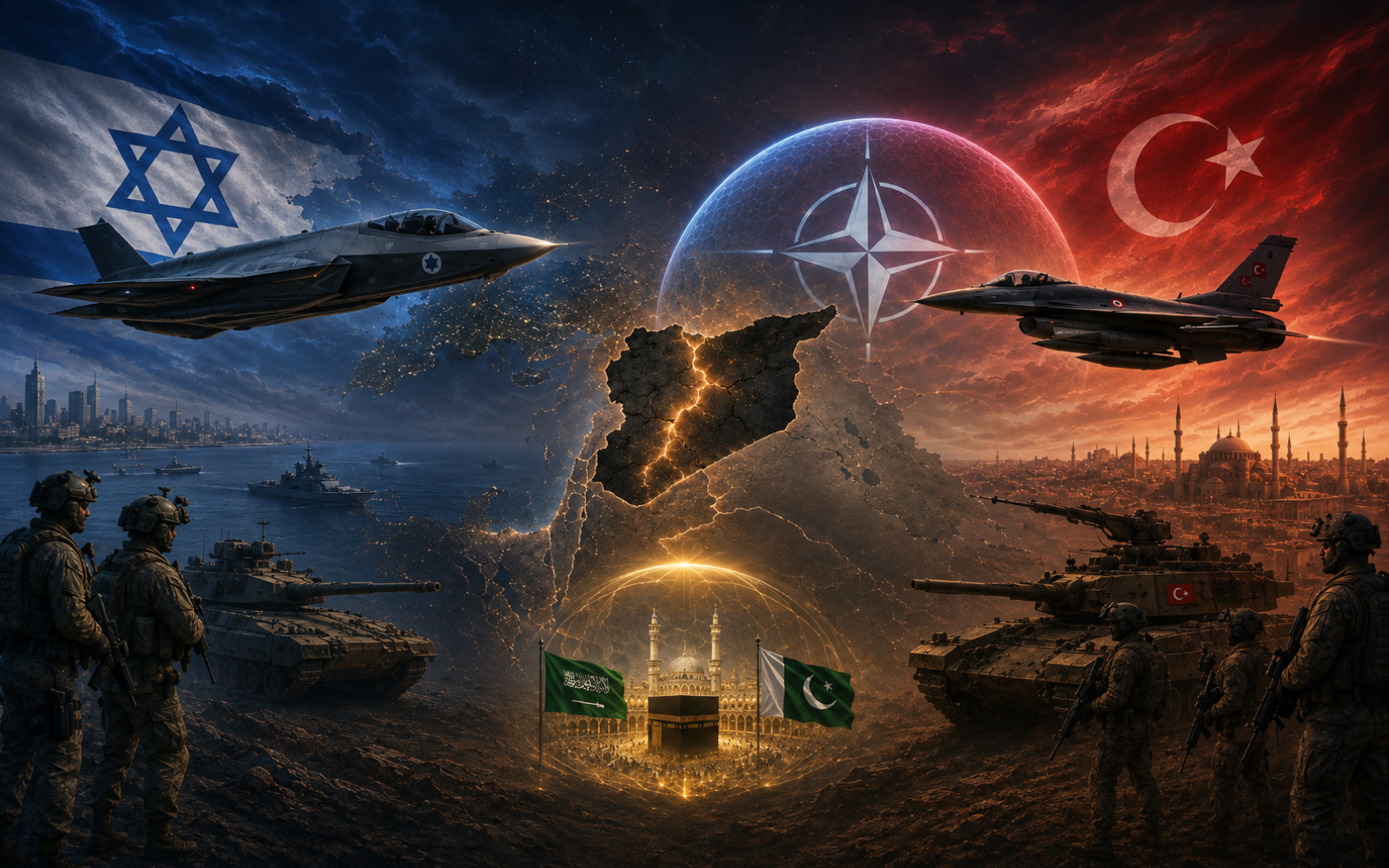
For years, a direct Israel-Turkey war seemed too dangerous to become real. The two countries could trade accusations, downgrade relations and compete for regional influence, but an actual military confrontation between Israel and a NATO member remained a worst-case scenario.
That assumption is becoming harder to sustain. Turkey’s expanding role in Syria, its relationship with Hamas and its new defense agreement with Saudi Arabia and Pakistan mean one military incident could have consequences far beyond the Middle East.
The danger became clearer on August 18, when Israeli aircraft struck Syria’s Abu al-Duhur airbase. Israel said it believed Turkish troops were about to deploy there; Turkey denied that its forces were present and condemned the strike. The United States then moved to strengthen a deconfliction mechanism involving Israel, Turkey and Syria.
The strike did not produce an Israel-Turkey war, but it showed how quickly one could begin. It also raised a question NATO may eventually have to answer: if Israel and Turkey exchange fire, does the conflict remain bilateral, or could Article 5 pull the alliance into the crisis?
Article 5 Does Not Automatically Mean NATO Goes to War
Article 5 is usually summarized in one famous phrase: an attack on one NATO member is an attack on all. That is correct, but incomplete.
The treaty says each ally will assist the attacked member by taking “such action as it deems necessary,” including the possible use of armed force. It does not automatically order every NATO country to declare war.
Geography matters too. Article 6 defines the territorial scope relevant to Article 5. Turkish sovereign territory is clearly covered, while allied vessels and aircraft are protected in specified areas, including the Mediterranean.
Turkish soldiers operating on Syrian soil are a different case. NATO membership does not turn every place a Turkish soldier deploys into NATO territory. An Israeli strike on a Turkish base inside Turkey would therefore present a much stronger Article 5 case than a strike on Turkish forces inside Syria.
Article 4 Could Come First
Before Article 5, another NATO provision may become more important: Article 4. It allows a member to request consultations whenever it believes its territorial integrity, political independence or security is threatened.
Turkey has invoked Article 4 several times over crises connected to Syria. A realistic escalation might therefore be an Israeli strike in Syria, an urgent Turkish request for NATO consultations and a fierce debate over responsibility before Article 5 is even discussed.
What If Turkey Helps Create the Confrontation?
The hardest case is not an unprovoked Israeli strike on Turkish territory. It is a confrontation that begins outside Turkey.
Suppose Ankara expands its military footprint in Syria and places troops, drones or air-defense systems there that Israel considers an immediate threat. Or suppose Turkish forces become directly involved in military action against Israel and Israel retaliates.
Would NATO governments automatically regard Turkey as the victim because Israeli weapons struck Turkish forces? Or would they first ask who initiated the confrontation, where it began and whether Turkey’s own actions contributed to the escalation?
NATO is fundamentally a defensive alliance. Article 1 also commits members to settle international disputes peacefully and to refrain from threats or uses of force inconsistent with the purposes of the United Nations.
That leads to a principle NATO may one day have to confront: Article 5 was designed to protect an ally from aggression, not necessarily to protect an ally from the consequences of a war it helped initiate.
That does not give Israel a free hand. Any Israeli use of force would still have to be judged under international law, including the rules governing self-defense, necessity and proportionality.
Hamas and Israel’s Deepening Distrust of Ankara
The military tension cannot be separated from Turkey’s political relationship with Hamas. President Recep Tayyip Erdoğan has rejected describing Hamas as a terrorist organization and has called it a “liberation group” and its fighters “mujahideen.”
Turkey has continued political contact with Hamas leaders. Ankara says those channels give it diplomatic influence; Israel sees the relationship very differently after the October 7 massacre.
The dispute has also entered NATO itself. Turkey previously blocked aspects of NATO cooperation with Israel over the Gaza war. In 2024, after Erdoğan suggested Turkey might intervene against Israel as it had done in Libya and Nagorno-Karabakh, Israel’s then-foreign minister Israel Katz called on NATO to expel Turkey.
That proposal went nowhere, but the underlying question remains: what happens if political hostility between Israel and one of NATO’s largest military powers becomes a shooting war?
Could NATO Expel Turkey First?
The answer is far less simple than many assume. NATO’s founding treaty provides a mechanism for a member to leave voluntarily, but it contains no ordinary procedure allowing the alliance simply to vote a country out.
No NATO member has ever been expelled. Turkey also has one of the alliance’s largest militaries and occupies a strategic position between Europe, the Black Sea, the Caucasus and the Middle East.
That makes the recent chronology striking. On July 7 and 8, NATO leaders met in Ankara and reaffirmed their “ironclad” commitment to collective defense under Article 5.
Less than one month later, Erdoğan signed another agreement built around remarkably similar language.
Why Does Turkey Need a Second Defense Umbrella?
On August 7, Turkey, Saudi Arabia and Pakistan signed the Makkah Joint Defense Agreement. Its central principle is unmistakable: an armed attack against one of the three states will be regarded as an attack against them all.
The agreement is presented as defensive and intended to strengthen collective deterrence. There is no public evidence that Erdoğan signed it because he expects Turkey to be expelled from NATO, or that the pact was secretly designed for a future war with Israel.
Still, asking why a major NATO power wants a second collective-defense arrangement is entirely legitimate.
The timing makes the question more striking. NATO reaffirmed Article 5 in Ankara on July 8. Turkey joined another attack-on-one-is-an-attack-on-all pact with Saudi Arabia and nuclear-armed Pakistan on August 7. Eleven days later, Israel struck Abu al-Duhur amid concerns over a possible Turkish military deployment in Syria.
These events do not prove a coordinated strategy. But they place Turkey in an unusual position: Ankara now appears to stand beneath two separate collective-defense umbrellas.
One explanation is regional leadership. For years, Iran presented itself as the principal regional power confronting Israel and the United States through its network of armed allies. But Iran’s position has been weakened by war and by major setbacks across its so-called “Axis of Resistance,” creating a possible leadership vacuum.
Erdoğan may see an opportunity in that vacuum. A security structure combining Turkish military power, Saudi financial influence and Pakistan’s nuclear capability could give Ankara a very different platform for leadership in the Muslim world—one based more on cooperation among powerful states than on Iran’s network of proxies.
Another explanation is strategic autonomy. Turkey has spent years seeking greater freedom of action from Washington and Europe while still benefiting from NATO membership.
A third possibility is insurance. If Turkey’s relations with NATO deteriorate seriously, or if Western allies refuse to support Ankara in a future Middle Eastern confrontation, stronger defense ties with Saudi Arabia and Pakistan could provide another layer of deterrence.
That does not mean Turkey is preparing to leave NATO. The more intriguing possibility is that Ankara wants to preserve NATO’s advantages while also building a second security network for a future in which Western support may be less certain.
If so, the Makkah pact may be more than another defense agreement. It could be part of Turkey’s attempt to secure both greater regional leadership and greater strategic freedom in a rapidly changing Middle East.
Israel’s Dilemma
Israel now faces a difficult calculation of its own. If Jerusalem believes Turkish military infrastructure in Syria could eventually threaten Israeli security, it may conclude that acting before such a presence becomes permanent is safer than waiting.
But there is a vast difference between striking Turkish forces on Syrian territory and deliberately striking Turkey itself. The first could trigger a serious bilateral confrontation and urgent NATO consultations. The second could push the alliance into a crisis for which it has no comfortable precedent.
NATO membership therefore gives Turkey significant deterrent value even where Article 5 is uncertain. That protection, however, could also create a dangerous temptation for Ankara: the belief that Israel will repeatedly stop short of decisive action because escalation involving a NATO member would carry enormous political costs.
If that calculation encourages Turkey to expand its military presence closer to Israel, place additional military capabilities in Syria or adopt increasingly confrontational positions, NATO’s deterrent shield could paradoxically make a collision more likely rather than less.
The danger, therefore, is not simply mutual miscalculation. It is that Ankara may eventually test how far NATO membership allows it to push Israel before Jerusalem concludes that continued restraint has become the greater security risk.
NATO’s Israel Nightmare
Turkey today occupies an extraordinary position. It is a NATO member increasingly active in Syria, maintains political relations with Hamas, competes with Israel for regional influence and has now entered a second collective-defense agreement with Saudi Arabia and Pakistan.
Israel, meanwhile, remains one of America’s closest military partners in the Middle East and has repeatedly shown that it will use force when it believes a strategic threat is emerging around its borders.
NATO’s founders designed Article 5 to deter aggression against alliance members. They did not design it for a world in which a NATO power and one of Washington’s closest Middle Eastern partners might begin shooting at each other.
If that day comes, the decisive question may not simply be, “Did Israel attack Turkey?” NATO governments would also have to ask where the attack occurred, who initiated the confrontation and what happened before the first missile was fired.
Behind those questions lies an even larger one. If Ankara now benefits from both NATO and the Makkah pact, is Turkey simply expanding its partnerships — or quietly preparing for a future in which one security umbrella may no longer be enough?
August 22, 2026
Tokyo, Japan