
Could Likud Embrace a Post-Netanyahu Israel?
In my previous essay, I considered a seemingly improbable possibility: What if Israel’s Arab political parties explicitly embraced Israel’s legitimacy as a Jewish and democratic state? Such a development could transform Israeli politics, make Arab participation in governing coalitions more acceptable to Jewish voters, and perhaps even advance the prospects for an eventual two-state solution.
I would like to consider another seemingly improbable possibility, one that could also bring substantial benefits to Israel: What if Likud politicians were willing to participate in a broad unity government without Benjamin Netanyahu as prime minister?
The October 27 election produced a political stalemate. Netanyahu’s bloc won 53 seats, the parties aligned with Gadi Eisenkot won 48, and the Arab parties secured the remaining 19. Neither major bloc has a majority in the 120-seat Knesset.
But consider another possibility. Likud’s 27 seats, combined with Eisenkot’s Yashar, B’Yachad, the Democrats, and Yisrael Beytenu, would produce a coalition of 75 seats. Such a government could include parties from the Israeli right, center, and left without depending on the ultra-Orthodox parties or the far-right parties of Ben Gvir and Smotrich.
Nor would it necessarily exclude Arab parties. As I argued in my previous essay, an Arab party willing to explicitly recognize Israel’s legitimacy as a Jewish and democratic state could become a valuable coalition partner. Ra’am, which has already participated in an Israeli governing coalition, would be a candidate for consideration.
The obstacle, of course, is Netanyahu. Eisenkot has ruled out serving under him, and Likud has shown little inclination to abandon its longtime leader. Yet Likud existed before Netanyahu and will exist after him. Is it inconceivable that some of its leaders might decide that the party’s interests, and Israel’s, would be better served by a government headed by someone else?
Israel cannot afford to lose the Democratic Party
The American midterm elections have made this question more urgent. Democrats have won control of both houses of Congress, and Israel will need to work with Democratic leaders during the remaining two years of President Trump’s term.
Unfortunately, Netanyahu has become deeply unpopular among many of those leaders.
The deterioration of his relationship with Democrats did not begin with the Gaza war. In 2015, Netanyahu accepted an invitation from Republican House Speaker John Boehner to address Congress in opposition to President Obama’s negotiations with Iran. The invitation was arranged without the customary consultation with the White House. Netanyahu had legitimate reasons to oppose the proposed nuclear agreement. But addressing Congress in such a politically charged manner reinforced the perception that Israel’s prime minister was aligning himself with Republicans against a Democratic president.
The consequences of this increasingly partisan relationship have persisted.
In March 2024, Senator Chuck Schumer, the highest-ranking Jewish elected official in American history and a longstanding supporter of Israel, declared that Netanyahu had “lost his way” and called for new Israeli elections.
More recently, in October 2026, former President Obama made troubling remarks in Belfast about Israel’s establishment and its conduct toward Palestinians. He argued that Israel had ceded moral ground and suggested that Palestinians had been dispossessed during the creation of the Jewish state. Obama’s comments reflect a broader change in Democratic attitudes toward Israel, one that cannot be attributed solely to Netanyahu.
Indeed, I have previously written about the tendency to treat Netanyahu as uniquely beyond the pale. Whatever one’s opinion of him, Israel’s problems cannot all be laid at his feet. Nor should we assume that his departure would suddenly reverse the growing hostility toward Israel among some American progressives. Nevertheless, Netanyahu’s continued leadership does little to improve Israel’s standing within the Democratic Party.
A government led by Eisenkot could provide an opportunity to rebuild relationships with Democrats who remain committed to Israel’s security but have become increasingly alienated by Netanyahu and his coalition partners.
Those relationships are too important to depend exclusively on which party controls the White House.
The domestic benefits of unity
The advantages of a broad unity government would extend well beyond Washington.
For years, Israeli governments have depended on relatively narrow coalitions in which small parties can exercise influence disproportionate to their electoral support.
Consider the controversy over ultra-Orthodox military service. After years of war and repeated reserve mobilizations, the unequal distribution of military obligations has become increasingly difficult to justify. Moreover, the relatively low workforce participation of Haredi men, combined with substantial government subsidies for religious institutions, places considerable pressure on Israel’s economy. A government not dependent on ultra-Orthodox parties could pursue reforms involving military or alternative national service, education, and greater workforce participation.
It should be noted that many Haredi citizens contribute substantially to Israeli society. But Israelis deserve policies that distribute national responsibilities more equitably and encourage greater economic participation.
Another benefit would be removing Ben Gvir and Smotrich from positions of influence. Their rhetoric and policies have become serious liabilities for Israel’s international standing. In June 2025, Britain, Canada, Australia, New Zealand, and Norway imposed sanctions on both men, accusing them of inciting violence against Palestinians in the West Bank. Their positions have also contributed to tensions with Israel’s Arab citizens, whose participation in the country’s political and economic life is essential to its future.
A government that did not depend on these parties could approach security and domestic issues without accommodating their more extreme positions. And a coalition that potentially included Ra’am would send a very different message about Jewish-Arab political cooperation.
Judicial reform is another example. Rather than pursuing sweeping changes supported by one political camp and vehemently opposed by another, a unity government could seek a more durable compromise.
Of course, a coalition spanning Likud and the Democrats would face substantial disagreements over settlements, Palestinian statehood, religion and state, and the judiciary. Its breadth would not guarantee stability. But it could provide an opportunity to address these issues through negotiation rather than confrontation.
A different face of Israel
A unity government led by Eisenkot could also affect how Israel is perceived internationally.
Eisenkot brings substantial national security experience, having served as IDF chief of staff and as a minister in the emergency government formed after October 7. His credentials would make it difficult to portray a government under his leadership as indifferent to Israel’s security.
There is another aspect of his background worth considering.
Eisenkot is the son of Moroccan Jewish immigrants. At a time when Israel is increasingly portrayed internationally as a European settler-colonial enterprise, his Mizrahi heritage could help challenge that narrative. While most Israelis are familiar with the country’s diverse Jewish origins, much of the world is not. An Israeli prime minister whose parents came from Morocco would offer a visible reminder of a history too often overlooked in international discussions of Israel.
An Eisenkot premiership would not end accusations of colonialism or erase disagreements over Israeli policy. But it could help challenge an oversimplified understanding of Israel’s population and history.
The question for Likud
None of this is likely to happen unless something changes within Likud.
Admittedly, there is little reason to expect a rebellion. Netanyahu has spent decades consolidating his control over the party, and many of those who challenged his leadership have been marginalized or have left. The politicians who remain have survived years of Netanyahu’s political maneuvering and, in many cases, have demonstrated their loyalty to him repeatedly.
Nevertheless, dissent has not been entirely absent.
Yuli Edelstein resisted Netanyahu over ultra-Orthodox military exemptions and eventually left Likud. Nir Barkat was reportedly involved, alongside Edelstein, in an unsuccessful effort to replace Netanyahu after October 7. According to Channel 12, that effort faltered partly because the participants could not agree on a successor. David Bitan has also publicly challenged Netanyahu’s efforts to increase his control over Likud’s candidate selection, although he has continued to support Netanyahu as leader.
Importantly, a new government would not necessarily require all of Likud to abandon Netanyahu. Depending on the coalition’s composition, a relatively small number of lawmakers could make the difference between another political stalemate and a governing majority.
There are formidable legal and political obstacles to such a development, including Israel’s rules governing factional defections. Nor should we underestimate the loyalty Netanyahu continues to command within his party.
Alternatively, Netanyahu himself could conceivably be persuaded to step aside. President Isaac Herzog, whose responsibilities include facilitating the formation of a government, might help negotiate a political transition. However, there is no indication that Netanyahu intends to relinquish his leadership voluntarily.
The objections to any such arrangement deserve consideration. Likud won more seats than any other party, and its supporters might reasonably ask why it should accept a prime minister from another party. Yet in Israel’s parliamentary system, winning the most seats does not by itself confer the ability to govern. A government must be capable of commanding the confidence of the Knesset.
The question is whether Likud’s politicians see their party primarily as the political vehicle of one individual or as an institution with responsibilities extending beyond any particular leader.
Leadership, sacrifice, and the possibility of change
One of Judaism’s most profound teachings is the concept of teshuva, the belief that human beings have the capacity to change. We are not prisoners of our nature, our circumstances, or our past decisions and allegiances. We can reconsider our choices and take a different path. This is not necessarily about wrongdoing. It is about recognizing that change is always possible, even when it seems improbable.
This principle applies to political leaders as well as individuals. Likud politicians need not repudiate their past support for Netanyahu to conclude that a different government might now better serve Israel. Nor is Netanyahu himself incapable of deciding that it is time for new leadership.
Extraordinary personal sacrifice was a hallmark of the leadership of Israel’s founders
Theodor Herzl sacrificed his health and much of his personal life in pursuit of a Jewish homeland. Chaim Weizmann devoted decades to that same cause, often at considerable cost to his family and scientific career. David Ben-Gurion, after leading Israel through its founding years, voluntarily left the premiership in 1953 to live in a modest home at Kibbutz Sde Boker.
None of these men was without ambition or political rivalries. Indeed, Ben-Gurion eventually returned to the premiership. But their lives raise a question worth considering today: Can political leaders distinguish between what is best for themselves and what is best for the country they serve?
A broad unity government could offer Israel substantial benefits: an opportunity to rebuild bipartisan American support, reduce domestic polarization, distribute the burdens of military service more equitably, address long-standing economic and institutional challenges, and improve relations with Israel’s Arab citizens.
It would not solve all of Israel’s problems. Nor would replacing Netanyahu automatically improve Israel’s international standing. But it could open possibilities that the present political divisions have made difficult to pursue.
In my previous essay, I asked whether Arab parties might take a step that currently seems politically inconceivable but could profoundly benefit Israelis, both Jewish and Arab, and perhaps Palestinians as well.
Perhaps it is equally worth asking whether Likud could do the same.
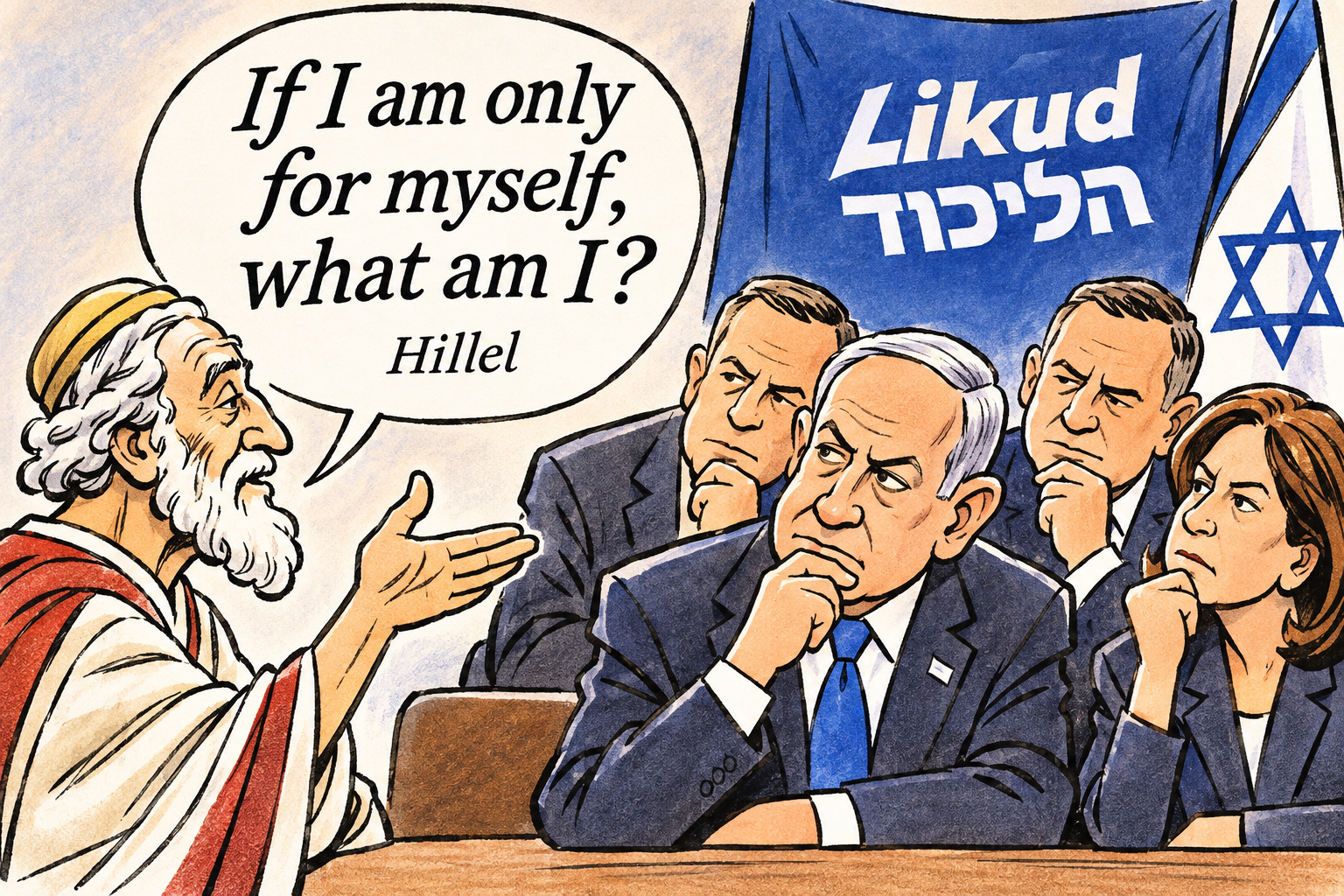
Hillel taught, “If I am only for myself, what am I?” It is a question worth asking of every political leader. Ultimately, leadership is measured not by the power one retains, but by what one is willing to sacrifice for the good of the nation.