
Could One Makkah Pact Clause Put All of India at Risk?
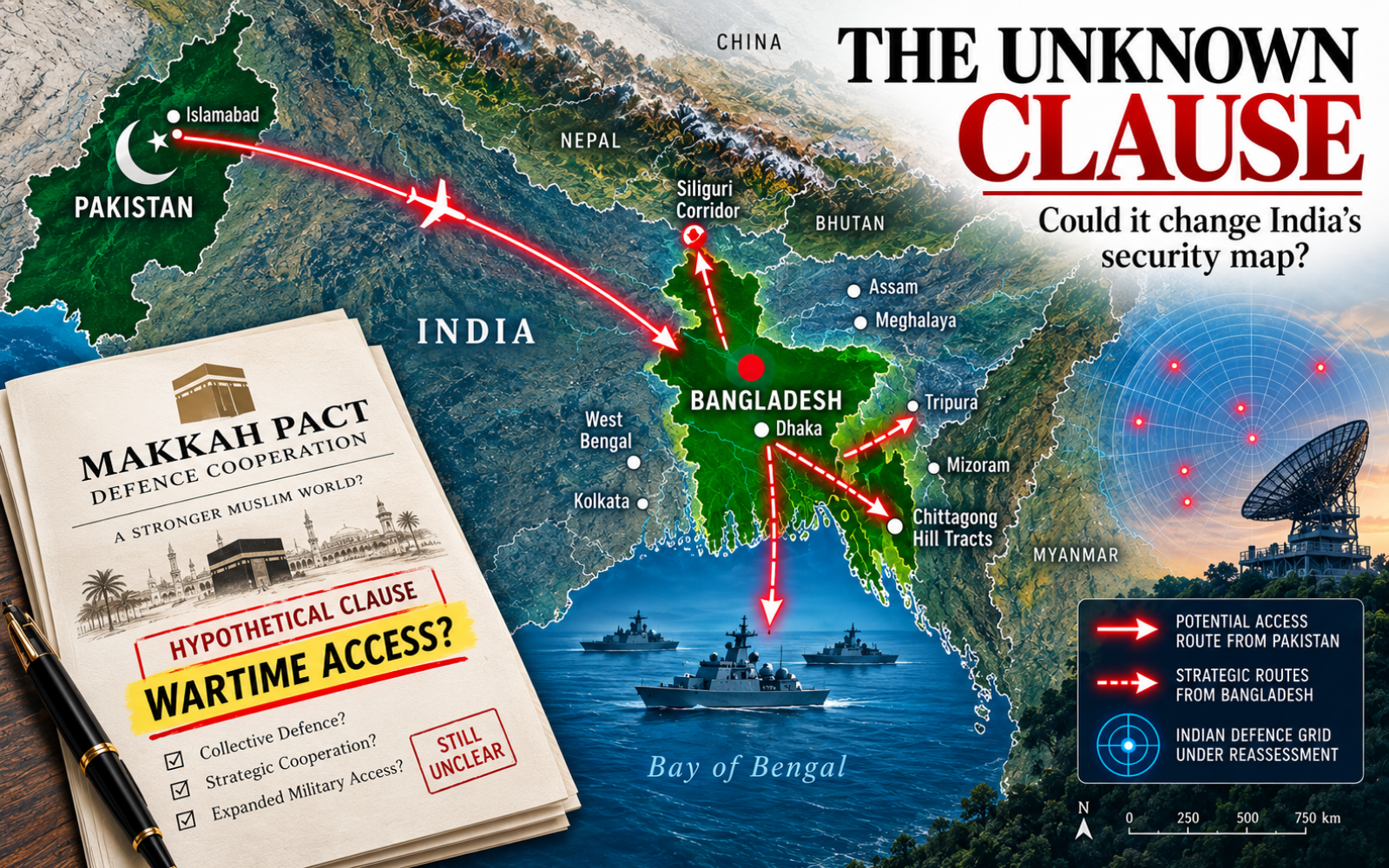
Bangladesh does not need India’s permission to join. But one unknown wartime-access rule could force New Delhi to rethink its entire eastern security map.
Bangladesh’s possible entry into the Makkah Pact has become one of the most hotly debated security issues in both Bangladesh and India. It is being discussed on television talk shows, social media, political platforms and in everyday conversations across the two countries.
At the centre of the debate is a simple question: Bangladesh is a sovereign country, so why should India care if it joins the pact?
The first part is correct. Bangladesh does not need India’s permission to choose its friends, defence partners or military alliances.
India, however, is asking a different question. If Bangladesh joins a defence pact that includes Pakistan, what military rights could Pakistan eventually gain inside Bangladesh — and what would happen if India and Pakistan were at war?
That is where a debate about Bangladesh’s freedom of choice becomes a much larger debate about India’s national security.
Bangladesh Sees Sovereignty, India Sees Security
Saudi Arabia, Turkey and Pakistan created the Makkah Joint Defence Agreement around a collective-defence principle: an armed attack on one member is to be treated as an attack on all.
Bangladesh has not joined, but Dhaka has shown interest in possible membership.
For many Bangladeshis, the issue begins with sovereignty. India surrounds Bangladesh on most sides, has a much larger economy and military, and has long exercised enormous regional influence.
A hardline Islamist-nationalist strategist in Bangladesh may therefore argue that closer ties with Pakistan, Turkey and Saudi Arabia would give Dhaka more strategic room and make it harder for India to pressure Bangladesh.
From that viewpoint, the pact does not have to mean preparing for war with India. It can be understood as deterrence: a way to ensure that Bangladesh is not strategically alone.
There is also a fairness argument. India has defence relationships with powerful states, including the United States, Russia, France and Israel. A Bangladeshi nationalist may ask why India’s partnerships are described as strategic autonomy while Bangladesh’s are treated as a threat.
An Indian strategist sees something different. Pakistan has fought several wars with India and remains one of its principal military rivals. For New Delhi, the harder question is whether Pakistan could gain treaty-based military rights inside a country directly beside India’s eastern and northeastern regions.
Bangladesh may see strategic balance. India may see Pakistan entering its eastern security calculation.
The Makkah Pact Clause That Could Change Everything
The pact’s most important operational rules are not publicly known. That uncertainty is the heart of the debate.
Imagine that the agreement contains, now or in the future, a rule saying: “During an armed conflict, members may use the territory, airspace, ports, airfields and military facilities of other members when required for collective defence.”
There is no public evidence that such a clause exists. This is a hypothetical example, not a claim about the current Makkah Pact.
If membership means only consultation, political support and voluntary military help, India may remain uncomfortable, but the direct military effect could be limited.
The calculation changes if every full member receives broad or automatic wartime access to every other member. India would then want to know what Pakistan could legally use inside Bangladesh during a future conflict.
The key question is not merely whether Bangladesh joins, but what rights membership would create.
Bangladesh Would Join a Common Pact, Not Its Own Pact
Bangladesh would be joining a multilateral arrangement already created by Pakistan, Turkey and Saudi Arabia. It would not be writing a separate pact designed only for Bangladesh.
That matters because alliances work through reciprocal rights and obligations. If Bangladesh expects the other members to help when Bangladesh is attacked, those states may expect Bangladesh to meet corresponding obligations when they invoke the pact.
There may be exceptions. Bangladesh could negotiate special accession terms, or the agreement may allow each government to decide what assistance it provides. None of this is publicly clear.
But unless the pact permits an exception, Bangladesh could not simply decide later that a common treaty right applies to Turkey and Saudi Arabia but not to Pakistan.
Suppose India says it respects Bangladesh’s sovereign right to join but wants one assurance: Pakistan must never receive military access to Bangladeshi territory.
Bangladesh may reject that as interference. But if Dhaka has already accepted a treaty obligation granting Pakistan such access, it may not be able to give India a conflicting promise. A bilateral assurance cannot erase a treaty right already granted to another member unless the pact itself allows that exception.
The deeper question, then, is not simply what Bangladesh wants to allow. It is what Bangladesh would already have agreed to allow by becoming a full member.
The India-Pakistan War Test
The best way to test the pact is not to ask what happens the morning after Bangladesh joins. Probably very little would change.
Now imagine that five years later India and Pakistan enter a major war. Pakistan invokes the Makkah Pact and asks the other members for support.
Could Bangladesh remain neutral? Could it refuse Pakistani use of Bangladeshi airspace, intelligence, logistics or military transport? Could it deny access to an airfield or port if those rights were already part of the agreement?
If Bangladesh remains free to refuse every request, much of India’s concern becomes smaller. If Bangladesh cannot refuse because those rights are common obligations, India’s concern becomes much more serious.
Alliance credibility also matters. If Bangladesh joins partly because it expects Pakistan, Turkey and Saudi Arabia to support it during a crisis, those states may ask for the same commitment when one of them invokes collective defence.
If Bangladesh refused Pakistan only because the opponent was India, Islamabad could ask what Bangladeshi membership actually means.
This scenario separates symbolic membership from binding military obligations.
Rangpur and the Chittagong Hill Tracts Change the Map
Geography turns a legal question into a strategic one.
Rangpur lies in northern Bangladesh, close to India’s North Bengal region and the wider strategic area around the Siliguri Corridor. The corridor is the narrow land connection between the main part of India and most of Northeast India, making it one of the country’s most sensitive geographical points.
Pakistan has traditionally been a military problem far to India’s west. If Pakistan ever gained treaty-based wartime access inside northern Bangladesh, Indian planners would have to consider Pakistan-linked capability from the east as well.
Pakistan would not need a permanent base in Rangpur for that change to matter. Temporary use of airspace or an airfield could matter, as could intelligence, radar information, surveillance, communications or logistics.
Distance also matters. There is no honest single figure for how quickly a missile, drone or aircraft could reach an Indian target from Bangladesh because different systems have different speeds and ranges. The strategic principle is enough: a capability positioned much closer to eastern India can reduce warning and reaction time.
The Chittagong Hill Tracts create another concern. The CHT sits beside India’s Tripura and Mizoram and close to Chittagong Port and the Bay of Bengal.
There is no evidence that Bangladesh plans to place Pakistani or Turkish military systems in the CHT. The point is geographical: if a future pact clause created wider wartime access across Bangladesh, northern and southeastern Bangladesh would have very different strategic meanings for India.
Rangpur raises the North Bengal and Siliguri question. The CHT raises the Tripura-Mizoram question. The Bay of Bengal adds a maritime dimension.
The same treaty right operating in Saudi Arabia would have one meaning for India. The same right operating from Bangladesh could have a very different meaning because geography changes military consequences.
Why Access Could Matter More Than Permanent Bases
Much of the public debate may focus on whether Pakistan could ever build a permanent military base in Bangladesh. That may be the wrong test.
Modern military cooperation can create strategic effects without permanent bases. Aircraft can use an airfield temporarily, military transport may need only airspace access, warships may require fuel or supplies, and intelligence can be shared electronically.
A promise of “no Pakistani base” would therefore not settle the issue if the pact created other forms of access.
The Bay of Bengal makes this especially important. If pact rules ever include wartime port or naval access, India would also have to consider whether Pakistani or Turkish naval vessels could receive logistical support in Bangladesh or whether maritime intelligence could be shared among members.
This is what “all of India at risk” means in the headline. It does not mean Bangladesh could suddenly threaten every Indian city. The broader risk is that India might have to revise national defence planning.
India already prepares for Pakistan in the west and China across a long northern and northeastern frontier. If Pakistan-linked military access became possible through Bangladesh, eastern air defence, the Northeast, the Siliguri area and the Bay of Bengal could all demand more attention and resources.
Religion, 1947 and the Security Dilemma
Religion cannot be removed completely from this debate because the political map of South Asia still carries the memory of religious division. British India was partitioned in 1947 during a political struggle in which religion played a central role.
Pakistan was created as a Muslim-majority state in two wings, with East Bengal becoming East Pakistan. Bangladesh emerged in 1971, showing that common religion alone could not overcome differences in language, political power, economics and national identity.
Israeli readers may recognise part of this problem from the Middle East. A political conflict becomes more dangerous when hostility toward a state spreads toward an entire religious community.
In extremist rhetoric in parts of the Middle East, hostility toward Israel has sometimes crossed into antisemitism aimed at Jews more broadly. South Asia faces a similar danger when hostility toward Indian policy becomes hostility toward Hindus, or when Hindu nationalism turns a political dispute with Muslim neighbours into a wider religious confrontation.
The 2025 Pahalgam attack showed how quickly religious identity can enter a security crisis. Gunmen killed 26 people, most of them Hindu tourists. Survivors told The Associated Press that some victims were questioned about their religion before being killed. The attack was followed by a serious military confrontation between India and Pakistan before a ceasefire was reached.
Bangladesh has also experienced attacks on Hindu homes, businesses and temples during periods of political disorder. Reuters documented such violence across several districts after Sheikh Hasina’s fall in August 2024.
These examples do not mean Muslims are naturally hostile to Hindus, or Hindus to Muslims. They show how quickly hardline politics can turn a security dispute into a communal one.
A hardline Islamist-nationalist in Bangladesh could see closer relations with Pakistan, Turkey and Saudi Arabia as protection from Indian dominance and as wider Muslim strategic solidarity. A hardline Hindu-nationalist strategist in India could see Pakistan, Islamic military solidarity and a new security problem appearing on India’s eastern side.
This can create a classic security dilemma. Bangladesh may move closer to the Makkah Pact because it fears Indian pressure. India may strengthen its eastern posture because it fears Pakistani access. Bangladesh may then read that response as proof that its original fear was justified and seek deeper cooperation.
Neither country needs to want war for both countries to become less secure.
Two Sovereignty Arguments, No Answer Yet
The Bangladeshi argument remains powerful. Bangladesh is sovereign, and India cannot decide which defence pact it joins.
The Indian argument is also powerful. Bangladesh cannot decide which military rights New Delhi must regard as harmless when those rights could involve Pakistan close to Indian territory.
The key distinction is between sovereignty before signing and treaty obligations after signing. Bangladesh is fully sovereign when deciding whether to join. But if it becomes a full member, it also accepts whatever common duties the agreement legally creates.
We still do not know whether military access would be automatic, whether Bangladesh could refuse Pakistan during an India-Pakistan war, whether assistance would remain voluntary, or whether new members could negotiate special limits.
If Bangladesh retains complete control over access to its territory, many Indian fears may prove exaggerated. If, however, one Makkah Pact clause gives every full member broad wartime rights over the territory, airspace, ports or military facilities of the others, the calculation becomes very different.
Bangladesh does not need India’s permission to join the Makkah Pact. India does not need Bangladesh’s permission to consider the military consequences a security risk.
There is no honest final answer today because the clause that may decide the argument is still unknown.
A defence agreement may contain hundreds of pages. Sometimes one clause is enough to change the meaning of an entire security map.
August 31, 2026
Tokyo, Japan