Learn. Grow. Self-Actualize.
Creating Worlds with Words
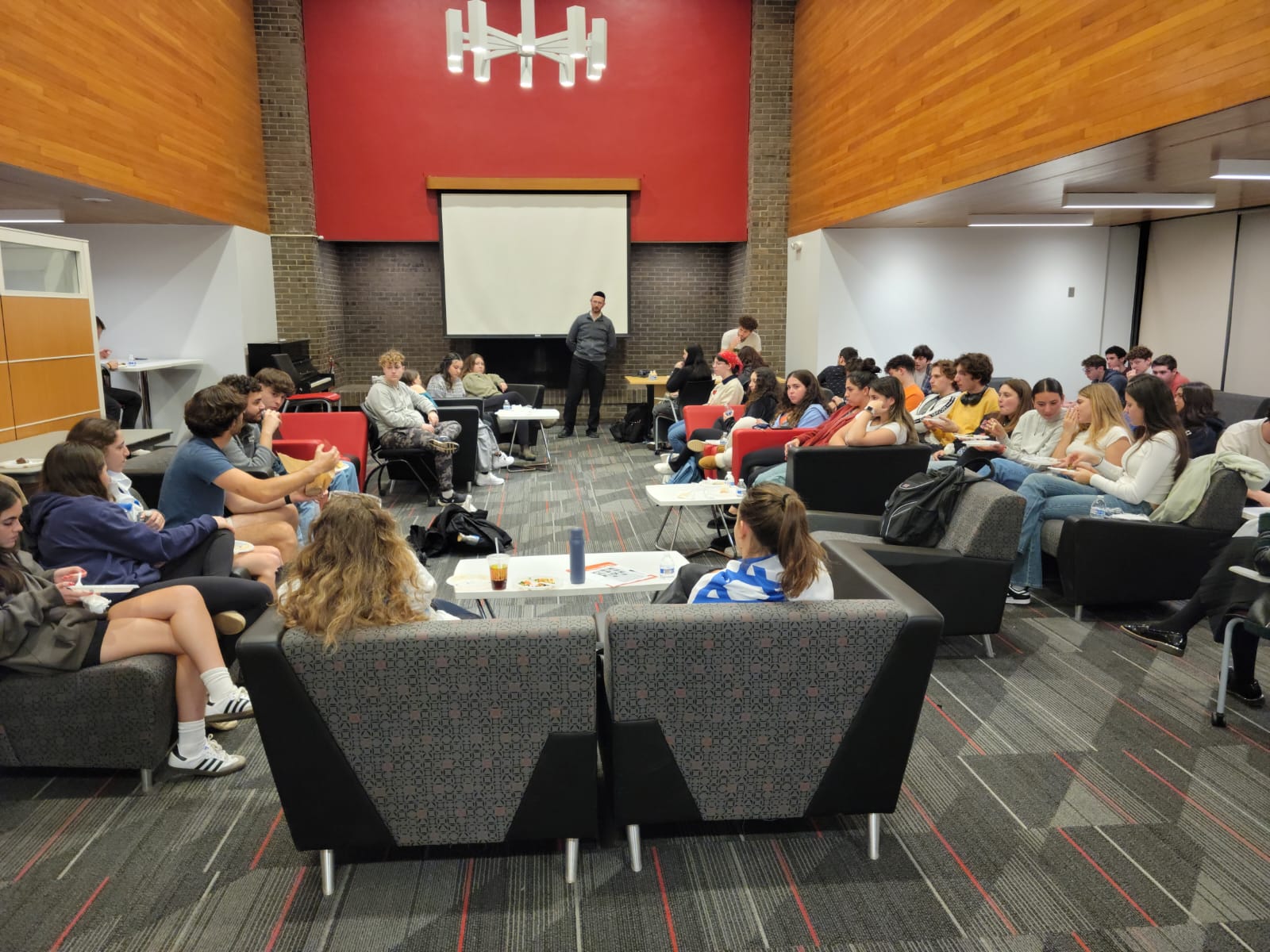
Rabbi Bob Barocas Speaking to RJX Students at Rutgers (Photo Credit: Rabbi Meir Goldberg)
Words can create worlds. They alter perspectives, form relationships, change a moment—or an entire life.
From the very first parashah of Sefer Bereshit, the Torah draws our attention to the creative force of speech. Again and again, the pasukim repeat the same phrase: “Vayomer Elokim”—“And God said”—“Let there be light,” “Let there be a firmament,” “Let the waters gather,” etc. Everything in creation emerges not from a gesture, not from a thought, but from speech. Hashem could have created the world in any way He wished—by thought, by action, etc.—but He chose words.
Every morning in Shacharit we praise God for this exact quality. We say, “Baruch she’amar v’haya ha’olam”—“Blessed is the One who spoke, and the world came into being.” In Hebrew, this idea goes even deeper: the word “davar” means both “word” and “thing.” Physical reality itself is the manifestation of divine speech. The world exists because God spoke it into existence.
Similarly, the word “halacha” (Jewish law) comes from “holech”—to walk. Halacha is not merely a legal system, it is a guide for walking in God’s ways. One of the central principles of Torah life is “halachta bidrachav”—emulating Hashem. If God created through speech, and He uniquely granted human beings the power of speech, then we are meant to use our words as creators as well.
The Gemara in Berachot (55a) offers a striking illustration of this idea in the story of Moshe and Betzalel. When constructing the Mishkan, Moshe instructed Betzalel to first fashion the vessels—the Aron, Menorah, and Shulchan—and only afterward build the structure itself. Betzalel questioned this approach: the “minhago shel olam” (way of the world) is to build a house first and then place vessels inside it. Moshe immediately realized how correct Betzalel was, and replied: “You must have been in the shadow [B’Tzel] of God [Kayl].”
With words alone, Betzalel altered the physical construction of the Mishkan, the spiritual center of the Jewish people in the desert—a microcosm of the universe itself. In no uncertain terms, speech reshaped sacred space for the better.
Just like Hashem used words to create the world we live in, our words can create worlds too. Every sentence we speak has the potential to bring us closer to the Almighty and each other or—Heaven forbid—distance us from Him and our fellow man.
How are you going to use yours?
—
(Source Sheets: https://voices.sefaria.org/profile/bob-barocas)
Related Topics