Rabbi of Tamid Palm Beach
We Know Good and Evil. Why Can’t We Choose Life?
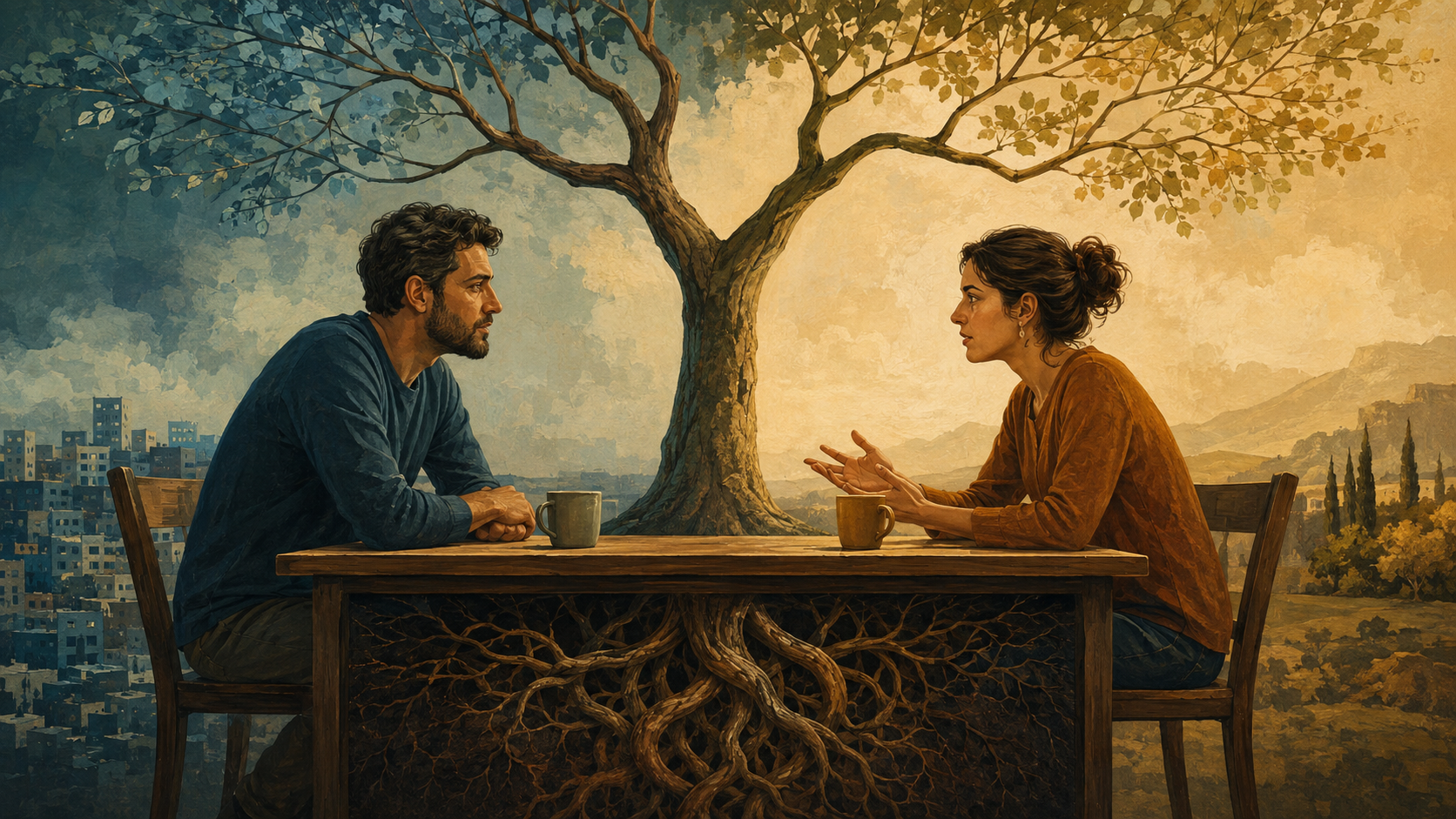
Choosing life isn't just about knowing right from wrong. It's about learning to see which path leads to more life, more wisdom, and more blessing. AI image by Feivel Strauss
When being right becomes the goal, relationships become collateral damage.
Recently, I wanted to raise the subject of Israel’s military draft with my Haredi sister.
I served in the Israeli army. She belongs to a community that understands Torah study and military service very differently. For both of us, the issue touches something fundamental: equality, sacrifice, religious identity and Israel’s future.
Part of me wanted a debate. I had arguments ready. I wanted to challenge her assumptions and explain why I believed my position was right.
Instead, I tried to broach the subject gently and with love.
I did not hold back because I was afraid of disagreement or uncertain about what I believed. I chose a different tone because I valued our relationship. Nothing I said would enlist a single soldier, change the status of a single yeshiva student or alter one vote in the Knesset. But the way I spoke could change what happened between us.
That did not mean avoiding the issue or pretending our differences were insignificant. It meant asking a harder question: Could I speak honestly without turning my sister into a symbol of everything I believed was wrong? Could I seek understanding without demanding agreement? Could we remain brother and sister while discussing something that reaches deeply into both our identities?
Not every conversation can change the issue being discussed. Every conversation can change the relationship in which it occurs.
Our culture is addicted to moral certainty. We sort people into categories with astonishing speed: good or evil, enlightened or dangerous, innocent or guilty, on the right side of history or beyond redemption. We may not be especially good at making these judgments, but we have become remarkably confident in them.
The problem is not that we care too much about morality. It is that we have confused moral certainty with moral maturity.
The opening chapters of Genesis are often read as a warning against knowledge. God permits Adam and Eve to eat from every tree in Eden except the Tree of Knowledge of Good and Evil. They eat, their eyes are opened, and humanity is expelled from paradise.
But knowledge itself cannot be the crime. The rest of the Bible demands moral discernment. The Psalms tell us to “turn from evil and do good.” When Solomon asks God for the ability to distinguish between good and evil, God grants his request.
The story makes more sense as an account of humanity’s entrance into moral adulthood.
Before eating, Adam and Eve live almost like children. They are fed and protected, naked without self-consciousness. After eating, they discover shame, sexuality, vulnerability and blame. Work becomes difficult. Death becomes the horizon of human life. They leave the protected home and enter history.
Perhaps Eden is not simply a paradise we ruined. It is a childhood we cannot reenter.
The fruit did not give humanity simple moral answers. It gave us the burden of making judgments in a world where the answers would rarely be simple.
Adult life does not always present an obvious good opposite an obvious evil. More often, one good collides with another. Justice competes with mercy. Truth threatens peace. Loyalty conflicts with fairness. Lifeboats do not always contain enough seats for every moral principle to remain intact.
Complexity makes us anxious. It exposes the limits of our knowledge and forces us to act without knowing every consequence. Certainty offers relief: a clear villain, an innocent tribe and freedom from self-examination. Our certainty may reveal less about the strength of our convictions than about our inability to bear anxiety.
Digital life intensifies the temptation. Silence looks suspicious, curiosity looks weak, and changing one’s mind looks like surrender. The reward goes to whoever delivers the fastest verdict with the greatest confidence.
Moral certainty gives us the temporary comfort of childhood. The good people are all on our side. The evil people are somewhere else. Nothing valuable is ever in conflict.
But that is not moral clarity. It is an escape from moral adulthood.
The opposite of certainty is not apathy. It is the ability to remain thoughtful and connected while taking a stand.
This may be one reason Judaism did not end with the written Torah. It produced the Talmud: a record of what happens when divine principles encounter actual human beings.
The Talmud is the literature of life outside Eden.
In Sanhedrin, Rabbi Yehoshua ben Korcha calls compromise a mitzvah, citing the prophet Zechariah’s demand for “a judgment of truth and peace.” Strict judgment may establish truth, the Talmud observes, but how can it produce peace when one party wins and another loses? Its answer is pesharah: a negotiated judgment that makes room for both.
This does not mean every conflict should end in compromise. There are lies that must be exposed, injustices that must be confronted and relationships from which people must walk away. Sometimes choosing life requires confrontation or a firm boundary.
Moral maturity is not finding the midpoint between justice and injustice. It means taking a position without claiming perfect knowledge, demanding agreement or turning another person into a symbol. We must make necessary judgments without pretending to possess God’s view of the whole.
Near the end of Deuteronomy, Moses says that God has placed before us “life and good, death and evil.” We might expect him to conclude, “Therefore, choose good.” Instead, he says, “Choose life.”
Life is not a morally neutral third option beyond good and evil. It is the larger orientation that helps us navigate among competing moral claims. It asks not only, “Am I right?” but also: “What will my righteousness create? What other value is at stake?”
My sister and I may never agree about Israel’s military draft. Choosing life did not require me to abandon my convictions or conceal them. It meant speaking with enough clarity to be honest and enough love to remember that I was talking to my sister, not debating a position.
Our conversation did not change Israeli policy. It did shape what happened between us. The relationship was not an inconvenience standing in the way of the argument. It was part of the moral reality.
Being right does not release us from responsibility for what our righteousness creates.
We know good and evil now. The harder command is to choose life.
Related Topics