Strategist and Diplomat Analyzing Somaliland and Horn Affairs
Cruz Pushes US Recognition of Somaliland
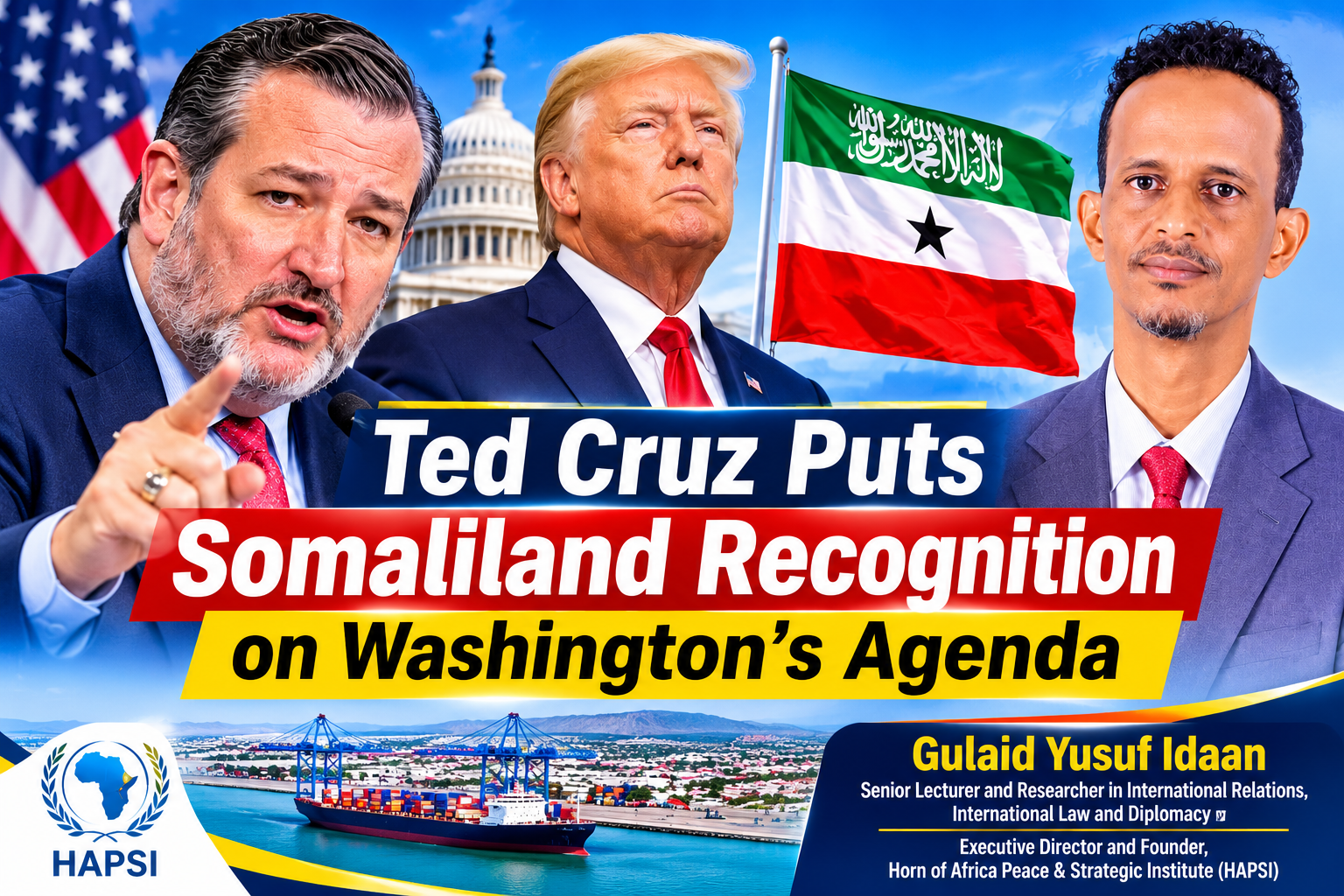
Ted Cruz challenges Washington to reconsider US recognition of Somaliland, highlighting its democratic record and strategic importance in the Horn of Africa. By Gulaid Yusuf Idaan | HAPSI #Somaliland #TedCruz #USRecognition #HornOfAfrica
Introduction: A Direct Challenge to Washington’s Somaliland Policy
The question of Somaliland’s international recognition took centre stage during a United States Senate Foreign Relations Committee hearing, where Senator Ted Cruz directly challenged President Donald Trump’s nominee for Ambassador to Somalia, Mr. Kennington, over Washington’s longstanding policy towards Somaliland.
At the heart of the exchange was a statement by President Trump, cited by Cruz, describing Somaliland as a “totally different country” from Somalia. Drawing directly on the President’s own words, Cruz advanced a pointed argument: if Somaliland is politically distinct, has maintained effective self-government since 1991, conducted multiple democratic elections, and occupies a strategically significant position along the Gulf of Aden, why has the United States continued to withhold formal diplomatic recognition?
Cruz’s intervention went beyond questioning the extent of American diplomatic engagement. He repeatedly pressed the nominee to acknowledge Somaliland’s distinct political identity, democratic record, and strategic importance, highlighting the apparent contradiction between President Trump’s remarks and the State Department’s continued adherence to its established policy towards Somalia.
In his responses, Kennington acknowledged several important dimensions of Somaliland’s political reality, including its effective self-government, experience with democratic elections, peaceful transfer of power following the November 2024 presidential election, diplomatic relationship with Taiwan, and strategic significance to American interests in the Horn of Africa and the wider Red Sea region. He also indicated that the Trump administration was interested in strengthening its engagement with Somaliland.
Nevertheless, Kennington initially reaffirmed that the official position of the United States remained support for the sovereignty and territorial integrity of the Federal Republic of Somalia, including the territory of Somaliland. However, his concluding remarks introduced a particularly significant qualification: the United States retains the ability to change its policy and formally recognise Somaliland as an independent state.
This final clarification is particularly important because it indicates that Washington’s existing recognition policy is not necessarily permanent or beyond reconsideration. Rather, a change in American policy remains a political and diplomatic possibility within the authority of the United States government.
The hearing therefore brought three interconnected dimensions of Washington’s Somaliland policy into focus: acknowledging Somaliland’s distinct political and strategic reality, expanding practical engagement with its authorities, and considering the possibility of formal diplomatic recognition.
Ultimately, Cruz’s questioning brought the recognition issue directly before the Senate Foreign Relations Committee, while Kennington’s final response left open the possibility of a fundamental shift in American policy towards Somaliland. The central question is no longer simply whether Somaliland is politically distinct from Somalia, but whether the United States is prepared to translate that distinction into a formal diplomatic recognition decision.
Trump’s Statement: “A Totally Different Country” from Somalia
The most consequential moment in the exchange came when Senator Cruz referred directly to President Donald Trump’s description of Somaliland as a “totally different country” from Somalia.
Cruz asked Kennington whether he agreed with the President’s assessment. The nominee initially responded by discussing the importance of subnational engagement throughout Somalia, explaining that such engagement could advance specific American national security, commercial, and economic interests. He indicated that Somaliland fell within this broader category of strategic engagement.
Cruz, however, sought a more direct answer. He reiterated the President’s statement and asked whether Kennington agreed that Somaliland was a totally different country from Somalia.
Kennington responded that the conditions on the ground in Hargeisa and Somaliland were certainly very different from those found elsewhere in Somalia.
Cruz then made his own position explicit. He stated that he believed President Trump was absolutely correct, declared that Somaliland was not Somalia, and argued that it was time for the United States to formally recognise Somaliland.
The significance of this exchange lies in the way Cruz connected presidential language to a fundamental question of diplomatic policy. Rather than treating Trump’s remark as an isolated political observation, he used it to challenge the State Department’s continued adherence to the established American position on Somalia’s territorial integrity.
An important distinction nevertheless remains. A presidential statement describing Somaliland as different from Somalia does not, in itself, constitute formal diplomatic recognition. The President’s remark, as cited during the hearing, became the foundation of Cruz’s political argument, but neither the statement nor the hearing itself announced a formal change in US recognition policy.
Nevertheless, the exchange placed the question directly before a Senate committee and a nominee expected to play a role in implementing American policy in the Horn of Africa.
Ted Cruz’s Argument: Why the United States Should Recognise Somaliland
Cruz’s argument was grounded in three interconnected considerations: Somaliland’s political record, its strategic geography, and its diplomatic relationships.
At the beginning of his intervention, Cruz thanked the Chairman and explained that, if confirmed, Kennington would have an important responsibility in advancing American interests in the Horn of Africa, including the relationship with Somaliland.
He emphasised Somaliland’s location along the Gulf of Aden, close to one of the world’s busiest international shipping corridors. He also highlighted its importance to regional counterterrorism and anti-piracy efforts.
Cruz argued that Somaliland’s strategic location gives it significance beyond its immediate geographical boundaries. The Gulf of Aden connects the Indian Ocean to the Red Sea and the Suez Canal, making the surrounding maritime environment central to international commerce, energy transportation, and global security.
He further highlighted Somaliland’s relationships with Taiwan and Israel. Referring to Israel’s recognition of Somaliland in December 2025, Cruz presented these diplomatic relationships as evidence of Somaliland’s growing international relevance.
The senator also referred to his September meeting with Somaliland’s President, Abdirahman Mohamed Abdullahi. According to Cruz, their discussions addressed Somaliland’s strategic importance to the United States and opportunities to strengthen bilateral relations, including through formal recognition.
His central proposition was that American recognition of Somaliland would advance US national security interests in the Horn of Africa and beyond.
Cruz then proceeded to test the nominee’s understanding of Somaliland through a series of questions concerning its governance, democratic elections, diplomatic relationships, and strategic orientation. These questions established the factual foundation of his broader argument for recognition.
Somaliland Since 1991: The Governance Question
Cruz first asked whether Somaliland had governed itself since 1991.
Kennington acknowledged that, according to his understanding, Somaliland’s government had effectively administered its territory since that year. However, he immediately distinguished this practical reality from the official American position, explaining that Washington continued to recognise the sovereignty and territorial integrity of the Federal Republic of Somalia, which the United States considers to include Somaliland.
Cruz then turned to Somaliland’s electoral record. He asked whether Somaliland had conducted multiple democratic elections.
Kennington initially hesitated, explaining that he was not in a position to comment on their validity. Cruz clarified that he was not asking him to certify the validity of the elections, but simply to confirm whether multiple elections had taken place.
Kennington subsequently confirmed that Somaliland had indeed held multiple elections. He specifically referred to the November 2024 presidential election, which was followed by a peaceful transfer of power. He added that the people of Somaliland were ultimately responsible for determining the legitimacy of their political processes.
When Cruz separately asked whether Somaliland had experienced peaceful transfers of power, particularly following the 2024 election, Kennington again confirmed that, according to his understanding, a peaceful transfer had taken place.
These responses were central to Cruz’s argument. He sought to establish that Somaliland had developed functioning political institutions and a record of electoral continuity distinct from the political and security challenges experienced elsewhere in Somalia.
For the nominee, however, acknowledging these circumstances did not mean that the United States had changed its position on sovereignty and territorial integrity.
This distinction illustrates the continuing tension between Somaliland’s practical political status and its unresolved international diplomatic status.
Taiwan, Israel, and the Geopolitical Dimension
Cruz also questioned Kennington about Somaliland’s relationships with Taiwan and Israel, introducing a wider geopolitical dimension to the hearing.
When asked whether Somaliland maintained close diplomatic relations with Taiwan, Kennington answered affirmatively.
Cruz then asked whether the Chinese government had publicly opposed Somaliland’s independence. Kennington confirmed that this was his understanding.
This exchange is significant because Somaliland’s relationship with Taiwan places it within a sensitive diplomatic environment involving China’s opposition to Taiwan’s international recognition and diplomatic partnerships.
For Washington, this relationship is relevant to broader strategic competition with Beijing, particularly as China continues to expand its diplomatic, commercial, and security presence across Africa and around the Red Sea.
Cruz subsequently asked whether Israel had formally recognised Somaliland as an independent country. Kennington confirmed that, according to his understanding, Israel had recognised Somaliland.
The reference to Israel’s recognition in December 2025 added another dimension to the discussion. Somaliland’s diplomatic relationships are increasingly connected to wider regional and international security calculations involving the Red Sea, the Gulf, and the Middle East.
For Cruz, these relationships reinforced the argument that Somaliland was strategically relevant to the United States and its allies. They also raised the question of whether Washington should reconsider its existing approach in light of Somaliland’s developing international partnerships.
Cruz Presses the Nominee: What Is Preventing Formal Recognition?
Having established the nominee’s acknowledgement of Somaliland’s governance, electoral record, and international relationships, Cruz moved to the central diplomatic question: why had the United States not formally recognised Somaliland?
He asked Kennington whether Somaliland had offered the United States favourable diplomatic, economic, and security partnerships.
Kennington responded that the Trump administration had made its interest in further engagement with Somaliland clear. He identified Somaliland’s position regarding China as favourable to American interests and pointed to several commercial and economic opportunities available to the United States.
He also recognised Somaliland’s important role in Red Sea security, explaining that these considerations created a clear American interest in strengthening engagement.
Kennington stated that, if confirmed, he would continue engaging with Somaliland’s authorities, including through in-person visits, and would keep the Senate committee informed about developments in the relationship.
Cruz interpreted the nominee’s answers as further evidence of Somaliland’s importance to the United States. He argued that Washington should prioritise partnerships with countries and territories whose interests align with those of America and its allies. In his view, these were the partners the United States should reward.
The senator then directly asked what was preventing the Department of State from formally recognising Somaliland as an independent country.
Kennington responded that, if confirmed, he would strengthen American engagement and continue maintaining relations with Somaliland’s authorities.
Cruz pressed him further, asking whether specific obstacles existed and emphasising that there must be a reason why Washington had not proceeded with recognition.
Kennington replied that, from his current position, he was unable to answer that question. Nevertheless, he reiterated that closer engagement with Somaliland was important for American national security, economic, and commercial interests.
He added that, if confirmed, he would certainly work to enhance the relationship between the United States and Somaliland.
Cruz concluded this part of the exchange by arguing that the Department of State should follow the President’s guidance. He also emphasised that Kennington’s confirmation depended on the State Department following the President’s direction.
The Chairman subsequently thanked Cruz for his contribution.
The exchange revealed a clear difference between Cruz’s advocacy for formal recognition and the nominee’s more cautious position. Kennington acknowledged the strategic case for engagement but did not identify a specific obstacle to recognition or announce that the administration was preparing to change its policy.
Nevertheless, his concluding clarification that the United States could change its policy and formally recognise Somaliland left the door open to a potential shift in Washington’s approach.
Berbera: The Strategic Geography Behind the Recognition Debate
The importance of Cruz’s intervention cannot be fully understood without considering Somaliland’s geographical position and the strategic significance of Berbera.
Located on the Gulf of Aden, Berbera provides access to maritime routes connecting the Indian Ocean with the Red Sea and the Suez Canal. Its port infrastructure and potential for further development make it relevant to international commerce, regional logistics, and maritime security.
The wider maritime environment has become increasingly important amid threats to international shipping, including attacks associated with the Houthi movement in the Red Sea. Disruptions along these routes have consequences for global trade, energy transportation, and the security calculations of states dependent on maritime commerce.
Somaliland’s location gives it a direct interest in the security of these routes. For external partners, the combination of Berbera’s port infrastructure, proximity to major shipping corridors, and Somaliland’s relative internal stability creates opportunities for cooperation in trade, investment, and maritime security.
The September Washington visit by President Abdirahman Mohamed Abdullahi also formed part of this diplomatic context. His engagement with American political and policy circles presented Somaliland as a potential partner in the Horn of Africa and Red Sea, with opportunities for cooperation extending beyond the immediate question of recognition.
Berbera should therefore be understood not simply as a commercial port, but as an important component of the changing strategic geography of the Gulf of Aden.
The Wider Regional Calculations: Ethiopia, Egypt, Türkiye, and the Gulf
The strategic importance of Somaliland has increased alongside competition among regional and external powers for influence around the Horn of Africa and the Red Sea.
Ethiopia’s interest in reliable maritime access, Egypt’s concerns about regional influence and the Nile Basin, Türkiye’s expanding relationship with Somalia, and the United Arab Emirates’ commercial and strategic interests all contribute to a complex regional environment.
For Washington, Somaliland presents both opportunities and diplomatic challenges. Stronger relations with Hargeisa could support American interests in maritime security, commercial connectivity, and strategic competition. At the same time, a major change in recognition policy could affect relations with Mogadishu and influence the positions of African and regional partners.
The African Union’s approach to territorial integrity and inherited colonial boundaries is also relevant to the diplomatic environment surrounding Somaliland’s claim. Washington must consider these regional and institutional sensitivities alongside its own security and economic interests.
This creates a policy dilemma: how can the United States expand its practical cooperation with Somaliland while managing the diplomatic consequences for its wider relationships in the region?
One possible approach is to distinguish practical engagement from formal recognition. Maritime security, port development, trade, investment, diplomatic communication, and institutional cooperation can be pursued as areas of partnership. Formal recognition, by contrast, requires a separate political decision and a broader assessment of its legal and diplomatic implications.
Recognition Versus Engagement: The Unresolved American Policy
The Senate hearing illustrates an important feature of international diplomacy: strategic engagement and formal recognition are related but distinct processes.
A state may cooperate with an entity because of its geographical location, political stability, economic opportunities, or security relevance without formally recognising it as an independent sovereign state. Such engagement may include diplomatic visits, trade arrangements, technical cooperation, maritime security discussions, and commercial partnerships.
Cruz’s position was that the United States should move beyond this form of engagement and formally recognise Somaliland. He presented its governance, electoral record, relationships with Taiwan and Israel, and strategic location as compelling reasons for doing so.
Kennington acknowledged several of these practical considerations. He recognised Somaliland’s effective self-government since 1991, its multiple elections, the peaceful transfer of power following the November 2024 election, its relationship with Taiwan, Israel’s recognition, and its relevance to American commercial and security interests.
Yet he did not announce a change in the official American position.
The distinction matters for Somaliland’s diplomatic strategy. Stronger engagement can expand international visibility and create practical cooperation, but it does not necessarily settle questions of sovereignty, recognition, or international legal status.
It also matters for Washington. The United States must consider the strategic value of Somaliland alongside its existing diplomatic commitments, its relationship with Somalia, and the potential response of regional and international institutions.
The central question is therefore no longer simply whether Somaliland has strategic relevance to the United States. The hearing demonstrated that this relevance is being openly discussed at the highest levels of congressional foreign policy scrutiny. The unresolved question is how far Washington is prepared to translate that strategic assessment into a formal diplomatic decision.
Conclusion: From Trump’s Words to the Question of Recognition
The exchange between Senator Ted Cruz and ambassadorial nominee Mr. Kennington placed Somaliland’s political status and strategic importance firmly within an American foreign policy debate.
Trump’s description of Somaliland as a “totally different country” from Somalia became the central reference point in Cruz’s intervention. The senator used the President’s words to challenge the Department of State’s continued policy and argue that the United States should formally recognise Somaliland.
Cruz supported his position by drawing attention to Somaliland’s effective self-government since 1991, its record of multiple elections, the peaceful transfer of power in November 2024, its diplomatic relationships with Taiwan and Israel, and its strategic location along the Gulf of Aden.
Kennington acknowledged these realities and expressed support for stronger American engagement. He also recognised Somaliland’s importance to American national security, commercial opportunities, and Red Sea security. However, he maintained that the official US position continued to recognise Somalia’s sovereignty and territorial integrity.
For Somaliland, the challenge is to convert this strategic visibility into sustained diplomatic engagement, credible institutional cooperation, and a clearly articulated legal and political case. For Washington, the question is whether the strategic arguments articulated by Cruz, alongside the President’s publicly cited remarks, will eventually lead to a reconsideration of the formal diplomatic position it has maintained for decades.
Related Topics
Related Posts