
London based entrepreneur, cybersecurity analyst doing a PhD in AI
CyberPsychology: Keeping bad actors out
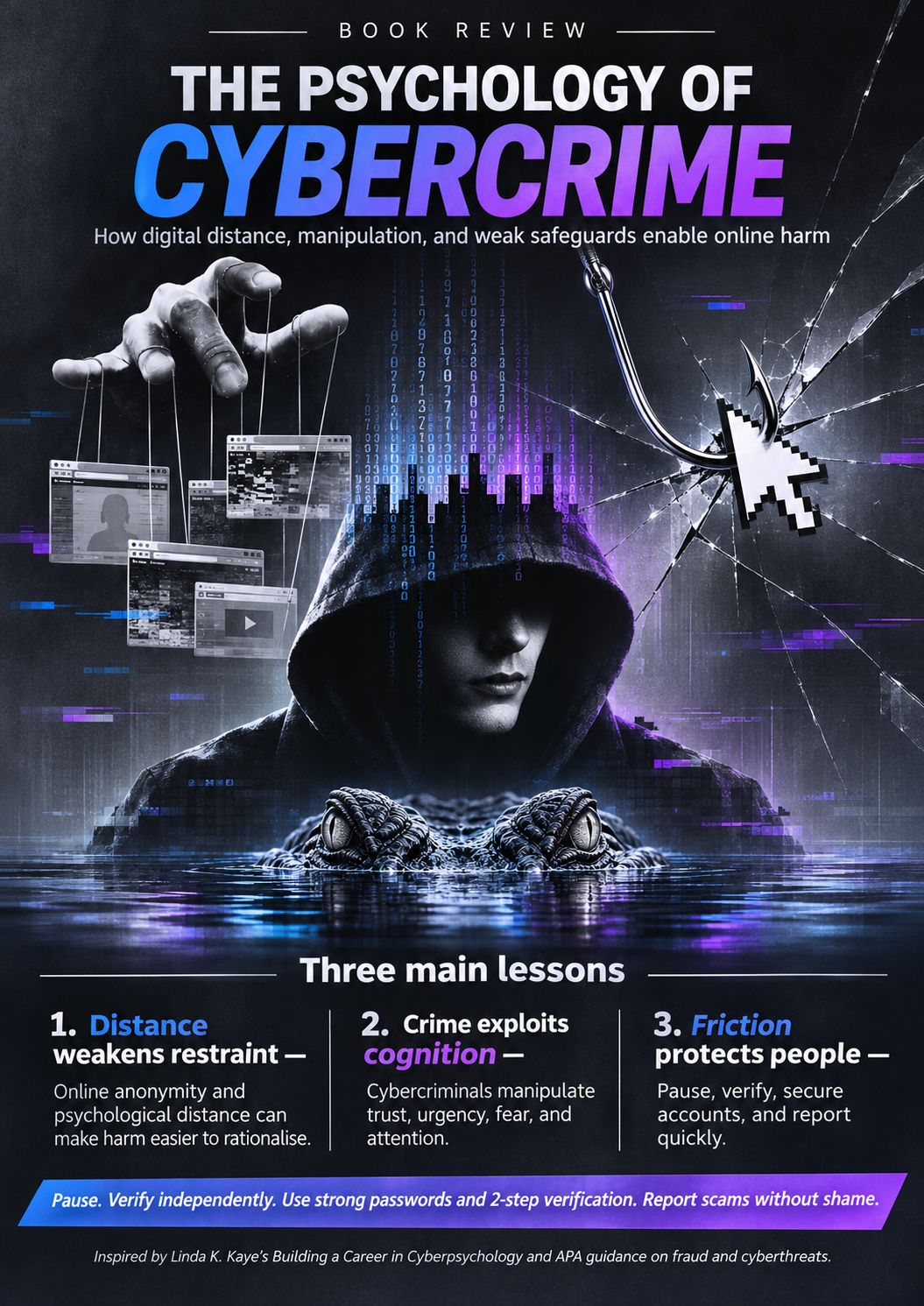
The Book Review
The Psychology of Cybercrime: Understanding the Criminal Mind and Protecting the Human One
Reviewing Professor Linda K. Kaye’s Building a Career in Cyberpsychology, alongside research from the American Psychological Association and British Psychological Society.
Imagine receiving a telephone call from your bank. The caller knows your name, your address and perhaps even your recent transactions. Someone is stealing your savings, they explain. Fortunately, they can help. Unfortunately, you have only minutes to act.
You transfer the money.
The account belongs to a criminal.
Your telephone was not hacked. Your bank’s encryption was not broken. The criminal exploited something considerably older than the internet: human psychology.
Cybercrime is commonly associated with malware, compromised servers, stolen passwords and sophisticated programming. Yet some of its most effective techniques require little more than understanding how people think.
Professor Linda K. Kaye’s recently published Building a Career in Cyberpsychology, alongside contemporary research from the American Psychological Association (APA) and British Psychological Society (BPS), provides an opportunity to examine a fundamental question:
What makes someone commit a cybercrime, what makes another person vulnerable, and how can psychology help prevent it?
Part I — The Psychology of Cybercrime
Reviewing Building a Career in Cyberpsychology
Published by Routledge in October 2026, Kaye’s book forms part of the BPS Pathways in Psychology series.
Kaye, a professor at Edge Hill University and founding member of the BPS Cyberpsychology Section, approaches cyberpsychology as the scientific study of human behaviour in digitally mediated environments.
The book is not exclusively about criminality. Its chapters explore consumer behaviour, digital health, organisational psychology and forensic investigation.
This breadth is important.
Digital technology has changed how people communicate, purchase products, develop relationships, work and commit crimes. Understanding these behaviours requires something more than programming expertise.
A particularly relevant chapter, Forensic and Investigative Cyberpsychology, addresses cybersecurity, digital investigations, online offences, offender profiling and victim susceptibility.
The published chapter outline places cybercrime at the intersection of forensic psychology, criminology and technological investigation.
The book’s principal attraction, judging from its structure and published descriptions, is its practical ambition: connecting psychological knowledge with real occupations and contemporary digital problems.
Its limitation for readers interested specifically in criminal behaviour is its scope. It is a career guide rather than a specialist textbook on cybercriminal motivations, fraud victimisation or investigative methodology. A detailed evaluation of its arguments would require the complete text.
Nevertheless, its broader premise is compelling: technological systems cannot be understood independently of the people who operate them.
To explore the criminal dimension further, we can combine this perspective with published BPS and APA research.
From that literature, I propose three interpretive axioms. These are conceptual principles, not independently validated psychological laws.
Axiom One: Digital Distance Can Reduce Moral Restraint
The more psychologically distant a victim appears, the easier harmful behaviour may become to rationalise.
Consider two scenarios.
In the first, a criminal enters an elderly person’s home and steals their savings.
In the second, the same criminal operates a fraudulent website, automatically stealing money from elderly people thousands of miles away.
The financial harm may be identical. The psychological experience of committing the crime can be very different.
In physical encounters, victims have faces, voices and visible emotional reactions.
Online, they may become account numbers, usernames or transaction records.
Psychologist John Suler’s influential 2004 research on the online disinhibition effect examined how anonymity, invisibility, delayed communication and reduced perceptions of authority can alter behaviour.
Online disinhibition is not inherently harmful. It can encourage honesty and generosity. But under certain circumstances, reduced restraint can facilitate aggression and misconduct.
A related BPS article, The Social Psychology of Cybersecurity, by John McAlaney, Helen Thackray and Jacqui Taylor, explores social identity, group influences and motivations within cybersecurity.
This matters because offenders do not always act independently.
An individual may participate in an online criminal group because of financial incentives, ideological identification, entertainment, status or pressure from others.
Group membership can also encourage moral disengagement: reframing harmful actions as harmless games, justified retaliation or obedience to collective objectives.
These psychological mechanisms do not explain every cybercrime, and anonymity does not automatically produce criminal behaviour.
Nevertheless, they expose an important vulnerability in digital environments.
When the human consequences become invisible, moral accountability can become easier to ignore.
Axiom Two: Cybercrime Exploits Ordinary Human Cognition
The success of many cybercrimes depends on manipulating normal psychological processes rather than defeating human intelligence.
In October 2026, the APA published Why We Keep Falling for Fraud, an examination of the psychology underlying modern financial scams.
The article discusses truth bias: the tendency to initially treat information as credible, particularly when distracted, hurried or operating with limited information.
Trust is essential for human cooperation. Criminals exploit this necessity.
A typical social-engineering attack follows four psychological stages:
Attention: A message announces an emergency, opportunity or threat.
Credibility: The sender imitates a trusted organisation or person.
Emotion: Fear, excitement, affection or embarrassment changes the target’s priorities.
Urgency: The victim is pressured to act before independently examining the claim.
Consider a message apparently sent by your child’s school requesting immediate payment, or a caller claiming your bank account has been compromised.
The individual may become focused on resolving the apparent problem rather than assessing whether the problem actually exists.
Psychological research discussed by the APA suggests that time pressure, distraction and cognitive load can impair careful evaluation.
Importantly, the APA warns against assuming that fraud victims are unintelligent.
There is no single personality profile that guarantees vulnerability or immunity. Circumstances, expectations, emotional states and previous experiences all matter.
Artificial intelligence introduces additional difficulties.
Criminals can now produce professionally written messages, fabricated photographs and convincing audio impersonations.
A familiar voice is no longer reliable evidence that a caller is genuine.
The APA also observes that traditional warning signs, such as poor spelling, are becoming less useful.
The criminal may not need to deceive someone indefinitely.
They need only establish sufficient credibility for one consequential decision.
The greatest psychological vulnerability is sometimes the confidence that we cannot be deceived.
Axiom Three: Cybercrime Thrives When Resistance Is Low
An attack becomes easier when harmful decisions can be made without sufficient opportunities for verification or interruption.
Imagine a company receiving a fraudulent invoice.
One employee can approve the transaction, alter the beneficiary’s banking details and transfer the payment.
Now imagine another organisation requiring independent confirmation of new payment details and approval by a second authorised employee.
The same fraud may be attempted, but its pathway is more difficult.
The APA recommends introducing deliberate friction: slowing suspicious interactions and independently verifying claims.
This is an application of behavioural science to system design.
Its importance extends beyond financial transactions.
In the APA’s earlier article The Psychology of Cyberthreats, psychologist Angela Sasse’s research challenges the assumption that users are simply careless.
Complicated security requirements, unrealistic memory demands and punitive organisational cultures can encourage unsafe shortcuts.
Security should therefore accommodate human limitations.
Password managers, multifactor authentication, clear warnings, sensible defaults and independent approvals reduce dependence on perfect individual judgment.
The same applies to reporting incidents.
Shaming victims or employees can discourage disclosure, giving criminals additional opportunities to cause harm.
Good cybersecurity should make safe behaviour easier, not demand that humans become psychologically infallible.
Beyond the Three Axioms
These principles describe three interacting elements: the offender, the target and the environment.
Understanding cybercrime requires examining all three.
Cybersecurity education should extend beyond recognising suspicious websites. It should teach emotional manipulation, social influence, group psychology and decision-making under uncertainty.
The objective is not to replace technical security with psychology, but to combine them.
A firewall cannot prevent every fraudulent decision. Neither can psychological awareness stop every malicious program.
Both are necessary.
Part II — Practical Guidance: Protecting the Human Operating System
The research points towards a straightforward conclusion: ordinary people do not need to understand every cyberattack. They need dependable habits that interrupt manipulation.
1. Recognise Emotional Manipulation
Before responding to an unexpected request, identify the emotion it produces.
Is someone making you afraid, excited, embarrassed or desperate?
Emotional intensity is not proof of fraud, but it should trigger additional scrutiny.
A message claiming that your account will close immediately may be designed to make verification feel inconvenient.
Ask yourself: What does this person want me to do, and why must I do it now?
2. Slow Down Before Acting
The APA recommends slowing suspicious interactions.
For an unexpected financial request, end the conversation and establish the facts independently.
Do not allow a stranger to keep you on the telephone while directing your decisions.
A genuine emergency may require a rapid response, but it does not eliminate the need for authentication.
For substantial transactions, introduce a second independent check.
3. Verify Identity Independently
A familiar logo, telephone number or email address is not conclusive evidence of authenticity.
Caller identification can be spoofed and websites can be imitated.
If someone claims to represent your bank, contact the bank through its official application or a previously established telephone number.
Never rely exclusively on contact details supplied by the suspicious caller.
Apply the same principle to employers, charities, government agencies and family members.
4. Secure Your Most Important Accounts
The UK’s National Cyber Security Centre recommends strong, unique passwords, two-step verification, software updates and secure backups.
A password manager reduces the burden of remembering numerous credentials.
Use passkeys where supported, particularly for important accounts.
Protect your primary email address carefully because criminals may exploit it to reset passwords elsewhere.
Never share authentication codes or approve unexpected login requests.
Remember that secure authentication cannot protect against every scam involving voluntarily authorised payments.
5. Prepare for AI Impersonation
Families should agree in advance how unusual emergency requests will be verified.
For example, if someone claiming to be a relative requests money, contact that relative through an established channel.
A family verification phrase can supplement this process, although it should not replace independent confirmation.
Teach children that familiar voices, photographs and video messages can be manipulated.
The appropriate response is verification, not automatic distrust of every communication.
6. Recognise Isolation Tactics
Criminals often discourage victims from consulting others.
Investment fraudsters may demand confidentiality. Romance scammers may discourage family involvement. Impersonators may claim that contacting the police would make matters worse.
Such secrecy can isolate victims inside the criminal’s preferred narrative.
Discuss unexpected requests involving significant money or sensitive information with somebody trustworthy.
Independent perspectives can expose contradictions that are difficult to recognise under emotional pressure.
7. Protect Your Personal Information
Public information can help criminals construct believable stories.
Social-media posts may reveal family relationships, employment details, travel plans and important life events.
Review privacy settings and avoid unnecessarily publishing sensitive personal information.
Be cautious with unsolicited job offers, investment opportunities, unfamiliar attachments and requests to install remote-access software.
The more information criminals possess, the more convincing their impersonation may become.
8. Make Reporting Immediate and Shame-Free
If you believe you have been scammed, stop communicating with the suspected criminal.
Contact your bank or payment provider immediately and ask whether the transaction can be stopped or recalled.
Change compromised credentials, preserve relevant evidence and report the incident.
In Israel, cyber incidents can be reported to the National Cyber Directorate through its 119 hotline. In the United Kingdom, use the appropriate police fraud-reporting service and contact your bank directly.
Beware of recovery scammers who promise to retrieve stolen money for an advance fee.
The APA also highlights the emotional consequences of fraud, including anxiety, depression and damaged relationships.
Victims need practical assistance and compassion, not humiliation.
9. Build a Family Cybersecurity Routine
Different generations face different risks.
Children may encounter grooming, coercion, impersonation or malicious gaming-related messages.
Working adults may receive fraudulent invoices or executive impersonation requests.
Older relatives may experience financial scams, misleading technical-support calls or fabricated family emergencies.
Establish simple household rules: verify unusual requests, protect authentication codes, discuss financial pressure and encourage immediate reporting.
Practise these habits before an incident occurs.
Conclusion: The Human Firewall
Technology will continue evolving. Criminal methods will evolve alongside it.
Artificial intelligence may make deceptive messages more persuasive, but the underlying psychological mechanisms remain recognisable: distance, trust, emotion, opportunity and pressure.
The three axioms provide a useful way to understand those mechanisms.
Digital distance can weaken moral restraint. Human cognition can be manipulated. Poorly designed environments can make exploitation easier.
The solution requires psychological awareness, reliable verification and thoughtfully designed security.
Cybercrime may begin with malicious code, but sometimes its most effective weapon is a perfectly ordinary sentence, delivered at exactly the wrong moment.
References and further reading
- Kaye, L. K. (2026). Building a Career in Cyberpsychology. Routledge. https://doi.org/10.4324/9781003581741
- Abramson, A. (2026). Why We Keep Falling for Fraud. APA, Monitor on Psychology, 57(7). https://www.apa.org/monitor/2026/10/fraud-spreads-interventions
- Pappas, S. (2019). The Psychology of Cyberthreats. APA, Monitor on Psychology, 50(2). https://www.apa.org/monitor/2019/02/cyberthreats
- McAlaney, J., Thackray, H., & Taylor, J. (2016). The Social Psychology of Cybersecurity. BPS, The Psychologist, 29(9), 686–689. https://eprints.bournemouth.ac.uk/24899/
- Suler, J. (2004). The Online Disinhibition Effect. CyberPsychology & Behavior, 7(3), 321–326. https://doi.org/10.1089/1094931041291295
- UK National Cyber Security Centre. Top Tips for Staying Secure Online. https://www.ncsc.gov.uk/collection/top-tips-for-staying-secure-online
Related Topics
Related Posts